2016.12.08
🎁 Extra Information 🎁
🍙 Mutation
In biology, a mutation is the permanent alteration of the nucleotide sequence of the genome of an organism, virus, or extrachromosomal DNA or other genetic elements. Mutations result from errors during DNA replication or other types of damage to DNA, which then may undergo error-prone repair (especially microhomology-mediated end joining), or cause an error during other forms of repair, or else may cause an error during replication (translesion synthesis). Mutations may also result from insertion or deletion of segments of DNA due to mobile genetic elements. Mutations may or may not produce discernible changes in the observable characteristics (phenotype) of an organism. Mutations play a part in both normal and abnormal biological processes including: evolution, cancer, and the development of the immune system, including junctional diversity.


🍙 Fable vs. Allegory
One way to distinguish allegory from fable is to note that an allegory is a figure of speech used within a literary work and a fable is a genre or type of literary work.
An allegory is an extended metaphor in which one thing is described in terms of another. The difference between allegory and metaphor is that a metaphor can be any figure with a tenor and vehicle not using explicit comparison but an allegory normally is extended and has a narrative component.
A fable is a very short narrative, using traditional subject matter, normally framed in simple language and style, and often conveying a moral point.
 v.s.
v.s.

🍙 Francis of Assisi
Saint Francis of Assisi (Italian: San Francesco d'Assisi), born Giovanni di Pietro di Bernardone, informally named as Francesco (1181/1182 – 3 October 1226), was an Italian Roman Catholic friarand preacher. He founded the men's Order of Friars Minor, the women’s Order of Saint Clare, the Third Order of Saint Francis and the Custody of the Holy Land. Francis is one of the most venerated religious figures in history. Pope Gregory IX canonized Francis on 16 July 1228. Along with Saint Catherine of Siena, he was designated Patron saint of Italy. He later became associated with patronage of animals and the natural environment, and it became customary for Catholic and Anglican churches to hold ceremonies blessing animals on his feast day of 4 October. In 1219, he went to Egypt in an attempt to convert the Sultan to put an end to the conflict of the Crusades. By this point, the Franciscan Order had grown to such an extent that its primitive organizational structure was no longer sufficient. He returned to Italy to organize the Order. Once his community was authorized by the Pope, he withdrew increasingly from external affairs. Francis is also known for his love of the Eucharist. In 1223, Francis arranged for the first Christmas live nativity scene. According to Christian tradition, in 1224 he received the stigmata during the apparition of Seraphic angels in a religious ecstasy making him the first recorded person in Christian history to bear the wounds of Christ's Passion. He died during the evening hours of 3 October 1226, while listening to a reading he had requested of Psalm 142 (141).

🍙 St. Peter
Saint Peter, also known as Simon Peter, Simeon, or Simōn, according to the New Testament, was one of the Twelve Apostles of Jesus Christ, leaders of the early Christian Church. He is also the "Apostle of the Apostles", an honor 3rd-century theologian Hippolytus of Rome gave him, and the Roman Catholic Church considers him to be the first pope, ordained by Jesus in the "Rock of My Church" dialogue in Matthew 16:18. The ancient Christian churches all venerate Peter as a major saint and associate him with founding the Church of Antioch and later the Church in Rome, but differ about the authority of his successors in present-day Christianity. The New Testament indicates that Peter was the son of John (or Jonah or Jona) and was from the village of Bethsaida in the province of Galilee or Gaulanitis. His brother Andrew was also an apostle. According to New Testament accounts, Peter was one of twelve apostles chosen by Jesus from his first disciples. Originally a fisherman, he played a leadership role and was with Jesus during events witnessed by only a few apostles, such as the supposed Transfiguration. According to the gospels, Peter confessed Jesus as the Messiah, was part of Jesus's inner circle, thrice denied Jesus and wept bitterly once he realized his deed, and preached on the day of Pentecost.

🍙 Bridge Over Troubled Water by Simon and Garfunkel
When you're weary
Feeling small
When tears are in your eyes
I will dry them all
I'm on your side
When times get rough
And friends just can't be found
Like a bridge over troubled water
I will lay me down
Like a bridge over troubled water
I will lay me down
When you're down and out
When you're on the street
When evening falls so hard
I will comfort you
I'll take your part
When darkness comes
And pain is all around
Like a bridge over troubled water
I will lay me down
Like a bridge over troubled water
I will lay me down
Sail on Silver Girl,
Sail on by
Your time has come to shine
All your dreams are on their way
See how they shine
If you need a friend
I'm sailing right behind
Like a bridge over troubled water
I will ease your mind
Like a bridge over troubled water
I will ease your mind

🍙 Scarborough Fair by Simon and Garfunkel
Parsley, sage, rosemary & thyme
Remember me to one who lives there
She once was a true love of mine
Tell her to make me a cambric shirt
(On the side of a hill in the deep forest green)
Parsely, sage, rosemary & thyme
(Tracing a sparrow on snow-crested ground)
Without no seams nor needlework
(Blankets and bedclothes a child of the mountains)
Then she'll be a true love of mine
(Sleeps unaware of the clarion call)
Tell her to find me an acre of land
(On the side of a hill, a sprinkling of leaves)
Parsely, sage, rosemary, & thyme
(Washed is the ground with so many tears)
Between the salt water and the sea strand
(A soldier cleans and polishes a gun)
Then she'll be a true love of mine
Tell her to reap it in a sickle of leather
(War bellows, blazing in scarlet battalions)
Parsely, sage, rosemary & thyme
(Generals order their soldiers to kill)
And to gather it all in a bunch of heather
(And to fight for a cause they've long ago forgotten)
Then she'll be a true love of mine
Are you going to Scarborough Fair?
Parsley, sage, rosemary & thyme
Remember me to one who lives there
She once was a true love of mine.
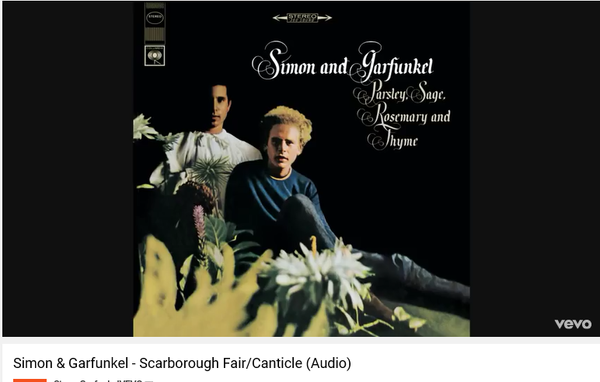
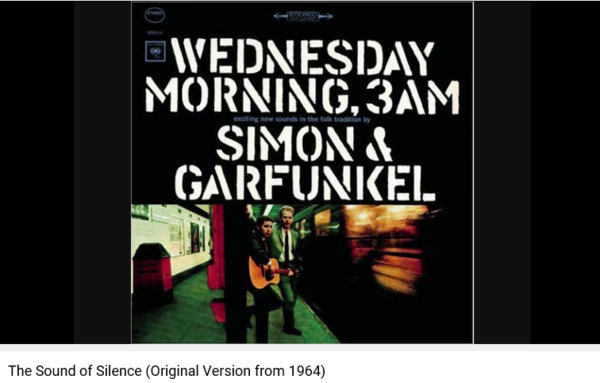
🍙 Sound of Silence by Simon and Garfunkel
Hello darkness, my old friend
I've come to talk with you again
Because a vision softly creeping
Left its seeds while I was sleeping
And the vision that was planted in my brain
Still remains
Within the sound of silence
In restless dreams I walked alone
Narrow streets of cobblestone
‘Neath the halo of a streetlamp
I turned my collar to the cold and damp
When my eyes were stabbed by the flash of a neon light
That split the night
And touched the sound of silence
And in the naked light I saw
Ten thousand people, maybe more
People talking without speaking
People hearing without listening
People writing songs that voices never share
No one dare
Disturb the sound of silence
“Fools” said I, “You do not know
Silence like a cancer grows
Hear my words that I might teach you
Take my arms that I might reach you”
But my words like silent raindrops fell
And echoed in the wells of silence
And the people bowed and prayed
To the neon god they made
And the sign flashed out its warning
In the words that it was forming
And the sign said “The words of the prophets
Are written on the subway walls
And tenement halls
And whispered in the sounds of silence”
🍙 To Helen by Edgar Allan Poe
Helen, thy beauty is to me
Like those Nicéan barks of yore,
That gently, o'er a perfumed sea,
The weary, way-worn wanderer bore
To his own native shore.
On desperate seas long wont to roam,
Thy hyacinth hair, thy classic face,
Thy Naiad airs have brought me home
To the glory that was Greece,
And the grandeur that was Rome.
Lo! in yon brilliant window-niche
How statue-like I see thee stand,
The agate lamp within thy hand!
Ah, Psyche, from the regions which
Are Holy-Land!

>>Analysis
The poem opens with the speaker comparing Helen's beauty to some ships that transported a lonely wanderer back home. In the second stanza, the speaker again compares himself to a lonely man for whom Helen's beauty has functioned like a saving grace (this time, her hair and face remind him of ancient Greece and Rome). In the third stanza, the speaker describes Helen standing in a "window-niche" (11), looking like a statue and like a beautiful woman from Greek mythology (Psyche).
🍙 The Birth of Venus
The Birth of Venus is a painting by Sandro Botticelli generally thought to have been painted in the mid 1480s. It has long been suggested that Botticelli was commissioned to paint the work by the Medici family of Florence, specifically Lorenzo di Pierfrancesco de' Medici under the influence of his cousin Lorenzo de' Medici, close patron to Botticelli. However, there are no documents associated with the painting, and its first identification with the Medici family only comes in the 1550 edition of Vasari's Lives. It depicts the goddess Venus, having emerged from the sea as an adult woman, arriving at the shore (which is related to the Venus Anadyomenemotif). The painting is on display at the Uffizi Gallery in Florence, Italy.

🎪 1100 Words I need to know 🎪
🎓 Week 1
Ob- : "toward, against, across, down,"
💠 Ostensible (adj.): ob "in front of" + tendere "to stretch"
- appearing or claiming to be one thing when it is really something else
➡ Their ostensible goal was to clean up government corruption, but their real aim was to unseat the government.
👉 Related: ostensive (adj.)
ostentation (n.)
ostensibly (adv.)
Ad- : "to, toward, near, at" in space or time
"with regard to, in relation to,"
💠 Arbiter (n.): ad- "to"+ baetere "to come, go."
- someone who makes a judgment, solves an argument, or decides what will be done
➡ the arbiters of fashion/taste
👉 Related: arbitrator (n.) / arbitrage / arbitration
arbitrary (adj.)
arbitrate (v.)
ex- : out of, from, upwards, completely, deprive of, without, former
💠 Expedite (v.): ex "out" + *pedis "fetter, chain for the feet,"
- to make something happen more quickly
➡ Something needs to be done to expedite the process.
👉 Related: expediate (v.)
expeditious (adj.) / expedient
expedition (n.)
🎄 MORE🎄
💠 Heresy (n.):
- (the act of having) an opinion or belief that is the opposite of or against what is the official or popular opinion, or an action that shows that you have no respect for the official opinion
➡ Radical remarks like this amount to heresy for most members of the Republican party.
2. a belief that is against the principles of a particular religion
➡ He was burned at the stake for heresy in the 15th century.
👉 Related: heretic (n.) / heresiarch
💠 Milieu (n.) : mi "middle" + lieu "place"
- the people, physical, and social conditions and events that provide the environment in which someone acts or lives
➡ It is a study of the social and cultural milieu in which Michelangelo lived and worked.
👉 (pl.) milieux, milieus
week31
🌟 heresy (n.)
"doctrine or opinion at variance with established standards" (or, as Johnson defines it, "an opinion of private men different from that of the catholick and orthodox church"), c. 1200, from Old French heresie, eresie "heresy," and by extension "sodomy, immorality" (12c.), from Latin hæresis, "school of thought, philosophical sect." The Latin word is from Greek hairesis "a taking or choosing for oneself, a choice, a means of taking; a deliberate plan, purpose; philosophical sect, school," from haireisthai "take, seize," middle voice of hairein "to choose," a word of unknown origin, perhaps from PIE *ser- (5) "to seize" (source of Hittite šaru "booty," Welsh herw "booty").
The Greek word was used by Church writers in reference to various sects, schools, etc. in the New Testament: the Sadducees, the Pharisees, and even the Christians, as sects of Judaism. Hence the meaning "unorthodox religious sect or doctrine" in the Latin word as used by Christian writers in Late Latin. But in English bibles it usually is translated sect. Transferred (non-religious) use in English is from late 14c.
🌟 prudent (adj.)
late 14c., from Old French prudent "with knowledge, deliberate" (c. 1300), from Latin prudentem (nominative prudens) "knowing, skilled, sagacious, circumspect;" rarely in literal sense "foreseeing;" contraction of providens, present participle of providere "to foresee" (see provide).
🌟 ostensible (adj.)
1762, "capable of being shown, presentable," from French ostensible, from Latin ostens-, past participle stem of ostendere "to show, expose to view; to stretch out, spread before; exhibit, display," from ob "in front of" (see ob-) + tendere "to stretch" (see tenet). Meaning "apparent, professed" is from 1771.
🌟 fervid (adj.)
1590s, "burning, glowing, hot," from Latin fervidus "glowing, burning; vehement, fervid," from fervere "to boil, glow" (see brew (v.)). Figurative sense of "impassioned" is from 1650s.
👉 Related: Fervidly; fervidness
🌟 spurious (adj.)
1590s, "born out of wedlock," from Latin spurius "illegitimate, false" (source also of Italian spurio, Spanish espurio), from spurius (n.) "illegitimate child," probably from Etruscan spural "public." Sense of "having an irregular origin, not properly constituted" is from c. 1600; that of "false, sham" is from 1610s; of writing, etc., "not proceeding from the source pretended, 1620s.
👉 Related: Spuriously; spuriousness.
🌟 propagate (v.)
1560s, "to cause to multiply," from Latin propagatus, past participle of propagare "to set forward, extend, procreate" (see propagation). Intransitive sense "reproduce one's kind" is from c. 1600.
👉 Related: Propagated; propagating.
🌟 anomaly (n.)
1570s, from Latin anomalia, from Greek anomalia "inequality," noun of quality from anomalos "uneven, irregular," from an-, privative prefix, "not" (see an- (1)) + homalos "even," from homos "same" (see same).
🌟 innocuous (adj.)
1590s, from Latin innocuus "harmless; innocent; inoffensive," from in- "not" (see in- (1)) + nocuus "hurtful," from root of nocere "to injure, harm," from *nok-s-, suffixed form of PIE root *nek- (1) "death" (see necro-).
👉 Related: Innocuously; innocuousness.
🌟 surfeit(n.)
early 14c., "excess quantity;" late 14c., "overindulgence," from Old French sorfet "excess; arrogance" (Modern French surfait), noun use of past participle of surfaire "overdo," from sur- "over" (see sur- (1)) + faire "do," from Latin facere "to make, do" (see factitious).
(v.) late 14c., intransitive, "indulge or feed to excess," from surfeit (n.).
🌟 milieu(n.)
"surroundings," 1877, from French milieu, "middle, medium, mean," literally "middle place" (12c.), from mi "middle" (from Latin medius; see medial (adj.)) + lieu "place" (see lieu).
🌟 strident (adj.)
1650s, from French strident (16c.) and directly from Latin stridentem (nominative stridens), present participle of stridere "utter an inarticulate sound, grate, screech," from PIE *(s)trei-, possibly of imitative origin (source also of Greek trismos "a grinding, scream").
👉 Related: Stridently; stridence; stridency.
🌟 concomitant (adj.)
c. 1600, from French concomitant, from Late Latin concomitantem (nominative concomitans), present participle of concomitari "accompany, attend," from com "with, together" (see com-) + comitari "join as a companion," from comes (genitive comitis) "companion"
🌟 lassitude (n.)
early 15c., from Latin lassitudinem (nominative lassitudo) "faintness, weariness," from lassus "faint, tired, weary," from PIE *led-to-, suffixed form of *led- "slow, weary" (source also of Old English læt "sluggish, slow;" see late (adj.)), from root *le- (2) "to let go, slacken" (see lenient).
🌟deleterious (adj.)
1640s, from Medieval Latin deleterius, from Greek deleterios "noxious," from deleter "destroyer," from deleisthai "to hurt, injure."
👉 Related: Deleteriously; deleteriousness.
🌟 efficacy (n.)
1520s, from Latin efficacia "efficacy, efficiency," from efficax (genitive efficacis) "powerful, effectual, efficient," from stem of efficere "work out, accomplish" (see effect (n.)). Earlier in same sense was efficace (c. 1200), from Old French eficace (14c.), from Latin efficacia; also efficacite (early 15c.), from Latin efficacitatem.
🌟dissent (v.)
early 15c., from Latin dissentire "differ in sentiments, disagree, be at odds, contradict, quarrel," from dis- "differently" (see dis-) + sentire "to feel, think" (see sense (n.)). Related: Dissented; dissenting. The noun is 1580s, from the verb.
Has there ever been a society which has died of dissent? Several have died of conformity in our lifetime. [Jacob Bronowski "Science and Human Values," 1956]
🌟 ferment (v.)
late 14c. (intransitive), from Old French fermenter (13c.) and directly from Latin fermentare "to leaven, cause to rise or ferment," from fermentum "substance causing fermentation, leaven, drink made of fermented barley," perhaps contracted from *fervimentum, from root of fervere "to boil, seethe" (see brew (v.)). Transitive use from 1670s. Figurative use from 1650s. Related: Fermented; fermenting.
(n.)
early 15c., from Middle French ferment (14c.), from Latin fermentum "leaven, yeast; drink made of fermented barley;" figuratively "anger, passion" (see ferment (v.)). Figurative sense of "anger, passion, commotion" in English is from 1670s.
🌟 attenuated (v.)
"to make thin, to make less," 1520s, from Latin attenuatus "enfeebled, weak," past participle of attenuare "to make thin, lessen, diminish," from ad "to" (see ad-) + tenuare "make thin," from tenuis "thin" (see tenet). Earlier was Middle English attenuen "to make thin (in consistency)," early 15c.
👉 Related: Attenuated; attenuating.
🌟 arbiter (n.)
late 14c., from Old French arbitre or directly from Latin arbiter "one who goes somewhere (as witness or judge)," in classical Latin used of spectators and eye-witnesses, in law, "he who hears and decides a case, a judge, umpire, mediator;" from ad- "to" (see ad-) + baetere "to come, go." The specific sense of "one chosen by two disputing parties to decide the matter" is from 1540s. The earliest form of the word attested in English is the fem. noun arbitress (mid-14c.) "a woman who settles disputes."
🌟 incumbent(n.)
early 15c., "person holding a church position," from Medieval Latin incumbentem (nominative incumbens) "holder of a church position," noun use of present participle of incumbere "to obtain or possess," from Latin incumbere "recline on," figuratively "apply oneself to," from in- "on" (see in- (2)) + -cumbere "lie down," related to cubare "to lie" (see cubicle). Extended to holders of any office from 1670s.
(adj.) 1560s, in relation to duties or obligations, from Medieval Latin incumbentem (nominative incumbens), present participle of incumbere (see incumbent (n.)). The literal, physical sense "lying or resting on something" is rare in English and first attested 1620s.
week32
🌟 profound (adj.)
c. 1300, "characterized by intellectual depth," from Old French profund (12c., Modern French profond), from Latin profundus "deep, bottomless, vast," also "obscure; profound; immoderate," from pro "forth" (see pro-) + fundus "bottom" (see fund (n.)). The literal and figurative senses both were in Latin, but English, having already deep, employed this word primarily in its figurative sense.
👉 Related: Profoundly.
🌟 alleviate (v.)
early 15c., " to mitigate, relieve (sorrows, suffering, etc.)," from Late Latin alleviatus, past participle of alleviare "lift up, raise," figuratively "to lighten (a burden), comfort, console," from Latin ad "to" (see ad-) + levis "light" in weight (see lever).
👉 Related: Alleviated; alleviating
🌟 prodigious (adj.)
1550s, "ominous," from Middle French prodigieux and directly from Latin prodigiosus "strange, wonderful, marvelous, unnatural," from prodigium (see prodigy). Meaning "vast, enormous" is from c. 1600.
👉 Related: Prodigiously; prodigiosity.
🌟 expedite (v.)
c. 1500 (implied in past participle expedit "accomplished"), from Latin expeditus, past participle of expedire "extricate, disengage, liberate; procure, make ready, put in order, make fit, prepare; explain, make clear," literally "free the feet from fetters," hence to liberate from difficulties, from ex "out" (see ex-) + *pedis "fetter, chain for the feet," related to pes (genitive pedis) "foot," from PIE root *ped- (1) "a foot" (see foot (n.)). Compare Greek pede "fetter."
👉 Related: Expedited; expediting.
🌟 celerity (n.)
late 15c., from Old French celeritee (14c., Modern French célérité), from Latin celeritatem (nominative celeritas) "swiftness," from celer "swift," from possible PIE root *kel- (3) "to drive, set in swift motion" (source also of Sanskrit carati "goes," Greek keles "fast horse or ship," keleuthos "journey, road," Lithuanian sulys "a gallop," Old High German scelo "stallion").
🌟 usurp (v.)
early 14c., from Old French usurper "to (wrongfully) appropriate" (14c.), from Latin usurpare "make use of, seize for use," in later Latin "to assume unlawfully, trespass on," from usus "a use" (see use (v.)) + rapere "to seize" (see rapid (adj.)).
👉 Related: Usurped; usurping.
🌟paltry (adj.)
1560s, probably an adjectival use of noun paltry "worthless thing" (1550s), associated with dialectal palt, pelt "trash," cognate with Middle Low German and East Frisian palte "rag," Middle Dutch palt "broken or torn fragment." Similar formation in Low German paltrig "rubbishy," East Frisian palterig "ragged, torn."
🌟 condone (v.)
1857, from Latin condonare "to give up, remit, permit," from com-, intensive prefix (see com-), + donare "to give" (see donation). Originally a legal term in the Matrimonial Causes Act, which made divorce a civil matter in Britain.
👉 Related: Condoned; condoning.
🌟 trivial (adj.)
"ordinary" (1580s); "insignificant, trifling" (1590s), from Latin trivialis "common, commonplace, vulgar," literally "of or belonging to the crossroads," from trivium "place where three roads meet," in transferred use, "an open place, a public place," from tri- "three" (see three) + via "road" (see via). The sense connection is "public," hence "common, commonplace."
The earliest use of the word in English was early 15c., a separate borrowing in the academic sense "of the trivium" (the first three liberal arts -- grammar, rhetoric, and logic); from Medieval Latin use of trivialis in the sense "of the first three liberal arts," from trivium, neuter of the Latin adjective trivius "of three roads, of the crossroads." For sense evolution to "pertaining to useless information," see trivia.
👉 Related: Trivially.
🌟 bizarre (adj.)
1640s, from French bizarre "odd, fantastic" (16c.), from Italian bizarro "irascible, tending to quick flashes of anger" (13c.), from bizza "fit of anger, quick flash of anger" (13c.). The sense in Italian evolved to "unpredictable, eccentric," then "strange, weird," in which sense it was taken into French and then English. Older derivation from Basque bizar "a beard" is no longer considered tenable.
🌟 menial (adj.)
late 14c., "pertaining to a household," from Anglo-French meignial, from Old French mesnie "household," earlier mesnede, from Vulgar Latin *mansionata, from Latin mansionem "dwelling" (see mansion). Sense of "lowly, humble, suited to a servant" is recorded by 1670s.
(n.) "domestic servant," late 14c., meynyal; see menial (adj.).
🌟 venerable (adj.)
early 15c., "worthy of respect," from Old French venerable and directly from Latin venerabilis "worthy of reverence or respect," from venerari "to worship, revere" (see veneration). As a title, used in reference to ecclesiastics (in the Anglican church, specifically of archdeacons) or those who had obtained the first degree of canonization.
👉 Related: Venerably; venerability.
🌟 extraneous (adj.)
1630s, from Latin extraneus "external, strange," literally "that is without, from without" (as a noun, "a stranger"), from extra "outside of" (see extra-). A doublet of strange.
👉 Related: Extraneously
🌟 ambiguous (adj.)
1520s, from Latin ambiguus "having double meaning, shifting, changeable, doubtful," adjective derived from ambigere "to dispute about, contend, debate," literally "to wander, go about, go around," figuratively "hesitate, waver, be in doubt," from ambi- "about" (see ambi-) + agere "drive, lead, act" (see act (n.)). First attested in Sir Thomas More (1528); related ambiguity dates to c. 1400.
👉 Related: Ambiguously; ambiguousness.
🌟 succinct (adj.)
early 15c., "having one's belt fastened tightly," from Middle French succincte, from Latin succinctus "prepared, ready; contracted, short," past participle of succingere "tuck up (clothes for action), gird from below," from assimilated form of sub "up from under" (see sub-) + cingere "to gird" (see cinch (n.)). Sense of "brief, concise" first recorded 1530s.
👉 Related: Succinctness.
🌟 archaic (adj.)
1810, from or by influence of French archaique (1776), ultimately from Greek arkhaikos "old-fashioned," from arkhaios "ancient," from arkhe "beginning" (see archon). Archaical is attested from 1799.
🌟emulate (v.)
1580s, back-formation from emulation, or else from Latin aemulatus, past participle of aemulari "to rival.
👉 Related: Emulated; emulating; emulable; emulative.
🌟 facetious (adj.)
1590s, from French facétieux (16c.), from facétie "a joke" (15c.), from Latin facetiae "jests, witticisms" (singular facetia), from facetus "witty, elegant, fine, courteous," which is of unknown origin, perhaps related to facis "torch." Formerly often in a good sense, "witty, amusing," but later implying a desire to be amusing that is often intrusive or ill-timed. "Facetiæ in booksellers' catalogues, is, like curious, a euphemism for erotica." [Fowler]
👉 Related: Facetiously; facetiousness.
🌟 salubrious (adj.)
1540s, from Latin salubris "promoting health, healthful," from salus (genitive salutis) "welfare, health" (see salute (v.)).
👉 Related: Salubriously; salubriousness.
Week 33
🌟complacent(adj)
1650s, "pleasing," from Latin complacentem (nominative complacens) "pleasing," present participle of complacere "be very pleasing" (see complacence). Meaning "pleased with oneself" is from 1767.
👉 Related: Complacently.
🌟 somber(adj)
1760 "gloomy, shadowy" (earlier sombrous, c. 1730), from French sombre "dark, gloomy," from Old French sombre (14c.), from an adjective from Late Latin subumbrare "to shadow," from sub "under" (see sub-) + umbra "shade, shadow," perhaps from a suffixed form of PIE *andho- "blind, dark" (see umbrage).
👉 Related: Somberly; somberness.
🌟debilitate(v)
1530s, from Latin debilitatus, past participle of debilitare "to weaken," from debilis "weak" (see debility).
👉 Related: Debilitated; debilitating.
🌟impetuous(adj)
late 14c., "hot-tempered, fierce;" late 15c., "done or given with a rush of force," from Old French impetuos (13c., Modern French impétueux) and directly from Late Latin impetuosus "impetuous, violent" (source also of Spanish and Italian impetuoso), from Latin impetus "attack" (see impetus).
👉 Related: Impetuously; impetuousness.
🌟occult(adj)
1530s, "secret, not divulged," from Middle French occulte and directly from Latin occultus "hidden, concealed, secret," past participle of occulere "cover over, conceal," from assimilated form of ob "over" (see ob-) + a verb related to celare "to hide," from PIE root *kel- (2) "to cover, conceal" (see cell). Meaning "not apprehended by the mind, beyond the range of understanding" is from 1540s. The association with the supernatural sciences (magic, alchemy, astrology, etc.) dates from 1630s.
🌟discreet(adj)
mid-14c., "morally discerning, prudent, circumspect," from Old French discret "discreet, sensible, intelligent, wise," from Latin discretus "separated, distinct," in Medieval Latin "discerning, careful," past participle of discernere "distinguish" (see discern). Meaning "separate, distinct" in English is late 14c. Spellings discrete and nativized discreet co-existed until after c. 1600, when discreet became the common word for "careful, prudent," and discrete was maintained in philosophy, medicine, music and other disciplines that remembered Latin and made effort to obey it.
👉 Related: Discreetly.
🌟foment(v)
early 15c., "apply hot liquids," from Old French fomenter "apply hot compress (to a wound)" (13c.), from Late Latin fomentare, from Latin fomentum "warm application, poultice," contraction of *fovimentum, from fovere "to warm; cherish, encourage" (see fever). Extended sense of "stimulate, instigate" (1620s), on the notion of "encourage the growth of," as if by heat, probably was taken from French.
👉 Related: Fomented; fomenting
🌟glean(v)
early 14c., "to gather by acquisition, scrape together," especially grains left in the field after harvesting, but the earliest use in English is figurative, from Old French glener "to glean" (14c., Modern French glaner) "to glean," from Late Latin glennare "make a collection," of unknown origin. Perhaps from Gaulish (compare Old Irish do-glinn "he collects, gathers," Celtic glan "clean, pure"). Figurative sense was earlier in English than the literal one of "gather grain left by the reapers" (late 14c.).
👉 Related: Gleaned; gleaning.
🌟quarry(v)
1774, from quarry (n.2).
👉 Related: Quarried; quarrying.
🌟slovenly(adj)
1510s, "low, base, lewd," later "untidy, dirty" (1560s), from sloven + -ly (1). also in this sense was slovenry (1540s), which OED reports in common use early 17c.
👉 Related: Slovenliness;
🌟abjure(v)
early 15c., "renounce on oath, repudiate, forswear," originally especially "renounce or recant (a heresy) on oath," from Middle French abjurer or directly from Latin abiurare "deny on oath," from ab "off, away from" (see ab-) + iurare "to swear," from ius (genitive iuris) "law" (see jurist).
👉 Related: Abjured; abjuring.
🌟reproach(v)
mid-14c., reprochen "to rebuke, reproach," from Anglo-French repruchier, Old French reprochier "upbraid, blame, accuse, speak ill of," from reproche (see reproach (n.)). Related: Reproached; reproaching.
(n)mid-14c., "a rebuke, blame, censure;" also "object of scorn or contempt;" c. 1400, as "disgrace, state of disgrace," from Old French reproche "blame, shame, disgrace" (12c.), from reprochier "to blame, bring up against," said by some French etymologists to be from Vulgar Latin *repropiare, from Latin re- "opposite of" + prope "near" (see propinquity), with suggestions of "bring near to" as in modern "get in (someone's) face." But others would have it from *reprobicare, from Latin reprobus/reprobare (see reprobate (adj.)).
🌟penitent(adj)
mid-14c., from Old French pénitent (14c.) and directly from Latin paenitentem (see penitence). As a noun, late 14c., from the adjective.
🌟evanescent(adj)
1717, "on the point of becoming imperceptible," from French évanescent, from Latin evanescentem (nominative evanescens), present participle of evanescere "disappear, vanish, pass away," figuratively "be forgotten, be wasted," from assimilated form of ex "out" (see ex-) + vanescere "vanish" (see vanish). Sense of "quickly vanishing, having no permanence" is by 1738.
🌟tantamount(adj)
1640s, from verbal phrase tant amount "be equivalent" (1620s), from Anglo-French tant amunter "amount to as much" (late 13c.), from Old French tant "as much" (11c., from Latin tantus, from tam "so;" see tandem) + amonter "amount to, go up" (see amount (v.)).
🌟propensity(n)
1560s, "disposition to favor," with -ty + obsolete adjective propense "inclined, prone" (1520s), from Latin propensus, past participle of propendere "incline to, hang forward, hang down, weigh over," from pro "forward" (see pro-) + pendere "hang" (see pendant).
🌟wary(adj)
late 15c., with -y (2) + ware, from Old English wær "prudent, aware, alert, wary," from Proto-Germanic *waraz (source also of Old Norse varr "attentive," Gothic wars "cautious," Old Saxon giwar, Middle Dutch gheware, Old High German giwar, German gewahr "aware"), from PIE root *wer- (4) "to perceive, watch out for"
👉 Related: Warily; wariness.
🌟allay(v)
Middle English alegen, from Old English alecgan "to put, place, put down; remit, give up, suppress, abolish; diminish, lessen," from a- "down, aside" (see lay (v.)). A common Germanic compound (cognates: Gothic uslagjan "lay down," Old High German irleccan, German erlegen "to bring down").
Early Middle English pronunciations of -y- and -g- were not always distinct, and the word was confused in Middle English with various senses of Romanic-derived alloy (v.) and especially a now-obsolete verb allege "to alleviate, lighten" (from Latin alleviare, from ad "to" + levis "light" in weight; see lever).
Amid the overlapping of meanings that thus arose, there was developed a perplexing network of uses of allay and allege, that belong entirely to no one of the original vbs., but combine the senses of two or more of them. [OED]
Hence senses "lighten, alleviate; mix, temper, weaken." The confusion with the Latin words probably also accounts for the unetymological double -l-, attested from 17c.
👉 Related: Allayed; allaying.
🌟deter(v)
1570s, from Latin deterrere "to frighten from, discourage from," from de- "away" (see de-) + terrere "frighten" (see terrible). Deterrent is from 1829.
🌟connoisseur(n)
1714, from French connoisseur (Modern French connaiseur), from Old French conoisseor "an expert, a judge, one well-versed," from conoistre "to know," from Latin cognoscere "to get to know, recognize, become well-acquainted with," from com "with, together" (see com-) + gnoscere "recognize" (see notice (v.)).
限會員,要發表迴響,請先登入


