2017.06.07
💠 Week 18
💠 Diction
Its original, primary meaning, refers to the writer's or the speaker's distinctive vocabulary choices and style of expression in a poem or story. A secondary, common meaning of "diction" means the distinctiveness of speech, the art of speaking so that each word is clearly heard and understood to its fullest complexity and extremity, and concerns pronunciation and tone, rather than word choice and style. This secondary sense is more precisely and commonly expressed with the term enunciation, or with its synonym articulation.
It has multiple concerns, of which register is foremost—another way of saying this is whether words are either formal or informal in the social context. Literary diction analysis reveals how a passage establishes tone and characterization, e.g. a preponderance of verbs relating physical movement suggests an active character, while a preponderance of verbs relating states of mind portrays an introspective character. Diction also has an impact upon word choice and syntax.
In Literature:
Diction is usually judged with reference to the prevailing standards of proper writing and speech and is seen as the mark of quality of the writing. It is also understood as the selection of certain words or phrases that become peculiar to a writer.
💠 Shakespeare and Love
Love is a most warming, happy, inspirational human feeling. It surrounds us throughout our lives and takes many shapes and forms. You will find it in the softness of your mother’s hands, the passions of youth or mature understanding with age. Since the story of mankind began, it has inspired some of the most beautiful images in poetry or painting.
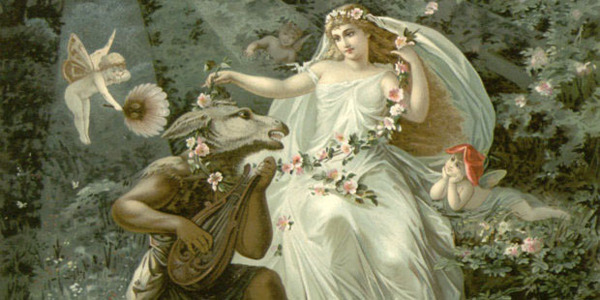
Love is something we all share no matter where we live and it disregards social status or age. Shakespeare has captured the spirit of it, its highs and lows, and the beauty of falling in love in some of the most poetical lines ever written. He wrote 38 plays and the word love is mentioned in each one of them.
🍙 Shakespeare love quotes
1. "Love looks not with the eyes, but with the mind,
And therefore is winged Cupid painted blind."
A Midsummer Night's Dream
2. "Is love a tender thing? it is too rough,
Too rude, too boisterous, and it pricks like thorn."
Romeo and Juliet
3. "If music be the food of love, play on."
Twelfth Night
4. "Shall I compare thee to a summer's day?
Thou art more lovely and more temperate."
The Sonnet 18
5. "Love sought is good, but given unsought is better."
Twelfth Night
6. "Hear my soul speak:
The very instant that I saw you, did
My heart fly to your service."
The Tempest
7. "I love you with so much of my heart that none is left to protest."
Much Ado About Nothing
8. "One half of me is yours, the other half yours,
Mine own, I would say; but if mine, then yours,
And so all yours."
The Merchant of Venice
9. "Love is a smoke and is made with the fume of sighs."
Romeo and Juliet
10. "Who ever loved that loved not at first sight?"
As You Like It
🍙 Romeo and Juliet
Is a tragedy written by William Shakespeare early in his career about two young star-crossed lovers whose deaths ultimately reconcile their feuding families. It was among Shakespeare's most popular plays during his lifetime and along with Hamlet, is one of his most frequently performed plays. Today, the title characters are regarded as archetypal young lovers.
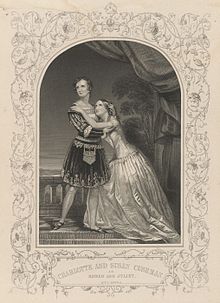
The story of Shakespeare’s Romeo and Juliet, a story unsurpassed in world literature as a celebration of young love – innocent and pure, love at first sight, strong and passionate. Although Shakespeare rarely invents the plots of his plays, he has created here an exceptionally powerful image of young love.
Love is a smoke rais’d with the fume of sighs;
Being purg’d , a fire sparkling in lover’s eyes;
Being vex’d, a sea raging with lover’s tears;
What is it else? A madness most discreet,
A choking gall and a preserving sweet.
Romeo’s love is pure emotion, thoughtless and driven by the spirit of feud and revenge. Juliet is the younger one, more practical and determined that they should be joined in marriage;
My bounty is as boundless as the sea,
My love as deep; the more I give to thee,
The more I have, for both are infinite.
➡ Psychoanalytic criticism
Early psychoanalytic critics saw the problem of Romeo and Juliet in terms of Romeo's impulsiveness, deriving from "ill-controlled, partially disguised aggression", which leads both to Mercutio's death and to the double suicide. Romeo and Juliet is not considered to be exceedingly psychologically complex, and sympathetic psychoanalytic readings of the play make the tragic male experience equivalent with sicknesses. Norman Holland, writing in 1966, considers Romeo's dream as a realistic "wish fulfilling fantasy both in terms of Romeo's adult world and his hypothetical childhood at stages oral, phallic and oedipal" – while acknowledging that a dramatic character is not a human being with mental processes separate from those of the author. Critics such as Julia Kristeva focus on the hatred between the families, arguing that this hatred is the cause of Romeo and Juliet's passion for each other. That hatred manifests itself directly in the lovers' language: Juliet, for example, speaks of "my only love sprung from my only hate" and often expresses her passion through an anticipation of Romeo's death. This leads on to speculation as to the playwright's psychology, in particular to a consideration of Shakespeare's grief for the death of his son, Hamnet.
💠 Psychoanalytic criticism
Adopts the methods of "reading" employed by Freud and later theorists to interpret texts. It argues that literary texts, like dreams, express the secret unconscious desires and anxieties of the author, that a literary work is a manifestation of the author's own neuroses. One may psychoanalyze a particular character within a literary work, but it is usually assumed that all such characters are projections of the author's psyche.
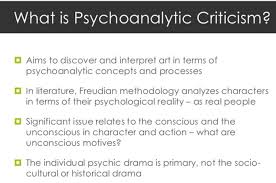
One interesting facet of this approach is that it validates the importance of literature, as it is built on a literary key for the decoding. Freud himself wrote, "The dream-thoughts which we first come across as we proceed with our analysis often strike us by the unusual form in which they are expressed; they are not clothed in the prosaic language usually employed by our thoughts, but are on the contrary represented symbolically by means of similes and metaphors, in images resembling those of poetic speech" .
Like psychoanalysis itself, this critical endeavor seeks evidence of unresolved emotions, psychological conflicts, guilt, ambivalences, and so forth within what may well be a disunities literary work. The author's own childhood traumas, family life, sexual conflicts, fixations, and such will be traceable within the behavior of the characters in the literary work. But psychological material will be expressed indirectly, disguised, or encoded (as in dreams) through principles such as "symbolism" (the repressed object represented in disguise), "condensation" (several thoughts or persons represented in a single image), and "displacement" (anxiety located onto another image by means of association).
Despite the importance of the author here, psychoanalytic criticism is similar to New Criticism in not concerning itself with "what the author intended." But what the author never intended (that is, repressed) is sought. The unconscious material has been distorted by the censoring conscious mind.
Psychoanalytic critics will ask such questions as, "What is Hamlet's problem?" or "Why can't Brontë seem to portray any positive mother figures?"
➡ Psychology
Is the science of behavior and mind, embracing all aspects of conscious and unconscious experience as well as thought. It is an academic discipline and a social science which seeks to understand individuals and groups by establishing general principles and researching specific cases.
In this field, a professional practitioner or researcher is called a psychologist and can be classified as a social, behavioral, or cognitive scientist. Psychologists attempt to understand the role of mental functions in individual and social behavior, while also exploring the physiological and biological processes that underlie cognitive functions and behaviors.
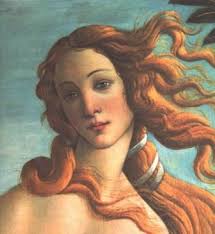
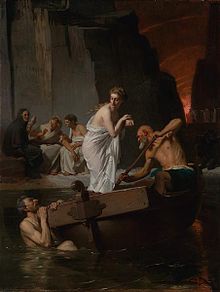
➡ Psyche
Greek term for "soul" or "spirit"
 |  |
Mythology:
Cupid and Psyche is a story originally from Metamorphoses (also called The Golden Ass), written in the 2nd Century AD by Lucius Apuleius Madaurensis (or Platonicus). It concerns the overcoming of obstacles to the love between Psyche ("Soul" or "Breath of Life") and Cupid ("Desire") or Amor ("Love"), and their ultimate union in a sacred marriage. Although the only extended narrative from antiquity is that of Apuleius, Eros and Psyche appear in Greek art as early as the 4th century BC. The story's Neoplatonic elements and allusions to mystery religions accommodate multiple interpretations, and it has been analyzed as an allegory and in light of folktale, Märchen or fairy tale, and myth.
Psychology:
In psychology, the psyche is the totality of the human mind, conscious and unconscious. Psychology is the scientific or objective study of the psyche. The word has a long history of use in psychology and philosophy, dating back to ancient times, and represents one of the fundamental concepts for understanding human nature from a scientific point of view. The English word soul is sometimes used synonymously, especially in older texts.
限會員,要發表迴響,請先登入


