2017.05.17
💠 Week 15
💠 John Keats (1795~1821)
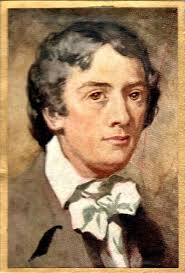 He was an English Romantic poet. He was one of the main figures of the second generation of Romantic poets, along with Lord Byron and Percy Bysshe Shelley, despite his works having been in publication for only four years before his death. His reputation grew after his death, and by the end of the 19th century, he had become one of the most beloved of all English poets. He had a significant influence on a diverse range of poets and writers. Jorge Luis Borges stated that his first encounter with Keats's work was the most significant literary experience of his life. The poetry of Keats is characterized by sensual imagery, most notably in the series of odes. This is typical of romantic poets, as they aimed to accentuate extreme emotion through the emphasis of natural imagery. Today his poems and letters are some of the most popular and most analyzed in English literature.
🍙 La Belle Dame sans Merci
Poem
O what can ail thee, knight-at-arms,
Alone and palely loitering?
The sedge has withered from the lake,
And no birds sing.
O what can ail thee, knight-at-arms,
So haggard and so woe-begone?
The squirrel’s granary is full,
And the harvest’s done.
I see a lily on thy brow,
With anguish moist and fever-dew,
And on thy cheeks a fading rose
Fast withereth too.
I met a lady in the meads,
Full beautiful, a fairy’s child;
Her hair was long, her foot was light,
And her eyes were wild.
I made a garland for her head,
And bracelets too, and fragrant zone;
She looked at me as she did love,
And made sweet moan
I set her on my pacing steed,
And nothing else saw all day long,
For sidelong would she bend, and sing
A faery’s song.
She found me roots of relish sweet,
And honey wild, and manna-dew,
And sure in language strange she said—
‘I love thee true’.
She took me to her Elfin grot,
And there she wept and sighed full sore,
And there I shut her wild, wild eyes
With kisses four.
And there she lullèd me asleep,
And there I dreamed—Ah! woe betide!—
The latest dream I ever dreamt
On the cold hill side.
I saw pale kings and princes too,
Pale warriors, death-pale were they all;
They cried—‘La Belle Dame sans Merci
Hath thee in thrall!’
I saw their starved lips in the gloam,
With horrid warning gapèd wide,
And I awoke and found me here,
On the cold hill’s side.
And this is why I sojourn here,
Alone and palely loitering,
Though the sedge is withered from the lake,
And no birds sing.
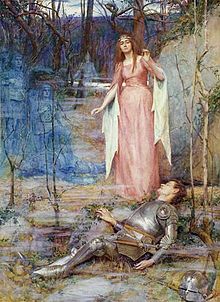
This is a ballad written by the English poet John Keats. It exists in two versions, with minor differences between them. Keats wrote the original in 1819. He used the title of the 15th-century La Belle Dame sans Mercy by Alain Chartier, though the plots of the two poems are different. The poem is considered an English classic, stereotypical of other of Keats' works. It avoids simplicity of interpretation despite simplicity of structure. At only a short twelve stanzas, of only four lines each, with a simple ABCB rhyme scheme, the poem is nonetheless full of enigmas, and has been the subject of numerous interpretations.
Analysis
Some readers see the poem as Keats' personal rebellion against the pains of love. In his letters and in some of his poems, he reveals that he did experience the pains, as well as the pleasures, of love and that he resented the pains, particularly the loss of freedom that came with falling in love. However, the ballad is a very objective form, and it may be best to read "La Belle Dame sans Merci" as pure story and no more.
🍙 Ballad
Is a form of verse, often a narrative set to music. Ballads derive from the medieval French chanson balladée or ballade, which were originally "danced songs''. Ballads were particularly characteristic of the popular poetry and song of the British Isles from the later medieval period until the 19th century.
➡ Origin
The ballad derives its name from medieval French dance songs or "ballares", to dance, from which 'ballet' is also derived, as did the alternative rival form that became the French ballade. As a narrative song, their theme and function may originate from Scandinavian and Germanic traditions of storytelling that can be seen in poems such as Beowulf. Musically they were influenced by the Minnesinger. The earliest example of a recognizable ballad in form in England is "Judas" in a 13th-century manuscript. This means that the two words, ballad and ballet, are both derived from the French language.
➡ Rule
Usually, only the second and fourth line of a quatrain are rhymed (in the scheme a, b, c, b), which has been taken to suggest that, originally, ballads consisted of couplets (two lines) of rhymed verse, each of 14 syllables.
Quiz of Drama
1. Which of the following best describes the crucial difference between drama and the other major genres of fictional prose and poetry?
A. Unlike prose and poetry, drama is written primarily to be performed.
B.Drama is midway in length between poetry (shortest) and novels (longest).
C.Drama relies completely on its audience to supply its meaning.
D.Unlike prose and poetry, most plays do not depend on any printed text at all.
2. In a dramatic performance, how does the exposition occur?
A.It is stated in the stage directions of the play.
B.It is outlined in the dramatis personae, which are printed in the program.
C.It is explained to the audience in the introduction.
D.It is conveyed implicitly through the play’s dialogue.
3. The typical structure of a dramatic plot involves which stages in the progression of the conflict?
A.introduction of characters, development of characters, resolution, conclusion
B.introduction of conflict, climax, resolution of conflict, conclusion
C.exposition of conflict, development of the protagonist’s part in the conflict, antagonist’s reaction, resolution of conflict, conclusion
D.exposition, rising action, climax, falling action, conclusion
4. The theme of a play is
A. clearly articulated by one of the characters during the exposition.
B.described in the stage directions at the beginning of the work.
C.a side-effect of the play’s tone.
D.inferred by the viewer from the action.
5. What term describes the suggestions provided by the playwright for how to produce and perform a drama?
A.dramatis personae
B.proscenium
C.dramatic narrator
D.stage directions
6. A theater stage in which the audience sits around three sides of the acting area is called
A.a thrust stage.
B.a proscenium stage.
C.an amphitheater.
D.an arena stage.
7. Verbal irony
A.is a subset of dramatic irony (in drama, all irony is dramatic).
B.is dialogue that seems to mean one thing but really means something else.
C.occurs only when one character is trying to hide a certain fact or event from another character.
D.is conveyed entirely by an actor’s tone.
8. The theme of a play is
A.clearly articulated by one of the characters during the exposition.
B.described in the stage directions at the beginning of the work.
C.a side-effect of the play’s tone.
D.inferred by the viewer from the action.
9. In terms of a play’s setting, “unity of time” refers to
A.the amount of time during which actors are on stage from beginning to end.
B.the convention by which a play lasts only a two or three hours, though the audience knows that the events would have taken much longer to unfold.
C.a limitation on the play’s action to a short span of time, usually no more than a day
.D.a technique for dividing the acting area into several spaces, each representing a different time period in the action.
10. Which of the following questions do you need to ask yourself when reading a play that you do not need to ask when you see a play performed live?
A.What are the main themes of the play?
B.What does the setting of this play look like?
C.Who is the primary antagonist?
D.Does this play fit into a recognizable dramatic
11. In drama, a foil is
A.the antagonist, sometimes called a villain.
B.a character designed to illuminate another character by contrast.
C.the heroine in a romantic comedy.
D.the leader (or first member to speak) of the chorus in an ancient Greek tragedy.
限會員,要發表迴響,請先登入


