2017.04.19
💠 Week 10
Quiz of Faulkner
1. Which of the following best describes the hired help Emily keeps?
A. a retinue of housekeepers, cooks, and gardeners
B. one black male servant who does not communicate with the town
C. one black male servant who gossips about her to the town elders
D. She does not keep any hired help.
2. What does the town expect Emily to do with the arsenic she buys from the druggist?
A. kill her cousins
B. kill her father
C. kill Homer Barron
D. kill herself
“So the next day we all said, ‘She will kill herself’; and we said it would be the best thing” (par. 43). Emily is able to get away with killing Homer Barron in part because the town expects her to behave in accordance with their ideas about Southern womanhood. They expect her to respond to her dishonor by killing herself rather than taking action
3. Emily’s relationship with her father was strained by the fact that he
A. drove away all her suitors.
B. forced her to study Greek and Latin.
C. divorced her mother in order to marry his mistress.
D. cross-dressed.
4. Which of the following is not an accurate description of Homer Barron?
A. He challenged the racial politics of the town by championing integration.
B. He was a Northerner.
C. He was more interested in men than in women.
D. The town perceived him as being of lower social status than Emily.
Homer Barron does not behave respectfully toward the black workers he oversees for the construction company and, in fact, is portrayed almost as an antebellum plantation overseer: “The little boys would follow in groups to hear him cuss the niggers, and the niggers singing in time to the rise and fall of picks”
5. The narrator of the story seems to have been present at all of the following scenes except
A. Emily’s interaction with the druggist when she purchases arsenic
B. the Board of Aldermen’s attempt to collect taxes from Emily.
C. the moment when Miss Emily’s bedroom door is forced open.
D. Emily’s meeting with the Baptist minister.
The first-person plural narrator of “A Rose for Emily” has long fascinated critics. The narrator seems to be the voice of the collective town and, as such, is present at a variety of events over a long span of time. An exception is the narrator’s presentation of Emily’s interview with the Baptist minister, who has been dispatched to counsel her on what the town views as her inappropriate relationship with Homer Barron: “The men did not want to interfere, but at last the ladies forced the Baptist minister—Miss Emily’s people were Episcopalian—to call upon her. He would never divulge what happened during that interview, but he refused to go back again
6. Emily attempts to earn money by
A. making and selling lace doilies.
B. giving china-painting lessons to local children.
C. making and selling packets of spiced pecans.
D. giving decoupage lessons to elderly people.
“From that time on her front door remained closed, save for a period of six or seven years, when she was about forty, during which she gave lessons in china-painting. She fitted up a studio in one of the downstairs rooms, where the daughters and grand-daughters of Colonel Sartoris’ contemporaries were sent to her with the same regularity and in the same spirit that they were sent on Sundays with a twenty-five-cent piece for the collection plate” (par. 49). The china-painting lessons, which the children seem to neither want nor need, are, as critic Judith Fetterley puts it, “a brilliant image of Emily’s economic uselessness”
7. Who attends Emily’s funeral?
A. only the Grierson family
B. .the entire town
C. Emily’s two cousins, the druggist, and the aldermen
D. No funeral is held for Emily.
“When Miss Emily Grierson died, our whole town went to her funeral . . .”
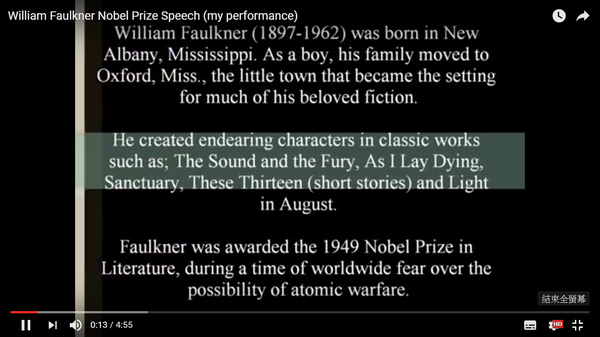
💠 William Faulkner’s Nobel Prize Speech
👉 Narrative Poetry
Is a form of poetry that tells a story, often making the voices of a narrator and characters as well; the entire story is usually written in metered verse. Narrative poems do not have to follow rhythmic patterns. The poems that make up this genre may be short or long, and the story it relates to may be complex. It is normally dramatic, with objectives, diverse characters, and meter. Narrative poems include epics, ballads, idylls, and lays.
👉 Lyric Poetry
Is a formal type of poetry which expresses personal emotions or feelings, typically spoken in the first person. The term derives from a form of Ancient Greek literature, the lyric, which was defined by its musical accompaniment, usually on a stringed instrument known as a lyre. The term owes its importance in literary theory to the division developed by Aristotle between three broad categories of poetry: lyrical, dramatic and epic.
History:
For the ancient Greeks, lyric poetry had a precise technical meaning: verse that was accompanied by a lyre, cithara, or barbitals. Because such works were typically sung, it was also known as melic poetry. The lyric or melic poet was distinguished from the writer of plays (although Athenian drama included choral odes, in lyric form), the writer of trochaic and iambic verses (which were recited), the writer of elegies (accompanied by the flute, rather than the lyre) and the writer of epic. The scholars of Hellenistic Alexandria created a canon of nine lyric poets deemed especially worthy of critical study. These archaic and classical musician-poets included Sappho, Alcaeus, Anacreon and Pindar. Archaic lyric was characterized by strophic composition and live musical performance. Some poets, like Pindar extended the metrical forms to a triad, including strophe, antistrophe (metrically identical to the strophe) and epode (whose form does not match that of the strophe).
👉 The Dramatic Monologue
Also known as a persona poem, is a type of poetry written in the form of a speech of an individual character. M.H. Abrams notes the following three features of the dramatic monologue as it applies to poetry
A single person, who is patently not the poet, utters the speech that makes up the whole of the poem, in a specific situation at a critical moment.
This person addresses and interacts with one or more other people; but we know of the auditors' presence, and what they say and do, only from clues in the discourse of the single speaker.
The main principle controlling the poet's choice and formulation of what the lyric speaker says is to reveal to the reader, in a way that enhances its interest, the speaker's temperament and character.
👉 Setting:
1. A location (geography) where something is set
2. Set construction in theatrical scenery
3. (narrative), the place and time in a work of narrative, especially fiction
4. Setting up to fail a manipulative technique to engineer failure

5. Stonesetting, in jewelry, when a diamond or gem is set into a frame or bet
6. Campaign setting in role playing games
7. In computers and electronics, the Computer configuration or options of the software or device
8. Set and setting, the context for psychedelic drug experiences
9. (knot), the tightening of a knot
10. Musical setting, the composition of music for an existing text, usually in choral music.
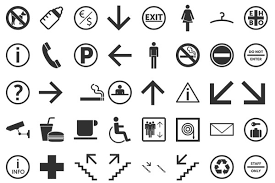
👉 Symbol
A symbol is a mark, sign, or word that indicates, signifies, or been understood as representing an idea, object, or relationship. Symbols allow people to go beyond what is known or seen by creating linkages between otherwise very different concepts and experiences. All communication (and data processing) is achieved through the use of symbols. Symbols take the form of words, sounds, gestures, ideas or visual images and are used to convey other ideas and beliefs. For example, a red octagon may be a symbol for "STOP". On a map, a blue line might represent a river. Numerals are symbols for numbers. Alphabetic letters may be symbols for sounds. Personal names are symbols representing individuals. A red rose may symbolize love and compassion. The variable 'x', in a mathematical equation, may symbolize the position of a particle in space.
👉 Literal and figurative language
Is a distinction within some fields of language analysis, in particular stylistics, rhetoric, and semantics.
Literal language uses words exactly according to their proper meanings or precise definitions.
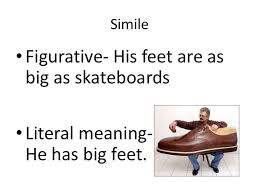
Figurative (or non-literal) language uses words deviating from their proper definitions in order to achieve a more complicated understanding or heightened effect. Figurative language is often achieved by presenting words in order for them to be equated, compared, or associated with other normally unrelated words or meanings.
Literal usage confers meaning to words, in the sense of the meaning they have by themselves, outside any figure of speech. It maintains a consistent meaning regardless of the context, with the intended meaning corresponding exactly to the meaning of the individual words. Figurative use of language is the use of words or phrases that implies a non-literal meaning which does make sense or that could be true.
👉 Theme
1. (album), an album by Leslie West.
2. (arts), the unifying subject or idea of the type of visual work
3. (Byzantine district), an administrative girth district in the Byzantine Empire governed by a Strategos
4. (computing), a custom graphical appearance for certain software.
5. (linguistics), topic
6. magazine
7. Theme Building, a landmark building in the Los Angeles International Airport
8. Theme music, a piece often written specifically for a radio program, television program, video game or film, and usually played during the intro, opening credits or ending credits
9. Theme vowel or thematic vowel, a vowel placed before the word ending in certain Proto-Indo-European words
10. Theme, a musical idea, usually a recognizable melody, upon which part or all of a composition is based
限會員,要發表迴響,請先登入


