2017.05.24
💠 Week 16
Quiz of The Midsummer Summer Night’s Dream
1. Who is chosen to play the lion in the craftsmen’s play?
Snug
2. Which of the young Athenians is first affected by the love potion?
Lysander
3. Which man does Hermia’s father want her to marry?
Demetrius
4. Where do Lysander and Hermia plan to be married?
Lysander’s aunt’s house
5. What part of her appearance does Hermia believe Helena has exploited to win Lysander’s love?
Her height
6. What does Oberon want that Titania refuses to give him?
Her attendant, an Indian prince
7. Why does Pyramus, in the craftsmen’s play, kill himself?
Pyramus believes Thisbe has been killed by a lion because he finds her tattered garment at their meeting place.
8. Who brings the complaint against Hermia to Theseus in Act I?
Egeus
9. Of whom is Hippolyta the queen?
The Amazons
10. How does Puck prevent Demetrius and Lysander from fighting?
By mimicking their voices and causing each to get lost in a separate part of the forest
11. hich of the women is afraid of fighting?
Helena
12. Whom does Demetrius love at the end of the play?
Helena
13. With whom does Titania fall in love in Act III?
Bottom
14. What prank does Puck play on Bottom?
He changes his head into that of an ass.
15. Who first thinks of using the love potion on Titania?
Oberon
16. Who speaks with Titania’s quartet of attendants?
Only Bottom
17. Why is the flower whose juice Oberon seeks special?
One of Cupid’s arrows struck it.
18. Which of the craftsmen is in charge of the rehearsals?
Quince
19. In what year was Shakespeare born?
1564
20. Who tells Demetrius that Lysander and Hermia are planning to elope?
Helena
21. What food does Bottom crave after Puck’s mischief?
Hay
22. What are Theseus and Hippolyta about to do before they discover the sleeping lovers?
Listen to Theseus’s hounds baying.
23. How many weddings take place before the play-within-a-play?
3
24. Who blesses Theseus and Hippolyta with a magical charm at the end of the play?
Oberon and Titania
25. Who suggests that the audience consider whether the entire play has been a dream?
Puck
💠 A Midsummer Night’s Dream
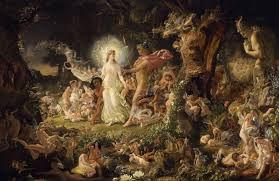
This is a comedy written by William Shakespeare in 1595/96. It portrays the events surrounding the marriage of Theseus, the Duke of Athens, to Hippolyta, the former queen of the Amazons. These include the adventures of four young Athenian lovers and a group of six amateur actors (the mechanicals) who are controlled and manipulated by the fairies who inhabit the forest in which most of the play is set. The play is one of Shakespeare's most popular works for the stage and is widely performed across the world.
🍙 About
Full title: A Midsummer Night’s Dream
Author: William Shakespeare
Type of work: Play
Genres: Comedy; fantasy; romance; farce
Language: English
Time and place written: London, 1594 or 1595
Date of first publication: 1600
Publisher: Thomas Fisher
Narrator: None
Climax: In the strictest sense, there is no real climax, as the conflicts of the play are all resolved swiftly by magical means in Act IV; the moment of greatest tension is probably the quarrel between the lovers in Act III, scene ii.
Protagonist: Because there are three main groups of characters, there is no single protagonist in the play; however, Puck is generally considered the most important character.
Antagonist: None; the play’s tensions are mostly the result of circumstances, accidents, and mistakes.
Settings (time): Combines elements of Ancient Greece with elements of Renaissance England
Settings (place): Athens and the forest outside its walls
Point of view: Varies from scene to scene
Falling action: Act V, scene i, which centers on the craftsmen’s play
Tense: Present
Foreshadowing: Comments made in Act I, scene i about the difficulties that lovers face
Tones: Romantic; comedic; fantastic; satirical; dreamlike; joyful; farcical
Symbols: Theseus and Hippolyta represent order, stability, and wakefulness; Theseus’s hounds represent the coming of morning; Oberon’s love potion represents the power and instability of love.
Themes: The difficulties of love; magic; the nature of dreams; the relationships between fantasy and reality and between environment and experience
🍙 Characters
Theseus—Duke of Athens
Hippolyta—Queen of the Amazons
Egeus—father of Hermia
Hermia—daughter of Egeus, in love with Lysander
Lysander—in love with Hermia
Demetrius—suitor to Hermia
Helena—in love with Demetrius
Philostrate—Master of the Revels
Peter Quince—a carpenter
Nick Bottom—a weaver
Francis Flute—a bellows-mender
Tom Snout—a tinker
Snug—a joiner
Robin Starveling—a tailor
Oberon—King of the Fairies
Titania—Queen of the Fairies
Robin Goodfellow—a puck
Peaseblossom, Cobweb, Mote, Mustardseed—fairy servants to Titania
Indian changeling
🍙 Theme
Love’s Difficulty
“The course of true love never did run smooth,” comments Lysander, articulating one of A Midsummer Night’s Dream’s most important themes—that of the difficulty of love. Though most of the conflict in the play stems from the troubles of romance, and though the play involves a number of romantic elements, it is not truly a love story; it distances the audience from the emotions of the characters in order to poke fun at the torments and afflictions that those in love suffer. The tone of the play is so lighthearted that the audience never doubts that things will end happily, and it is therefore free to enjoy the comedy without being caught up in the tension of an uncertain outcome.
🍙 Symbol
Theseus and Hippolyta bookend A Midsummer Night’s Dream, appearing in the daylight at both the beginning and the end of the play’s main action. They disappear, however, for the duration of the action, leaving in the middle of Act I, scene i and not reappearing until Act IV, as the sun is coming up to end the magical night in the forest. Shakespeare uses Theseus and Hippolyta, the ruler of Athens and his warrior bride, to represent order and stability, to contrast with the uncertainty, instability, and darkness of most of the play. Whereas an important element of the dream realm is that one is not in control of one’s environment, Theseus and Hippolyta are always entirely in control of theirs. Their reappearance in the daylight of Act IV to hear Theseus’s hounds signifies the end of the dream state of the previous night and a return to rationality.
THE LOVE POTION
The love potion is made from the juice of a flower that was struck with one of Cupid’s misfired arrows; it is used by the fairies to wreak romantic havoc throughout Acts II, III, and IV. Because the meddling fairies are careless with the love potion, the situation of the young Athenian lovers becomes increasingly chaotic and confusing (Demetrius and Lysander are magically compelled to transfer their love from Hermia to Helena), and Titania is hilariously humiliated (she is magically compelled to fall deeply in love with the ass-headed Bottom). The love potion thus becomes a symbol of the unreasoning, fickle, erratic, and undeniably powerful nature of love, which can lead to inexplicable and bizarre behavior and cannot be resisted.
限會員,要發表迴響,請先登入


