2017.03.22
💠 Week 6
Quiz of Anton Chekhov
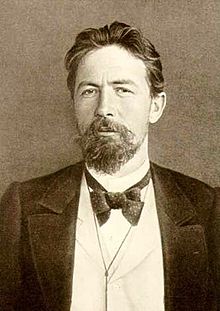
💠 Anton Chekhov (1860~1904)
He was a Russian playwright and short story writer, who is considered to be among the greatest writers of short fiction in history. His career as a playwright produced four classics and writers and critics hold his best short stories in high esteem. Along with Henrik Ibsen and August Strindberg, Chekhov is often referred to as one of the three seminal figures in the birth of early modernism in the theatre. Chekhov practiced as a medical doctor throughout most of his literary career: "Medicine is my lawful wife", he once said, "and literature is my mistress."
👉 Quote
1. People don’t notice whether it is winter or summer when they are happy.
2. Knowledge is of no value unless you put it into practice.
3. Don’t tell me the moon is shining; show me the glint of light on broken glass.
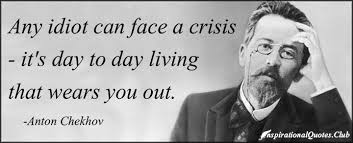
4. Let learn to appreciate there will be times when the trees will be bare, and look forward to the time when we may pick the fruit.
5. The world perishes not from bandits and fires, but from hatred, hostility, and all these petty squabbles.
💠 The Lady with the Dog
This is a short story by Anton Chekhov first published in 1899. It tells the story of an adulterous affair between a Russian banker and a young lady he meets while vacationing in Yalta. The story comprises four parts: part I describes the initial meeting in Yalta, part II the consummation of the affair and the remaining time in Yalta, part III Gurov's return to Moscow and his visit to Anna's town, and part IV Anna's visits to Moscow. One of Chekhov's most famous pieces of short fiction, Vladimir Nabokov declared that it was one of the greatest short stories ever written.
👉 Summary
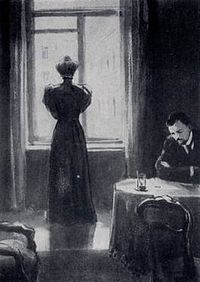
A young woman walking along the sea front of Yalta with her small Pomeranian dog intrigues a forty-year-old man named Dmitri Gurov. Dmitri dislikes his shrewish and intelligent wife and, as a result, has numerous love affairs. Although the protagonist disparages women and calls them "the lower race," he secretly acknowledges that he is more at ease in their company than in men's. One day, "the lady with the dog" sits down next to Dmitri to eat in the public gardens. The man pets her dog in order to strike up a conversation. He learns that she is called Anna Sergeyevna, that she is married, and that she has come to Yalta on vacation. Over the next week, Anna and Dmitri see a lot of each other and grow close. The older man is intrigued by the exuberant naïveté of his young partner, yet he also recognizes a trace of sadness in her character. In contrast to the elder women with whom he used to have affairs and who would occasionally display a "rapacious expression" on their beautiful faces, Anna excites Dmitri's desire with her fresh and unaffected nature. In particular, he is drawn by her "diffidence, the angularity of inexperienced youth" that reminds him of his daughter. Every evening the couple observes the sunset from the vantage point over Yalta at Oreanda and are impressed anew by the "beautiful and majestic" scenery. The only things that mar Anna's happiness is the thought that her husband, Von Diderits, will send for her and her fear that she has lost Dmitri's respect by sleeping with him. In the end, Von Diderits sends Anna a letter urging her return, and she leaves Dmitri with something like relief. When parting with Dmitri, Anna states, "It's a good thing I am going away … It's fate itself!"
The action switches to describe Dmitri's daily routine in Moscow: visiting his clubs, reading newspapers, and working at his bank. Dmitri believes that his memories of Anna will soon wane and that he can continue his everyday routine in peace and satisfaction. However, this does not happen, and soon the protagonist grows to despise the "useless pursuits and conversations" with which he is surrounded. Consequently, Dmitri resovles to visit Anna in her unspecified hometown. The protagonist takes the train to "S—-" and arrives only to pace in front of the Von Diderits' residence, futilely hoping that Anna will emerge and speak with him. When this does not happen, Dmitri decides to go to the theater that evening to see a production of the operetta "The Geisha," hoping his lover will also attend. Sure enough, the protagonist sees Anna in the audience watching the show with her obsequious and insincere-looking husband. When Von Diderits leaves the theater to smoke during the interval, Dmitri approaches Anna and confesses his love for her. The young woman tells Dmitri that she has missed him but also berates him for coming to see her. The lovers decide that Anna will visit Dmitri in Moscow, on the excuse that she has to see a gynecologist.
The story concludes with a description of Anna's visits to Moscow and the unbearable strain she feels living this lie. Although Dmitri is perfectly happy with the way things have worked out, he does admit to feeling disconcerted about the implications of falling in love for the first time. He criticizes himself for being an aging, graying old man who seduced women by pretending to be someone he was not. Dmitri comforts Anna as best he can, but he knows that there will be a long way to go before they can be freed from their "intolerable bonds" and live together openly.
👉 Analysis
The Lady with the Dog is perhaps Chekhov's best known and certainly one of his best-loved stories. It exemplifies the author's subtle yet powerful style, as Chekhov is economical with language and never says more than he needs. He conveys emotional complexity in just a few words, thus preserving the intensity of his characters' feelings. For example, on first seeing Anna at the theater in her hometown, Chekhov expresses Dmitri's romantic yearning with the passage: "she, this little woman, in no way remarkable, lost in a provincial crowd, with a vulgar lorgnette in her hand, filled his whole life now, was his sorrow and his joy … He thought and dreamed." The author writes as though he is painting a canvas, producing a work that is grand in scope yet intimate in feel. The author uses colors to convey both the changing spirits and feelings of the characters, as they veer from the grandly impressive to the muted and prosaic. For example, the aging Dmitri's hair is described as graying, and he often wears gray suits, whereas the sea at Yalta is suffused with color as "the water was of a soft warm lilac hue, and there was a golden streak from the moon upon it." Chekhov presents Yalta as a romantic oasis for Anna and Dmitri, a place of color, freedom, and intimacy that they cannot hope to recreate elsewhere. The lovers worry about what they mean to one another—Anna frets that Dmitri thinks of her only as a "common woman," while Dmitri thinks that Anna is beguiled by a false impression of him as a "kind, exceptional, lofty" man—because both recognize that their relationship is founded on past disappointments and future hopes, as well as on present desires. Chekhov thus plays with our implicit belief that characters do not exist beyond their narrative framework: clearly, Anna and Dmitri are people defined by the past and their dreams for the future, as much as they are by the short period of their lives conveyed here. As the editor Donald Rayfield has noted, The Lady with the Dog talks more about beginnings than it does endings. There is no straightforward linear progression in Chekhov's narrative: readers are called to question what has happened outside of its bounds and to wonder at the lives its characters will continue to lead.
Indeed, in order to understand this tale, we have to guess at what has happened before the events described and what will happen after them. Dmitri may be interpreted as an aging seducer entering the twilight his womanizing years, who dupes Anna just as he realizes that he has deceived himself for many years. However, the protagonist could also be understood as a man searching for conviction, as someone who is enchanted and ultimately redeemed by the innocent romanticism of his young lover. The tale itself is riddled with ambiguity: we see that Anna rekindles Dmitri's desire for life but also that Dmitri's love for her complicates as well as tarnishes his view of home. Because Dmitri remembers the vistas of Yalta as being boundless in their magnificence and beauty, so Moscow seems to him endlessly dreary, as though he were cooped up in a "madhouse or in penal servitude." Chekhov suggests that, for Dmitri, the world of love and of women is not straightforward, and, indeed, Dmitri's devotion to the female sex or "lower race" is rewarded by confusion and a faint hope in future salvation. The story ends on a typical note of ambiguity, as Dmitri recognizes that he is living two lives: "one open, seen and known by all who cared to know" and another "running its course in secret." The only way the couple can resolve their fears is to acknowledge that they are poised at the beginning of a "new and splendid life," albeit one that they will not openly enjoy for a long time to come.
🍙 Point of view:
1. (philosophy), an attitude how one sees or thinks of something.
2. (literature) or narrative mode, the perspective of the narrative voice; the pronoun used in narration
3. (painting), the angle of painter vision

4. Point of view shot, a technique in motion photography
5. (pornography), as used in adult film
🍙 Character:
1. (arts), an agent within a work of art, including literature, drama, cinema, opera, etc.
2. Character sketch or character, a literary description of a character type
3. (Theophrastus), a classical Greek set of character sketches attributed to Theophrastus
4. (novel), a 1936 Dutch novel by Ferdinand Bordewijk
5. (film), a 1997 Dutch film based on that novel
6. Game character (disambiguation), various types of character in a video game or role playing game
7. Player character, as above but who is controlled or whose actions are directly chosen by a player
8. Non-player character, as above but not player-controlled
9. (biology), the abstraction of an observable physical or biochemical trait of an organism
10. (mathematics), a type of function used in algebra

11. (symbol), a sign or symbol
12. (computing), a unit of information roughly corresponding to a grapheme
13. Chinese character, a written language symbol used in Chinese, Japanese, and other languages
14. Character structure, a person's traits
15. Moral character, an evaluation of a particular individual's durable moral qualities
16. Character education, a US term for values education
限會員,要發表迴響,請先登入


