2017.04.26
💠 Week 11
Quiz of Genre_ Poetry
1. How do a poem’s theme and tone differ?
A. Theme is the poem’s situation; tone is the formal shape of a poem.
B. Theme is the poem’s underlying meaning; tone is its subject matter.
C. Theme is what the poem says about its topic; tone is its attitude toward its topic.
D. Theme is the poem’s subject matter; tone is its argument for the reader.
2. The speaker of a poem is
A. the poet.
B. not necessarily the poet.
C. the poet’s alter ego.
D. a stand-in for the reader.
3. “The vacuum cleaner sulks in the corner closet,” a line from Howard Nemerov’s “The Vacuum,” is an example of which of the following figures of speech?
A. simile
B.personification
C.allegory
D.allusion
4. Percy Bysshe Shelley’s “Ode to the West Wind,” the first six lines of which are quoted below, is an example of which poetic form? O wild West Wind, thou breath of Autumn’s being,
Thou, from whose unseen presence the leaves dead
Are driven, like ghosts from an enchanter fleeing,
Yellow, and black, and pale, and hectic red,
Pestilence-stricken multitudes: O thou,
Who chariotest to their dark wintry bed
A. ottava rima
B. sestina
C. terza rima
D. ballad stanza
5. Which of the following is NOT true of the sonnet?
A. Because of its brevity and discipline, only the most conservative poets use it.
B. Its origins lie in the Middle Ages, in Italian and French poetry.
C. The two most popular varieties in English are called the Shakespearean (three quatrains and a final couplet) and Petrarchan (one octave and one sestet) sonnets.
D. Though most sonnets exhibit a strict rhyme scheme and iambic pentameter, the only absolute rule is that sonnets have fourteen lines.
6. The first four lines of Liz Rosenberg’s “Married Love” are “The trees are uncurling their first / green messages: Spring, and some man / lets his arm brush my arm in a darkened / theatre. Faint-headed, I fight the throb.” Why might we call this poem a monologue?
A. The poem records a conversation between a woman and a man in a theater.
B. The poem is about isolation and loneliness
C. The poem presents an attempt by a man to imagine a woman’s thoughts.
D. The poem transcribes a single person’s thoughts
7. Why is it important, when first encountering a poem, to pay attention to its form?
A. A poem’s form (especially rhythm and rhyme) is what makes a poem fun to read.
B. A poem’s entire meaning, including its tone and situation, are bound up within its form.
C. A poem’s form can tie it to generic traditions and help set readers’ expectations for what the poem will mean.
D. Scanning a poem’s form will tell you immediately how long the poem is.
8. What kind of metrical foot accounts for the majority of Wendy Cope’s “Emily Dickinson” (quoted in its entirety below)? Higgledy-piggledy
Emily Dickinson
Liked to use dashes
Instead of full stops.
Nowadays, faced with such
Idiosyncrasy,
Critics and editors
Send for the cops.
A. Dactyl
B. Spondee
C. Iamb
D. Troche
9. What term describes a poem’s word choice?
A. Expression
B. Selection
C. Diction
D. Articulation
10. Why is it important, when first encountering a poem, to consider its title?
A. The title often contains the essential meaning of the poem.
B. A poem’s title is the poet’s first opportunity to shape a reader’s expectations.
C. Knowing the title and author can establish the identity of the poem’s speaker.
D. Titles always supply clues to
11. To understand the situation of a poem, the reader needs to know
A. the speaker’s identity and motives.
B. the poem’s major themes and concerns.
C. from when and where the speaker speaks.
D. the basic circumstances depicted
💠 William Shakespeare (1564~1616)
He was an English poet, playwright, and actor, widely regarded as the greatest writer in the English language and the world's pre-eminent dramatist. He is often called England's national poet, and the "Bard of Avon". His extant works, including collaborations, consist of approximately 38 plays, 154 sonnets, two long narrative poems, and a few other verses, some of uncertain authorship. His plays have been translated into every major living language and are performed more often than those of any other playwright.
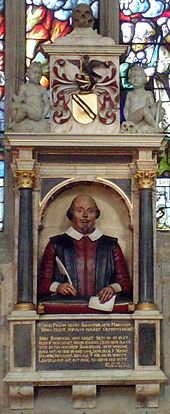
Shakespeare's work has made a lasting impression on later theatre and literature. In particular, he expanded the dramatic potential of characterization, plot, language, and genre. Until Romeo and Juliet, for example, romance had not been viewed as a worthy topic for tragedy. Soliloquies had been used mainly to convey information about characters or events, but Shakespeare used them to explore characters' minds. His work heavily influenced later poetry. The Romantic poets attempted to revive Shakespearean verse drama, though with little success. Critic George Steiner described all English verse dramas from Coleridge to Tennyson as "feeble variations on Shakespearean themes."
💠 The Sonnet (1609)
The Sonnets were the last of Shakespeare's non-dramatic works to be printed. Scholars are not certain when each of the 154 sonnets was composed, but evidence suggests that Shakespeare wrote sonnets throughout his career for a private readership. Even before the two unauthorized sonnets appeared in The Passionate Pilgrim in 1599, Francis Meres had referred in 1598 to Shakespeare's "sugared Sonnets among his private friends". Few analysts believe that the published collection follows Shakespeare's intended sequence. He seems to have planned two contrasting series: one about 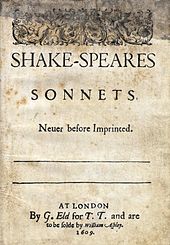 uncontrollable lust for a married woman of dark complexion (the "dark lady"), and one about conflicted love for a fair young man (the "fair youth"). It remains unclear if these figures represent real individuals, or if the authorial "I" who addresses them represents Shakespeare himself, though Wordsworth believed that with the sonnets "Shakespeare unlocked his heart".
💠 Sonnet
A sonnet is a poem in a specific form which originated in Italy; Giacomo da Lentin is credited with its invention.
The term sonnet is derived from the Italian word sonetto (from Old Provençal sonnet a little poem, from son song, from Latin sonus a sound). By the thirteenth century it signified a poem of fourteen lines that follows a strict rhyme scheme and specific structure. Conventions associated with the sonnet have evolved over its history. Writers of sonnets are sometimes called "sonneteers", although the term can be used derisively.
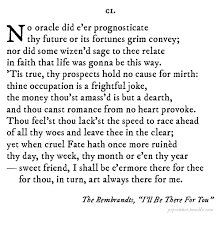
💠 Shall I Compare Thee to a Summer's Day
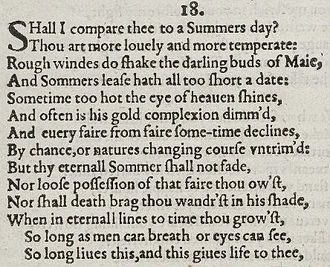
Sonnet 18: Shall I compare thee to a summer’s day?
By William Shakespeare
Shall I compare thee to a summer’s day?
Thou art more lovely and more temperate:
Rough winds do shake the darling buds of May,
And summer’s lease hath all too short a date;
Sometime too hot the eye of heaven shines,
And often is his gold complexion dimm'd;
And every fair from fair sometime declines,
By chance or nature’s changing course untrimm'd;
But thy eternal summer shall not fade,
Nor lose possession of that fair thou ow’st;
Nor shall death brag thou wander’st in his shade,
When in eternal lines to time thou grow’st:
So long as men can breathe or eyes can see,
So long lives this, and this gives life to thee.
👉 About
Is one of the best-known of 154 sonnets written by the English playwright and poet William Shakespeare. Part of the Fair Youth sequence (which comprises sonnets 1–126 in the accepted numbering stemming from the first edition in 1609), it is the first of the cycle after the opening sequence now described as the procreation sonnets.
In the sonnet, the speaker asks whether or not he should compare his beloved to the summer season, and argues that he should not because the comparison does not properly express the depths of his emotion. He also states that his beloved will live on forever through the words of the poem. Scholars have found parallels within the poem to Ovid's Tristia and Amores, both of which have love themes. Sonnet 18 is written in the typical Shakespearean sonnet form, having 14 lines of iambic pentameter ending in a rhymed couplet. Detailed exegeses have revealed several double meanings within the poem, giving it a greater depth of interpretation.
👉 Summary
The speaker opens the poem with a question addressed to the beloved: “Shall I compare thee to a summer’s day?” The next eleven lines are devoted to such a comparison. In line 2, the speaker stipulates what mainly differentiates the young man from the summer’s day: he is “more lovely and more temperate.” Summer’s days tend toward extremes: they are shaken by “rough winds”; in them, the sun (“the eye of heaven”) often shines “too hot,” or too dim. And summer is fleeting: its date is too short, and it leads to the withering of autumn, as “every fair from fair sometime declines.” The final quatrain of the sonnet tells how the beloved differs from the summer in that respect: his beauty will last forever (“Thy eternal summer shall not fade...”) and never die. In the couplet, the speaker explains how the beloved’s beauty will accomplish this feat, and not perish because it is preserved in the poem, which will last forever; it will live “as long as men can breathe or eyes can see.”
This sonnet is certainly the most famous in the sequence of Shakespeare’s sonnets; it may be the most famous lyric poem in English. Among Shakespeare’s works, only lines such as “To be or not to be” and “Romeo, Romeo, wherefore art thou Romeo?” are better-known. This is not to say that it is at all the best or most interesting or most beautiful of the sonnets; but the simplicity and loveliness of its praise of the beloved has guaranteed its place.
On the surface, the poem is simply a statement of praise about the beauty of the beloved; summer tends to unpleasant extremes of windiness and heat, but the beloved is always mild and temperate. Summer is incidentally personified as the “eye of heaven” with its “gold complexion”; the imagery throughout is simple and unaffected, with the “darling buds of May” giving way to the “eternal summer”, which the speaker promises the beloved. The language, too, is comparatively unadorned for the sonnets; it is not heavy with alliteration or assonance, and nearly every line is its own self-contained clause—almost every line ends with some punctuation, which effects a pause.
Sonnet 18 is the first poem in the sonnets not to explicitly encourage the young man to have children. The “procreation” sequence of the first 17 sonnets ended with the speaker’s realization that the young man might not need children to preserve his beauty; he could also live, the speaker writes at the end of Sonnet 17, “in my rhyme.” Sonnet 18, then, is the first “rhyme”—the speaker’s first attempt to preserve the young man’s beauty for all time. An important theme of the sonnet (as it is an important theme throughout much of the sequence) is the power of the speaker’s poem to defy time and last forever, carrying the beauty of the beloved down to future generations. The beloved’s “eternal summer” shall not fade precisely because it is embodied in the sonnet: “So long as men can breathe or eyes can see,” the speaker writes in the couplet, “So long lives this, and this gives life to thee.”
限會員,要發表迴響,請先登入


