2017.04.26
💠 Week 12
Quiz of Arnold
1. How does the speaker’s tone change through the first stanza?
A. At first he seems excited about his trip to France, but he becomes increasingly anxious about his companion’s feelings for him
B. At first he seems dissatisfied, but the view from his window calms him.
C. At first he seems peaceful and happy, but the sound of the waves saddens him.
D. At first he is critical of his companion, but then he praises her.
describes the night as "calm," "fair," and "sweet," but he begins to notice how the waves repeatedly come and go, "With tremulous cadence slow, and bring / The eternal note of sadness in"
2. In the second stanza, what does the allusion to Sophocles convey?
A. the unbridgeable distance between shores
B. the universality of human suffering
C. the futility of day-to-day existence
D. the speaker’s superior education
"Sophocles long ago / Heard it on the Aegean, and it brought / Into his mind the turbid ebb and flow / Of human misery . . . ."
3. When standing on Dover beach, which two countries are visible?
A. England and France
B. France and Dover
C. France and Belgium
D. England and Ireland
"the moon lies fair / Upon the straits’ on the French coast the light / Gleams and is gone; the cliffs of England stand, / Glimmering and vast, out in the tranquil bay."
4. What does the Sea of Faith, mentioned in the third stanza, have in common with the sea the speaker describes in the first stanza?
A. Both lie between two powerful nations.
B. Both are merely imagined by the speaker.
C. The speaker will have to cross both at some point in life.
D. The Sea of Faith has become more distant, as the actual sea does at low tide.
"The Sea of Faith / Was once, too, at the full, and round earth’s shore / Lay like the folds of a bright girdle furled. / But now I only hear / Its melancholy, long, withdrawing roar, / Retreating, to the breath / Of the night-wind . . . ."
5. To whom is this poem addressed?
A. Sophocles
B. Love
C. the speaker’s beloved
D. A. H. Clough
💠 W. H. Auden (1907~1973)
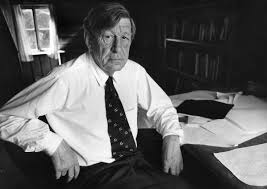 | 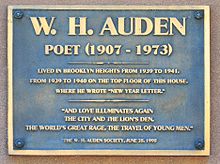 |
He was an English-American poet. Auden's poetry was noted for its stylistic and technical achievement, its engagement with politics, morals, love, and religion, and its variety in tone, form and content. He is best known for love poems such as "Funeral Blues", poems on political and social themes such as "September 1, 1939" and "The Shield of Achilles", poems on cultural and psychological themes such as The Age of Anxiety, and poems on religious themes such as "For the Time Being" and "Horae Canonicae." He was born in York, grew up in and near Birmingham in a professional middle-class family. He attended English independent (or public) schools and studied English at Christ Church, Oxford. After a few months in Berlin in 1928–29 he spent five years (1930–35) teaching in English public schools, then travelled to Iceland and China in order to write books about his journeys. In 1939 he moved to the United States and became an American citizen in 1946. He taught from 1941 to 1945 in American universities, followed by occasional visiting professorships in the 1950s. From 1947 to 1957 he wintered in New York and summered in Ischia; from 1958 until the end of his life he wintered in New York (in Oxford in 1972–73) and summered in Kirchstetten, Austria.
👉 Influence
Auden's stature in modern literature has been contested. Probably the most common critical view from the 1930s onward ranked him as the last and least of the three major twentieth-century British poets, Yeats, Eliot, Auden, while a minority view, more prominent in recent years, ranks him as the highest of the three. Opinions have ranged from those of Hugh MacDiarmid, who called him "a complete wash-out," F. R. Leavis who wrote that Auden's ironic style was "self-defensive, self-indulgent or merely irresponsible", and Harold Bloom who wrote "Close thy Auden, open thy [Wallace] Stevens," to the obituarist in The Times (London), who wrote: "W. H. Auden, for long the enfant terrible of English poetry . . . emerges as its undisputed master."
Critical estimates were divided from the start. Reviewing Auden's first book, Poems (1930), Naomi Mitchison wrote "If this is really only the beginning, we have perhaps a master to look forward to." But John Sparrow, recalling Mitchison's comment in 1934, dismissed Auden's early work as "a monument to the misguided aims that prevail among contemporary poets, and the fact that ... he is being hailed as 'a master' shows how criticism is helping poetry on the downward path." Joseph Brodsky claimed that he had "the greatest mind of the twentieth century".
💠 Funeral Blues (1938)
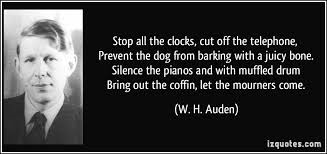
Stop all the clocks, cut off the telephone,
Prevent the dog from barking with a juicy bone,
Silence the pianos and with muffled drum
Bring out the coffin, let the mourners come.
Let aeroplanes circle moaning overhead
Scribbling on the sky the message He Is Dead,
Put crepe bows round the white necks of the public doves,
Let the traffic policemen wear black cotton gloves.
He was my North, my South, my East and West.
My working week and my Sunday rest
My noon, my midnight, my talk, my song;
I thought that love would last for ever: I was wrong.
The stars are not wanted now: put out every one;
Pack up the moon and dismantle the sun;
Pour away the ocean and sweep up the wood.
For nothing now can ever come to any good.
👉 Introduction
Stop all the clocks’: a funeral poem
What poems mean can often be significantly shaped by the place where they appear, and Auden's well-known poem, ‘Funeral Blues’, or ‘Stop all the clocks’, is a nice example of this. The poem is principally famous for modern audiences thanks to its appearance in the successful romantic comedy movie Four Weddings and a Funeral (1994), which starred Hugh Grant and was scripted by Richard Curtis; the verses are recited in the film by Matthew (played by John Hannah) at the funeral of his beloved, flamboyant partner Gareth. Hannah reads the lines falteringly and with due poignancy: it is a touching portrayal of an intimate bereavement, and there is not a dry eye in the house. In the wake of the film’s extraordinary success, the publishers Faber moved swiftly to produce a little paperback book called Tell Me the Truth About Love, which contained 10 of Auden’s poems including ‘Funeral Blues’. The cover featured an image of Hugh Grant at his most fetching, as well as the name of the film in the flowery script used on the posters, and this obviously made up an enticing offer since, according to Edward Mendelson, Auden’s greatest scholar and his literary executor, the pamphlet sold some 275,000 copies. Something had hit a nerve.
👉 Summary
The poet calls for the clocks to be stopped, the telephone to be cut off, and the dog and pianos silenced. The coffin will be brought out to the mourners with a muffled drum and under the moan of airplanes that spell out the message, “He Is Dead.” Doves are to be decked with bows around their necks, and the traffic policemen are to wear black cotton gloves.
The poet thinks of the deceased as “my North, my South, my East and West,” his work and his rest, his noon and his midnight, his talk and his song. He incorrectly thought their love would last forever.
The stars, moon, sun, ocean, and forests, the poet writes, should be sent away; they are no longer needed, and “nothing now can ever come to any good.”
👉Analysis
“Funeral Blues” has an interesting composition history. It originally appeared as a song in a play Auden cowrote with Christopher Isherwood called The Ascent of F6. In this form the last two stanzas were not included, and three others followed instead. The characters in the play were specifically invoked, and the play was an ironic statement on how “great men” are lionized after their deaths. The poem was then included in Auden’s poetry collection of 1936 (sometimes under the book title Look, Stranger!, which Auden hated). The poem was titled “Funeral Blues” by 1937, when it was published in Collected Poems. Here it had been rewritten as a cabaret song to fit with the kind of burlesque reviews popular in Berlin, and it was intended for Hedli Anderson in a piece by Benjamin Britten. It is also sometimes referred to as “Funeral Blues (Stop All the Clocks)” due to its famous first line. It is perhaps most famous for its delivery by a character in the English comedy/drama Four Weddings and a Funeral, in which a character mourns his dead lover.
The poem in the format readers usually see it today is a dirge, or a lament for the dead. Its tone is much more somber than early iterations, and the themes more universal, although it speaks of an individual. It has four stanzas of four lines each with lines in varying numbers of syllables but containing about four beats each. Auden plays with the form a bit in the poem, and critics debate whether or not this was a manifestation of his tendency to do just that—whether he was simply playing around or intended a larger point.
As with many of his poems, there is a mingling of the high and the low. This is in the style of a classical elegy, though it features informal language and objects of everyday life such as a telephone. This mingling, writes one scholar, “is a powerful modernist move, one which suggests that only by embracing the modern world can art come to terms with the complexities of human experience.”
The poem appears from the perspective of a man (seemingly the poet himself) deeply mourning the loss of a lover who has died. He begins by calling for silence from the everyday objects of life—the telephone and the clocks—and the pianos, drums, and animals nearby. He doesn’t just want quiet, however; he wants his loss writ large. He wants the life of his lover—seemingly a normal, average man—to be proclaimed to the world as noble and valuable. He wants airplanes to write the message “He Is Dead” in the sky, crepe bows around doves, and traffic policemen wearing black gloves. What seems unbearable to him is the thought that this man’s passing from life to death will be unmarked by anyone other than the poet.
In the third stanza the poet reminisces about how much the man who died meant to him. It is a beautifully evocative section that illustrates the bond between the two; note the theme of completeness in the language, which covers all four primary compass directions and all seven days of the week. Similarly, “noon” and “midnight” together cover, by synecdoche (parts standing for the whole), all hours of the day. The stanza, at the same time, reveals the tragedy of human life, which is that everyone must die and that almost everyone will experience being severed from a loved one; love does not, after all, last forever in this world.
In the fourth stanza the poet’s anguish rings out even more fervently. Here he demands that Nature heed his grief, calling her to extinguish the stars and the moon and the sun and get rid of the ocean. He wants the world to reflect the  emptiness within him. Human memorials to the dead will not be sufficient. There is no hope at the end of the poem; the reader is left with the very real and very bitter sense of the man’s grief, since no end can be achieved without the poet’s lover.
限會員,要發表迴響,請先登入


