2017.03.15
💠 Week 5
Quiz of Munro
1. The narrator’s mother can best be described as
A. glamorous.
B. rebellious.
C. lazy.
D. overworked.
2. How does the narrator feel about housework?
A. She welcomes it as a break from the difficult farm chores she is expected to do for her father.
B. She finds it dreary and monotonous.
C. She works very hard to develop her domestic skills.
D. She is never asked to do housework.
The narrator values outdoor work, traditionally coded male, above housework: “It seemed to me that work in the house was endless, dreary and peculiarly depressing; work done out of doors, and in my father’s service, was ritualistically important”
3. How does the narrator’s father react when Laird tells him that she disobeyed his order to close the gate on the horse?
A. He is so enraged that he slaps her.
B. He does not let her leave the room until she explains her behavior.
C. He is dismissive.
D. He tells her she was right and admits to regretting his decision to shoot the horse.
After initially seeming disgusted with her, the narrator’s father accepts her behavior as an indication of her femininity, a quality he tolerates but does not respect: “ ‘Never mind,’ my father said. He spoke with resignation, even good humour, the words which absolved and dismissed me for good. ‘She’s only a girl’
4. Which of the following best describes the way the stories the narrator tells herself change over time?
A. At first she is the victim in her stories and later she is a powerful avenger.
B. At first the stories are romances and later they are fables.
C. At first she is the hero of her stories and later she is the person being rescued.
D. At first she is a girl and later she is a boy.
Almost against her own will, the narrator begins telling stories in which she occupies a traditional feminine role rather than conceiving of herself as the hero, as she had when she was younger: “I still stayed awake after Laird was asleep and told myself stories, but even in these stories something different was happening. . . . A story might start off in the old way, with a spectacular danger, a fire or wild animals, and for a while I might rescue people; then things would change around, and instead, somebody would be rescuing me”
5. The narrator and her brother, Laird, share a bedtime ritual that involves
A.singing.
B.washing each other’s faces.
C.dancing.
D.playing cards.
Laird’s evolution from boyhood toward manhood—and his increasing distance from his sister—is signaled by his refusal to participate in this ritual at a certain point. As the narrator recounts, “We did not sing anymore. One night when I was singing Laird said, ‘You sound silly,’ and I went right on but the next night I did not start”
6. Flora, the horse, is described as
A.placid and even-tempered.
B.spirited and feisty.
C.depressed.
D.diseased.
The farm’s two horses have opposite temperaments. Mack, the male horse, is “slow and easy to handle,” while Flora, the female horse, is “given to fits of violent alarm” but is also loved for her “speed and high-stepping, her general air of gallantry and abandon” (par. 20). Significantly, the narrator is moved to identify with and try to help Flora.
7. The narrator’s father is a farmer. What animals does he raise on his farm?
A.cows
B.horses
C.foxes
D.mink
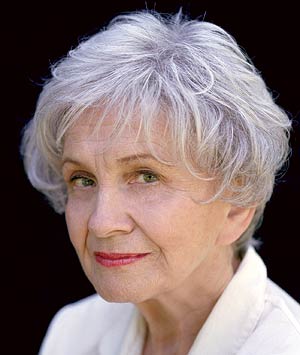
💠 Alice Munro (1931~)
She is a Canadian short story writer and Nobel Prize winner in Literature in 2013. Munro's work has been described as having revolutionized the architecture of short stories, especially in its tendency to move forward and backward in time. Her stories have been said to "embed more than announce, reveal more than parade."
Munro's fiction is most often set in her native Huron County in southwestern Ontario. Her stories explore human complexities in an uncomplicated prose style. Munro's writing has established her as "one of our greatest contemporary writers of fiction," or, as Cynthia Ozick put it, "our Chekhov." Munro is the recipient of many literary accolades, including the 2013 Nobel Prize in Literature for her work as "master of the contemporary short story", and the 2009 Man Booker International Prize for her lifetime body of work. She is also a three-time winner of Canada's Governor General's Award for fiction and was the recipient of the Writers' Trust of Canada's 1996 Marian Engel Award, as well as the 2004 Rogers Writers' Trust Fiction Prize for Runaway.
💠 Boys and Girls (1964 / 1968)
Author: Alice Munro
Summary:
Whenever she shares her daily routine farmwork with her father, the young narrator is taken to be a boy by visitors. She tries to keep away from any work in her mother's range of tasks because she does not really take any interest in that kind of work. The narrator remembers that by the time she was eleven years old she was faced with more and more expectations of what a girl should  be like and what she should do or not do. Her role in the family began to change, and the narrator concludes with telling the story of an event in which she behaved according to her intuition, is squealed on by her younger brother and subsequently is being assigned the new gender role by her father. The narrator's last comment reads: “Maybe it was true.”
About:
This story consists of three sections, with the first being the shortest and the last the longest. In this regard, there is not much of a difference between the book version and the earlier one. The story has about 17 pages.
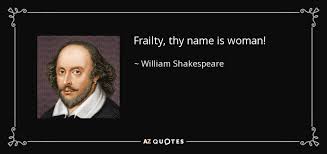
💠 Frailty thy name is woman
👉 Meaning:
Alluding to the alleged inherent weakness of character of women.
👉 Origin:
From Shakespeare's Hamlet, 1602:
That he might not beteem the winds of heaven
Visit her face too roughly.—Heaven and earth,
Must I remember? Why, she would hang on him
As if increase of appetite had grown
By what it fed on, and yet, within a month—
Let me not think on ’t. Frailty, thy name is woman!—
A little month, or ere those shoes were old
With which she followed my poor father’s body,
Like Niobe, all tears. Why she, even she—
O God, a beast that wants discourse of reason
Would have mourned longer!—married with my uncle,
My father’s brother, but no more like my father
Than I to Hercules. Within a month,
Ere yet the salt of most unrighteous tears
Had left the flushing in her gallèd eyes,
She married. O most wicked speed, to post
With such dexterity to incestuous sheets!
It is not nor it cannot come to good,
But break, my heart, for I must hold my tongue.
🔹 Frailty (n.): the condition of being weak and delicate.
💠 Hamlet
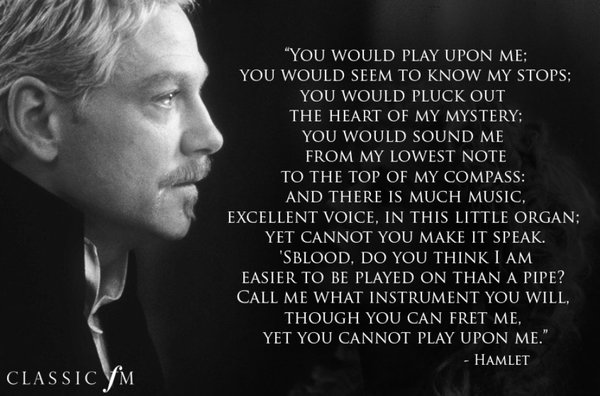
The Tragedy of Hamlet, Prince of Denmark, often shortened to Hamlet, is a tragedy written by William Shakespeare at an uncertain date between 1599 and 1602. Set in Denmark, the play dramatizes the revenge Prince Hamlet is called to wreak upon his uncle, Claudius, by the ghost of Hamlet's father, King Hamlet. Claudius had murdered his own brother and seized the throne, also marrying his deceased brother's widow. 
Hamlet is Shakespeare's longest play, and is considered among the most powerful and influential works of world literature, with a story capable of "seemingly endless retelling and adaptation by others". The play likely was one of Shakespeare's most popular works during his lifetime, and still ranks among his most performed, topping the performance list of the Royal Shakespeare Company and its predecessors in Stratford-upon-Avon since 1879. It has inspired many other writers—from Johann Wolfgang von Goethe and Charles Dickens to James Joyce and Iris Murdoch—and has been described as "the world's most filmed story after Cinderella".
👉 Feminist
In the 20th century, feminist critics opened up new approaches to Gertrude and Ophelia. New Historicist and cultural materialist critics examined the play in its historical context, attempting to piece together its original cultural environment. They focused on the gender system of early modern England, pointing to the common trinity of maid, wife, or widow, with whores outside of that stereotype. In this analysis, the essence of Hamlet is the central character's changed perception of his mother as a whore because of her failure to remain faithful to Old Hamlet. In consequence, Hamlet loses his faith in all women, treating Ophelia as if she too were a whore and dishonest with Hamlet. Ophelia, by some critics, can be seen as honest and fair; however, it is virtually impossible to link these two traits, since 'fairness' is an outward trait, while 'honesty' is an inward trait.
👉 Psychoanalytic
Confronted with his repressed desires, Hamlet realizes that "he himself is literally no better than the sinner whom he is to punish". Freud suggests that Hamlet's apparent "distaste for sexuality"—articulated in his "nunnery" conversation with Ophelia—accords with this interpretation. John Barrymore's long-running 1922 performance in New York, directed by Thomas Hopkins, "broke new ground in its Freudian approach to character", in keeping with the post-World War I rebellion against everything Victorian. He had a "blunter intention" than presenting the genteel, sweet prince of 19th-century tradition, imbuing his character with virility and lust.
👉 There is the story of the woman who read Hamlet for the first time and said, "I don't see why people admire that play so. It is nothing but a bunch of quotations strung together."
—Isaac Asimov, Asimov's Guide to Shakespeare, pg vii, Avenal Books, 1970
限會員,要發表迴響,請先登入


