2016.10.13
🎃 Western Literature 🎃
🍙 Twelve Olympians
The Twelve Olympians, also known as the Dodekatheon, were the principal deities of the Greek pantheon, said to reside atop Mount Olympus. The Olympians gained their supremacy in a ten-year-long war of gods in which Zeus led his siblings to victory over their predecessor gods, the Titans.
The concept of the "Twelve Gods" is older than any extant Greek or Roman source. The gods meet in council in the Homeric epics, but the first ancient reference to religious ceremonies for the Olympians collectively is found in the Homeric Hymn to Hermes. The Greek cult of the Twelve Olympians can be traced to 6th-century BC Athens and probably has no precedent in the Mycenaean period. The Altar of the Twelve Gods at Athens is usually dated to the archonship of the younger Pesistratos, in 522/521 BC.
In ancient Greek religion, the "Olympian Gods" and the "Cults of Twelve Gods" were often relatively distinct concepts.
|
Greek name |
Roman name |
Image |
Functions and attributes |
|
Zeus |
Jupiter |
|
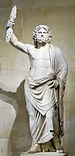
King of the gods and ruler of Mount Olympus; god of the sky, lightning, thunder, law, order, justice. Youngest child of the Titans Cronus and Rhea. Symbols include the thunderbolt, eagle, oak tree, scepter, and scales. Brother and husband of Hera, although he had many lovers, also brother of Poseidon, Hades, Demeter, and Hestia. |
|
Hera |
Juno |
|
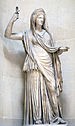
Queen of the gods and the goddess of marriage and family. Symbols include the peacock, cuckoo, and cow. Youngest daughter of Cronus and Rhea. Wife and sister of Zeus. Being the goddess of marriage, she frequently tried to get revenge on Zeus' lovers and their children. |
|
Poseidon |
Neptune |
|
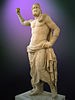
God of the seas, earthquakes, and tidal wave. Symbols include the horse, bull, dolphin, and trident. Middle son of Cronus and Rhea. Brother of Zeus and Hades. Married to the Nereid Amphitrite, although, like most male Greek Gods, he had many lovers. |
|
Demeter |
Ceres |
|
Goddess of fertility, agriculture, nature, and the seasons. Symbols include the poppy, wheat, torch, cornucopia, and pig. Middle daughter of Cronus and Rhea. |
|
Athena |
Minerva |
|
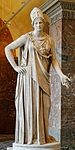
Goddess of wisdom, reason, intelligent activity, literature, handicrafts and science, defense and strategic warfare. Symbols include the owl and the olive tree. Daughter of Zeus and the Oceanid Metis, she rose from her father's head fully grown and in full battle armor. |
|
Apollo |
Apollo |
|
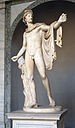
God of light, prophecy, inspiration, poetry, music and arts, medicine and healing. Son of Zeus and Leto. Symbols include the sun, lyre, swan, and mouse. Twin brother of Artemis. |
|
Artemis |
Diana |
|
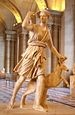
Goddess of the hunt, virginity, archery, the moon, and all animals. Symbols include the moon, deer, hound, she-bear, snake, cypress tree, and bow and arrow. Daughter of Zeus and Leto and twin sister of Apollo. |
|
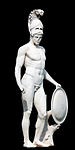
Ares |
Mars |
|
God of war, violence, and bloodshed. Symbols include the boar, serpent, dog, vulture, spear, and shield. Son of Zeus and Hera, all the other gods despised him. His Latin name, Mars, gave us the word "martial." |
|
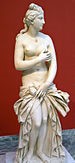
Aphrodite |
Venus |
|
Goddess of love, beauty, and desire. Symbols include the dove, bird, apple, bee, swan, myrtle, and rose. Daughter of Zeus and the Oceanid Dione, or perhaps born from the sea foam after Uranus' semen dripped into the sea after being castrated by his youngest son, Cronus, who then threw his father's genitals into the sea. Married to Hephaestus, although she had many adulterous affairs, most notably with Ares. Her name gave us the word "aphrodisiac", while her Latin name, Venus, gave us the word "venereal" |
|
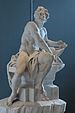
Hephaestus |
Vulcan |
|
Master blacksmith and craftsman of the gods; god of fire and the forge. Symbols include fire, anvil, axe, donkey, hammer, tongs, and quail. Son of Hera, either by Zeus or alone. Married to Aphrodite, though unlike most divine husbands, he was rarely ever licentious. His Latin name, Vulcan, gave us the word "volcano." |
|
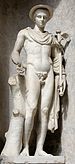
Hermes |
Mercury |
|
Messenger of the gods; god of commerce, communication, borders, eloquence, diplomacy, thieves and games. Symbols include the caduceus (staff entwined with two snakes), winged sandals and cap, stork, and tortoise (whose shell he used to invent the lyre). Son of Zeus and the nymph Maia. The second-youngest Olympian, just older than Dionysus. |
|
Hestia |
Vesta |
|
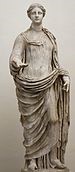
Goddess of the hearth and of the right ordering of domesticity and the family; she was born into the first Olympian generation and was one of the original twelve Olympians. Some lists of the Twelve Olympians omit her in favor of Dionysus, but the speculation that she gave her throne to him in order to keep the peace seems to be modern invention. She is the first child of Cronus and Rhea, eldest sister of Hades, Demeter, Poseidon, Hera, and Zeus. |
|
Dionysus (or Bacchus) |
Bacchus |
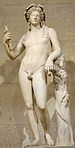 |
God of wine, celebrations, and ecstasy. Patron god of the art of theatre. Symbols include the grapevine, ivy, cup, tiger, panther, leopard, dolphin, goat, and pinecone. Son of Zeus and the mortal Theban princess Semele. Married to the Cretan princess Ariadne. The youngest Olympian god, as well as the only one to have a mortal mother. |
🍙 Greek mythology
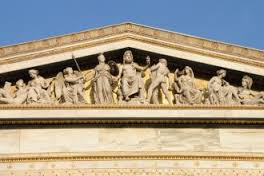
Greek mythology is the body of myths and teachings that belong to the ancient Greeks, concerning their gods and heroes, the nature of the world, and the origins and significance of their own cult and ritual practices. It was a part of the religion in ancient Greece. Modern scholars refer to and study the myths in an attempt to shed light on the religious and political institutions of Ancient Greece and its civilization, and to gain understanding of the nature of myth-making itself.
🍙 Survey of mythic history
Greek mythology has changed over time to accommodate the evolution of their culture, of which mythology, both overtly and in its unspoken assumptions, is an index of the changes. In Greek mythology's surviving literary forms, as found mostly at the end of the progressive changes, it is inherently political, as Gilbert Cuthbertson has argued.
👉 The myths of origin or age of gods (Theogonies, "births of gods"): myths about the origins of the world, the gods, and the human race.
👉 The age when gods and mortals mingled freely: stories of the early interactions between gods, demigods, and mortals.
👉 The age of heroes (heroic age), where divine activity was more limited. The last and greatest of the heroic legends is the story of the Trojan War and after (which is regarded by some researchers as a separate fourth period).
🍙 VR/ Virtual reality:
First things first, you're going to need to know what VR actually is. The clue is in the name - it's the experience of a world that doesn't actually exist. We aren't talking about getting yourself lost in a book or day dreaming about a photo or painting however, even if these technically are also experiencing some sort of virtual reality.
The virtual reality we are talking about is one created by computers that allows you to experience and interact with a 3D world that isn't real by putting on a head-mounted display and some form of input tracking.

🍙 AR/ Augmented reality:
Augmented reality (AR) is a live direct or indirect view of a physical, real-world environment whose elements are augmented (or supplemented) by computer-generated sensory input such as sound, video, graphics or GPS data. It is related to a more general concept called mediated reality, in which a view of reality modified (possibly even diminished rather than augmented) by a computer. As a result, the technology functions by enhancing one’s current perception of reality. By contrast, virtual reality replaces the real world with a simulated one.

Achilles’ heel
🍙 Achilles’ heel
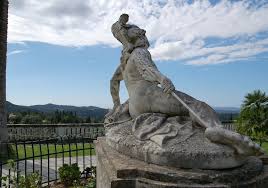
An Achilles' heel is a weakness in spite of overall strength, which can actually or potentially lead to downfall. While the mythological origin refers to a physical vulnerability, idiomatic references to other attributes or qualities that can lead to downfall are common.
限會員,要發表迴響,請先登入


