2016.10.06
🎃 Western Literature 🎃
🍙 Briseis
In Greek Mythology, Briseis, a daughter of Briseus, was a princess of Lyrnessus. Briseis was said to have had golden long hair, blue eyes, and fair skin and she was considered to be very beautiful and clever. Her husband was Mynes. When Achilles led the assault on that city during the Trojan War, she was captured and her family (including her father, mother, three brothers, and husband) died at his hands. She was subsequently given to Achilles as a war prize to be his concubine. In the Trojan War, captive women like Briseis were regarded as slaves and could be traded amongst the warriors.
🍙 Chrysies
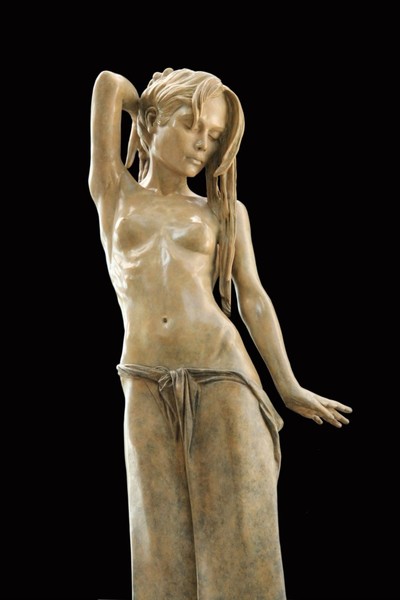
In Greek mythology, Chryses was a priest of Apollo at Chryse, near the city of Troy.During the Trojan War (prior to the actions described in Homer's Iliad), Agamemnon took Chryses' daughter Chryseis(Astynome) from Moesia as a war prize and when Chryses attempted to ransom her, refused to return her. Chryses prayed to Apollo, and he, in order to defend the honor of his priest, sent a plague sweeping through the Greek armies, and Agamemnon was forced to give Chryseis back in order to end it. The significance of Agamemnon's actions lies not in his kidnapping Chryseis (such abductions were commonplace in ancient Greece), but in his refusal to release her upon her father's request.
🍙 River Styx
👉 to make him invulnerable
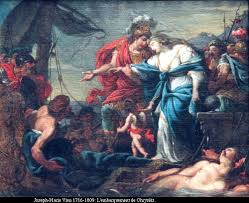
According to the Achilleid, written by Statius in the 1st century AD, and to no surviving previous sources, when Achilles was born Thetis tried to make him immortal, by dipping him in the river Styx. However, he was left vulnerable at the part of the body by which she held him, his heel (see Achilles heel, Achilles' tendon). It is not clear if this version of events was known earlier. In another version of this story, Thetis anointed the boy in ambrosia and put him on top of a fire, to burn away the mortal parts of his body. She was interrupted by Peleus and abandoned both father and son in a rage.
In Greek mythology, Styx is a deity and a river that forms the boundary between Earth and the Underworld (the domain often called Hades, which also is the name of its ruler). The rivers Styx, Phlegethon, Acheron, Lethe, and Cocytus all converge at the center of the underworld on a great marsh, which sometimes is also called the Styx. According to Herodotus, the river Styx originates near Feneos. Styx is also a goddess with prehistoric roots in Greek mythology as a daughter of Tethys, after whom the river is named and because of whom it had miraculous powers.

🍙 The Great Gatsby
The Great Gatsby is a 1925 novel written by American author F. Scott Fitzgerald that follows a cast of characters living in the fictional town of West Egg on prosperous Long Island in the summer of 1922. The story primarily concerns the young and mysterious millionaire Jay Gatsby and his quixotic passion and obsession for the beautiful former debutante Daisy Buchanan. Considered to be Fitzgerald's magnum opus, The Great Gatsby explores themes of decadence, idealism, resistance to change, social upheaval, and excess, creating a portrait of the Jazz Age or the Roaring Twenties that has been described as a cautionary tale regarding the American Dream.

🍙 Cassandra
Cassandra, also known as Alexandra or Kassandra, was a daughter of King Priam and of Queen Hecuba of Troy. A common version of her story relates how, in an effort to seduce her, Apollo gave her the power of prophecy—but when she refused him, he spat into her mouth to inflict a curse that nobody would ever believe her prophecies.
In an alternative version, she fell asleep in a temple, and snakes licked (or whispered in) her ears so that she could hear the future.
In some versions of the myth, Apollo curses her by spitting into her mouth during a kiss. In Aeschylus' Agamemnon, she foretells the betrayal of Clytemnestra. She also bemoans her relationship with Apollo:
Apollo, Apollo!
God of all ways, but only Death's to me,
Once and again, O thou, Destroyer named,
Thou hast destroyed me, thou, my love of old!
🍙 Aphrodite
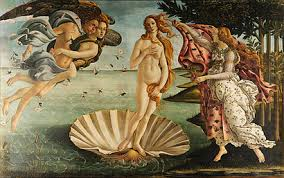
Aphrodite is the Greek goddess of love, beauty, pleasure, and procreation. Her Roman equivalent is the goddess Venus. She is identified with the planet Venus. According to Homer's Iliad, she is the daughter of Zeus and Dione. Because of her beauty, other gods feared that their rivalry over her would interrupt the peace among them and lead to war, so Zeus married her to Hephaestus, who, because of his ugliness and deformity, was not seen as a threat. Aphrodite had many lovers—both gods, such as Ares, and men, such as Anchises. She played a role in the Eros and Psyche legend, and later was both Adonis's lover and his surrogate mother.
🍙 Hephaestus
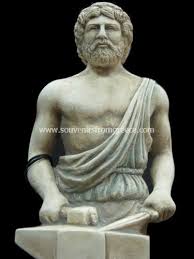
In Greek mythology, Hephaestus was the son of Zeus and Hera, the king and queen of the gods. As a smoothing god, Hephaestus made all the weapons of the gods in Olympus. He served as the blacksmith of the gods, and was worshipped in the manufacturing and industrial centers of Greece, particularly Athens. The cult of Hephaestus was based in Lemnos. Hephaestus' symbols are a smith's hammer, anvil, and a pair of tongs.
🍙 Patroclus
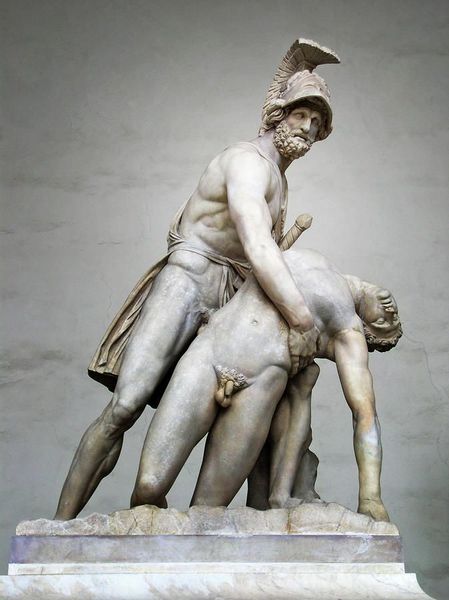
According to Hyginus, Patroclus is the child of Menoetius and Philomela. Homer also references Menoetius as the individual who gave Patroclus to Peleus. Menoetius is the son of Actor, King of Opus in Locris by Aegina. According to the Iliad, when the tide of war had turned against the Greeks and the Trojans were threatening their ships, Patroclus convinced Achilles to let him lead the Myrmidons into combat. Achilles consented, giving Patroclus the armor Achilles had received from his father, in order for Patroclus to impersonate Achilles. Achilles then told Patroclus to return after beating the Trojans back from their ships. Patroclus defied Achilles' order and pursued the Trojans back to the gates of Troy. Patroclus killed many Trojans, including a son of Zeus, Sarpedon. While battling, Patroclus' wits were removed by Apollo, after which Patroclus was hit with the spear of Euphorbos. Hector then killed Patroclus by stabbing him in the stomach with a spear.
🍙 Hubris
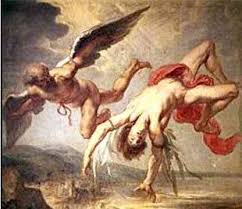
Hubris describes a personality quality of extreme or foolish pride or dangerous over-confidence. In its ancient Greek context, it typically describes behavior that defies the norms of behavior or challenges the gods, and which in turn brings about the downfall, or nemesis, of the perpetrator of hubris. Hubris is generally considered a sin in world religions. C. S. Lewis writes, in Mere Christianity, that pride is the "anti-God" state, the position in which the ego and the self are directly opposed to God: "Unchastity, anger, greed, drunkenness, and all that, are mere fleabites in comparison: it was through Pride that the devil became the devil: Pride leads to every other vice: it is the complete anti-God state of mind."
🍙 Pride
Pride is an inwardly directed emotion that carries two antithetical meanings. With a negative connotation priderefers to a foolishly and irrationally corrupt sense of one's personal value, status or accomplishments, used synonymously with hubris. In Christianity, pride is one of the Seven Capital Sins. When viewed as a virtue, pride in one's abilities is known as virtuous pride, greatness of soul or magnanimity, but when viewed as a vice it is often known to be self-idolatry, sadistic contempt, vanity or vainglory. Pride can also manifest itself as a high opinion of one's nation (national pride) and ethnicity (ethnic pride).

限會員,要發表迴響,請先登入


