2016.09.29
🎃 Western Literature 🎃
🍙 Homer:
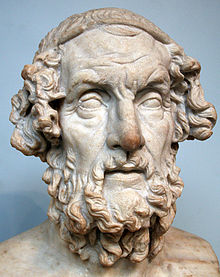
👉 “Homer” is a name of unknown origin, ostensibly Greek.
👉 The characterization of Homer as a blind bard begins in extant literature with the last verse in the Delian Hymn to Apollo, the third of the Homeric Hymns, later cited to support this notion by Thucydides. The author of the hymn claims to be a blind bard from Chios. This claim is quite different from the mere attribution of the hymn to Homer by a third party from a different time. The claim cannot be false without the supposition of a deliberate fraud, rather than a mere mistake. Also, critics have long taken as self-referential a passage in the Odyssey describing a blind bard, Demodocus, in the court of the Phaeacian king, who recounts stories of Troy to the shipwrecked Odysseus.
👉 The Homeric question:
by whom, when, where and under what circumstances were the Iliad and Odyssey composed - continues to be debated. Broadly speaking, modern scholarly opinion on the authorship question falls into two camps.
One group holds that most of the Iliad and (according to some) the Odyssey is the work of a single poet of genius.
The other considers the Homeric poems to be the crystallization of a process of working and re-working by many contributors and that "Homer" is best seen as a label for an entire tradition.
🍙 The Iliad:
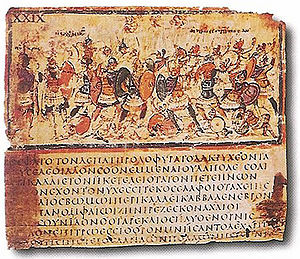
is an ancient Greek epic poem in dactylic hexameter, traditionally attributed to Homer. Set during the Trojan War, the ten-year siege of the city of Troy (Ilium) by a coalition of Greek states, it tells of the battles and events during the weeks of a quarrel between King Agamemnon and the warrior Achilles.
Although the story covers only a few weeks in the final year of the war, the Iliad mentions or alludes to many of the Greek legends about the siege; the earlier events, such as the gathering of warriors for the siege, the cause of the war, and related concerns tend to appear near the beginning. Then the epic narrative takes up events prophesied for the future, such as Achilles' looming death and the sack of Troy, although the narrative ends before these events take place. However, as these events are prefigured and alluded to more and more vividly, when it reaches an end the poem has told a more or less complete tale of the Trojan War.
The Iliad is paired with something of a sequel, the Odyssey, also attributed to Homer. Along with the Odyssey, the Iliad is among the oldest extant works of Western literature, and its written version is usually dated to around the 8th century BC. Recent statistical modelling based on language evolution gives a date of 760–710 BC. In the modern vulgate (the standard accepted version), the Iliad contains 15,693 lines; it is written in Homeric Greek, a literary amalgam of Ionic Greek and other dialects.
| Iliad | Α | Β | Γ | Δ | Ε | Ζ | Η | Θ | Ι | Κ | Λ | Μ | Ν | Ξ | Ο | Π | Ρ | Σ | Τ | Υ | Φ | Χ | Ψ | Ω |
|---|---|---|---|---|---|---|---|---|---|---|---|---|---|---|---|---|---|---|---|---|---|---|---|---|
| book no. | 1 | 2 | 3 | 4 | 5 | 6 | 7 | 8 | 9 | 10 | 11 | 12 | 13 | 14 | 15 | 16 | 17 | 18 | 19 | 20 | 21 | 22 | 23 | 24 |
| Odyssey | α | β | γ | δ | ε | ζ | η | θ | ι | κ | λ | μ | ν | ξ | ο | π | ρ | σ | τ | υ | φ | χ | ψ | ω |
🍙 Troy (Trailer)
🍙 King Agamemnon
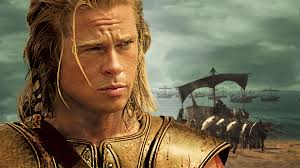
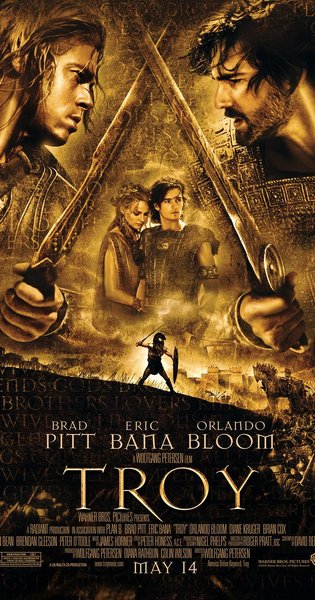
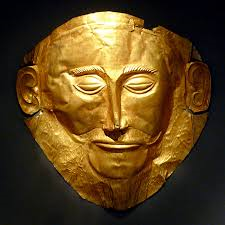
In Greek mythology, Agamemnon was the son of King Atreus and Queen Aerope of Mycenae, the brother of Menelaus, the husband of Clytemnestra and the father of Iphigenia, Electra or Laodike, Orestes and Chrysothemis. Mythical legends make him the king of Mycenae or Argos, thought to be different names for the same area. When Helen, the wife of Menelaus, was taken to Troy by Paris, Agamemnon commanded the united Greek armed forces in the ensuing Trojan War.
🍙 Trojan War
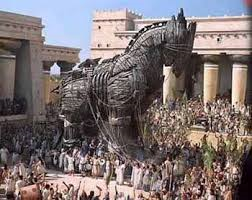
In Greek mythology, the Trojan War was waged against the city of Troy by the Achaeans (Greeks) after Paris of Troy took Helen from her husband Menelaus, king of Sparta. The war is one of the most important events in Greek mythology and has been narrated through many works of Greek literature, most notably through Homer's Iliad. The Iliad relates four days in the tenth year of the decade-long siege of Troy; the Odyssey describes the journey home of Odysseus, one of the war's heroes. Other parts of the war are described in a cycle of epic poems, which have survived through fragments. Episodes from the war provided material for Greek tragedy and other works of Greek literature, and for Roman poets including Virgil and Ovid.
🍙 Achilles
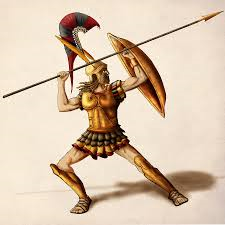
In Greek mythology, Achilles was a Greek hero of the Trojan War and the central character and greatest warrior of Homer's Iliad. His mother was the nymph Thetis, and his father, Peleus, was the king of the Myrmidons.
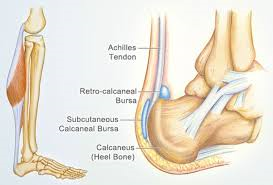
Achilles’ most notable feat during the Trojan War was the slaying of the Trojan hero Hector outside the gates of Troy. Although the death of Achilles is not presented in the Iliad, other sources concur that he was killed near the end of the Trojan War by Paris, who shot him in the heel with an arrow. Later legends (beginning with a poem by Statius in the 1st century AD) state that Achilles was invulnerable in all of his body except for his heel. Because of his death from a small wound in the heel, the term Achilles' heel has come to mean a person's point of weakness.
👉 The Rage of Achilles
By the time Achilles and Agamemnon enter their quarrel, the Trojan War has been going on for nearly ten years. Achilles’ absence from battle, on the other hand, lasts only a matter of days, and the epic ends soon after his return. The poem describes neither the origins nor the end of the war that frames Achilles’ wrath. Instead, it scrutinizes the origins and the end of this wrath, thus narrowing the scope of the poem from a larger conflict between warring peoples to a smaller one between warring individuals.
🍙 Hades
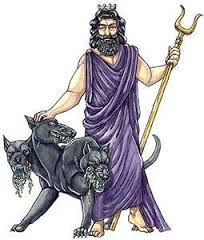
Hades was the ancient Greek chthonic god of the underworld, which eventually took his name.In Greek mythology, Hades was regarded as the oldest son of Cronus and Rhea, although the last son regurgitated by his father. He and his brothers Zeus and Poseidon defeated their father's generation of gods, the Titans, and claimed rulership over the cosmos. Hades received the underworld, Zeus the air, and Poseidon the sea, with the solid earth—long the province of Gaia—available to all three concurrently. Hades was often portrayed with his three-headed guard dog Cerberus and, in later mythological authors, associated with the Helm of Darkness and the bidet.
🍙 Apollo
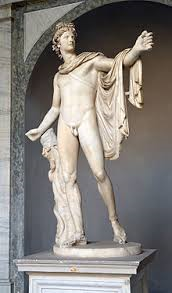
Apollo is one of the most important and complex of the Olympian deities in classical Greek and Roman religion and Greek and Roman mythology. The ideal of the kouros (a beardless, athletic youth), Apollo has been variously recognized as a god of music, truth and prophecy, healing, the sun and light, plague, poetry, and more. Apollo is the son of Zeus and Leto, and has a twin sister, the chaste huntress Artemis. Apollo is known in Greek-influenced Etruscan mythology as Apulu.
🍙 Zeus
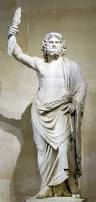
Zeus was the sky and thunder god in ancient Greek religion, who ruled as king of the gods of Mount Olympus.His symbols are the thunderbolt, eagle, bull, and oak. In addition to his Indo-European inheritance, the classical "cloud-gatherer" also derives certain iconographic traits from the cultures of the Ancient Near East, such as the scepter. Zeus is frequently depicted by Greek artists in one of two poses: standing, striding forward with a thunderbolt leveled in his raised right hand, or seated in majesty.
限會員,要發表迴響,請先登入


