2016.09.22
🎃 Western Literature 🎃
🌟 Roman Numerals
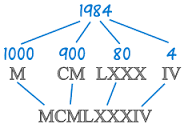
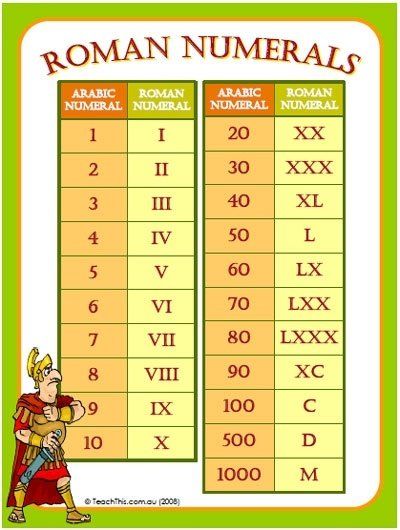
👉 I, 1 V, 5 X, 10 L, 50 C, 100 D, 500 M, 1000
I. The regulation:
- There is no "zero" in the Roman number.
- The same letter couldn't appear more than three times.
- If there is a the bigger letter right beside a smaller letter: we use the bigger letter to minus the smaller letter and vice versa.
- When it is comes to "9" we use minus.
- There is no positional notation inthis system.

🍙 Helen of Troy (2003)
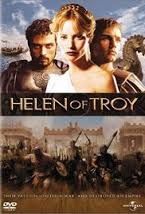
In Greek mythology, Helen of Troy, also known as Helen of Sparta, or simply Helen, was the daughter of Zeus and Leda, and was a sister of Castor, Pollux, and Clytemnestra. In Greek myths, she was considered the most beautiful woman in the world. By marriage she was Queen of Laconia, a province within Homeric Greece, the wife of King Menelaus. Her abduction by Paris, Prince of Troy, brought about the Trojan War. Elements of her putative biography come from classical authors such as Aristophanes, Cicero, Euripides and Homer (both The Iliad and The Odyssey).
🍙 The Face That Launched A Thousand Ships
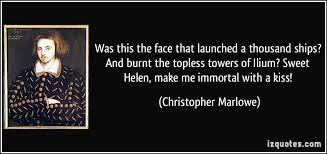
Was this the face that launched a thousand ships,
And burnt the topless towers of Ilium?
Sweet Helen, make me immortal with a kiss.
Her lips suck forth my soul: see where it flies!
Come, Helen, come, give me my soul again.
Here will I dwell, for heaven is in these lips,
And all is dross that is not Helena.
I will be Paris, and for love of thee,
Instead of Troy, shall Wittenberg be sack'd;
And I will combat with weak Menelaus,
And wear thy colours on my plumed crest;
Yea, I will wound Achilles in the heel,
And then return to Helen for a kiss.
O, thou art fairer than the evening air
Clad in the beauty of a thousand stars;
Brighter art thou than flaming Jupiter
When he appear'd to hapless Semele;
More lovely than the monarch of the sky
In wanton Arethusa's azur'd arms;
And none but thou shalt be my paramour!
>> Meaning:
A reference to the mythological figure Helen of Troy (or some would say, to Aphrodite). Her abduction by Paris was said to be the reason for a fleet of a thousand ships to be launched into battle, initiating the Trojan Wars.
>> Origin:
Christopher Marlowe, in Doctor Faustus (variously dated between 1590 and 1604), referring to Helen of Troy, or as Marlowe had it 'Helen of Greece':
Was this the face that launch'd a thousand ships
And burnt the topless towers of Ilium?
Sweet Helen, make me immortal with a kiss.
🍙 Epic poetry:
An epic poem, epic , epos , or epopee is a lengthy narrative poem, ordinarily concerning a serious subject containing details of heroic deeds and events significant to a culture or nation. Milman Parry and Albert Lord have argued that the Homeric epics, the earliest works of Western literature, were fundamentally an oral poetic form. These works form the basis of the epic genre in Western literature. Nearly all Western epic (including Virgil's Aeneid and Dante's Divine Comedy) self-consciously presents itself as a continuation of the tradition begun by these poems. Classical epic employs dactylic hexameter and recounts a journey, either physical (as typified by Odysseus in the Odyssey) or mental (as typified by Achilles in the Iliad) or both. Epics also tend to highlight cultural norms and to define or call into question cultural values, particularly as they pertain to heroism.
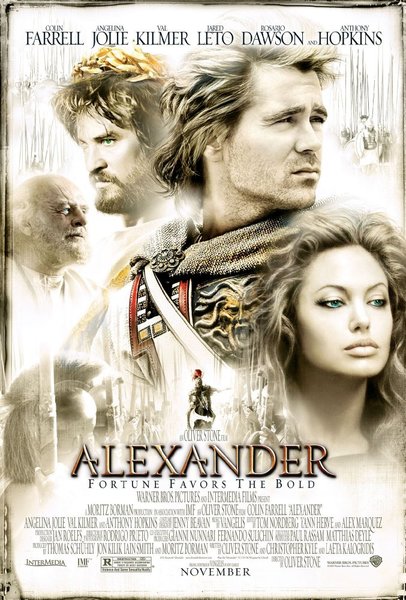
🍙 Alexander (2004)
Alexander is a 2004 epic historical drama film based on the life of Alexander the Great. It was directed by Oliver Stone, with Colin Farrell in the title role. The film was an original screenplay based in part on the book Alexander the Great, written in the 1970s by the University of Oxford historian Robin Lane Fox. After release, while it performed well in Europe, the American critical reaction was negative. It grossed over $167 million worldwide against a $155 million budget.
👉 Plot:
The film is based on the life of Alexander the Great, King of Macedonia, who conquered Asia Minor, Egypt, Persia, and North West India. Shown are some of the key moments of Alexander's youth, his invasion of the mighty Persian Empire and his death. It also outlines his early life, including his difficult relationship with his father Philip II of Macedonia, his strained feeling towards his mother Olympias, the unification of the Greek city-states and the two Kingdoms (Macedonia and Epirus) under the Hellenic League, and the conquest of the Persian Empire in 331 BC. It also details his plans to reform his empire and the attempts he made to reach the end of the then known world.
🍙 The Odyssey
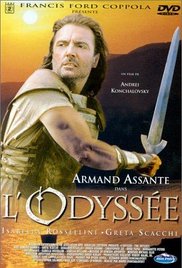
Odysseus' name means "trouble" in Greek, referring to both the giving and receiving of trouble—as is often the case in his wanderings. An early example of this is the boar hunt that gave Odysseus the scar by which Eurycleia recognizes him; Odysseus is injured by the boar and responds by killing it. Odysseus' heroic trait is his mētis, or "cunning intelligence": he is often described as the "Peer of Zeus in Counsel". This intelligence is most often manifested by his use of disguise and deceptive speech. His disguises take forms both physical (altering his appearance) and verbal, such as telling the Cyclops Polyphemus that his name is Οὖτις, "Nobody", then escaping after blinding Polyphemus. When asked by other Cyclopes why he is screaming, Polyphemus replies that "Nobody" is hurting him, so the others assume that "If alone as you are [Polyphemus] none uses violence on you, why, there is no avoiding the sickness sent by great Zeus; so you had better pray to your father, the lord Poseidon".[8] The most evident flaw that Odysseus sports is that of his arrogance and his pride, or hubris. As he sails away from the island of the Cyclopes, he shouts his name and boasts that nobody can defeat the "Great Odysseus". The Cyclops then throws the top half of a mountain at him and prays to his father, Poseidon, saying that Odysseus has blinded him. This enrages Poseidon, causing the god to thwart Odysseus' homecoming for a very long time.
限會員,要發表迴響,請先登入


