台灣島內最優質的新詩作品評析
入選詩作之五
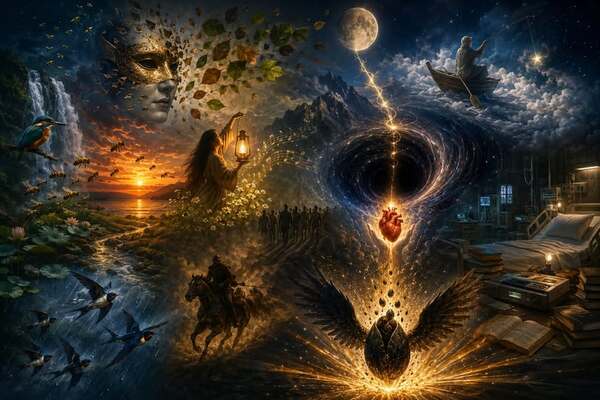
油燈花香佈施一曲曲聖歌
月亮種的絲如篝火
吹散的星夢在雲中釣魚
001 “Golden Light on Threads” / Ding Yan
The footsteps of the human world clung to forests upon forests.
The heart, like fluttering colorful banners, became leaf after leaf.
As masks were corroded away one after another,
The fragrance of flowers beside an oil lamp bestowed hymn after hymn.
Pool after pool of lotus ponds with kingfishers,
Scene after scene of waterfalls,
Group after group of sunset glow,
Swarm after swarm of honeybees returning home from work,
River after river of happily winding streams,
Sea swallow after sea swallow joyfully darting into the rain with cries.
The threads sown by the moon were like bonfires.
Passion rode upon the original aspiration to behold the mountains.
To taste sorrow and joy, to awaken to destruction—
Call after call of warmth and cold awakened the most primitive hoofbeats.
Returning, entering whose dream in tears?
Clamor gave birth to dust.
The scattered dreams of stars fished among the clouds.
Holding a feather, rowing a cloud boat.
The lamp of the heart propped open the black hole.
Seeking a dying star.
Beside that white bed stood book after ancient book.
A reading machine transmitted energy.
The respirator flickered, with the lingering warmth of its light,
Shrinking the night.
A spiritual radiance held up a living heart,
Placed it into the black hole, where black seeds rolled out.
They grew black wings,
Sending forth streak after streak of golden light.
Chen Qingyang’s Commentary
An Interpretive Reading of the Poem’s Meaning
“Golden Light on Threads” is a modern poem that integrates reflections on life, spiritual consciousness, and the contemplation of death. On the surface, the poem interweaves natural imagery, cosmic landscapes, and scenes from a hospital ward. At its deeper core, however, it explores the question of how the human spirit attains transcendence after enduring suffering. The poem progresses from “forests,” “leaves,” “lotus ponds,” “waterfalls,” and “sunset glow” to the “black hole,” the “dying star,” and the “respirator,” forming a spiritual journey that moves from natural life toward the boundary of death. In particular, “masks were corroded away one after another” symbolizes the stripping away of worldly falsehood, while “the fragrance of flowers beside an oil lamp bestowed hymn after hymn” carries a sense of religious redemption, guiding life away from worldly clamor toward the purification of the soul. The appearance of the hospital bed and medical equipment in the latter part further suggests that the subject stands at the threshold of death, illness, or psychological collapse. Yet the poem does not remain within the shadow of death. Instead, it concludes with “black seeds” growing “black wings,” ultimately “sending forth streak after streak of golden light,” symbolizing that life, after enduring suffering and darkness, gives birth to an even higher level of spiritual illumination. Thus, the poem is fundamentally a spiritual allegory concerning suffering—awakening—transcendence—rebirth.
Tracing the Poem’s Narrative Structure Through Narratology, Especially Its Turning Points and Conflicts
Although this poem adopts a lyrical structure, it still contains an implicit narrative axis. The opening line, “The footsteps of the human world clung to forests upon forests,” reveals that the subject still dwells within the earthly world, carrying a profound sense of existential anxiety and spiritual wandering. Meanwhile, “The heart, like fluttering colorful banners, became leaf after leaf” suggests that the self gradually becomes naturalized and fragmented. The first major turning point appears in “As masks were corroded away one after another,” where the subject begins to shed social roles and false identities, entering into the contemplation of the inner soul. What follows is an abundance of natural collective images—lotus ponds, waterfalls, sunset glow, honeybees, winding streams, and sea swallows—forming a magnificent panorama in which life continues to flow vigorously. Yet within it already lies the spiritual conflict expressed in “To taste sorrow and joy, to awaken to destruction”: on one side stands the passion of life, while on the other looms the sense of existential annihilation. This conflict deepens further after “Clamor gave birth to dust,” symbolizing the collapse of secular civilization and the disillusionment of dreams. The true climax of the poem emerges in the hospital ward scene: “Beside that white bed stood book after ancient book / A reading machine transmitted energy / The respirator flickered.” Here life has approached the boundary of death. The juxtaposition of medical equipment with ancient books creates an immense tension between technology and the soul, between the human body and spiritual faith. Finally, “A spiritual radiance held up a living heart” becomes the poem’s ultimate reversal. The black hole is no longer merely an instrument of destruction but becomes the womb of new life. The “black seeds” and the “golden light” together form a dramatic spiritual ascent from darkness toward illumination, completing the narrative of spiritual rebirth.
A Reading of Its Formal Design and Expressive Techniques Through the Principles of Modern Poetic Rhetoric
This poem extensively employs modern poetic techniques including symbolism, synesthesia, surrealism, montage, and parallelism.
The opening line, “The footsteps of the human world clung to forests upon forests,” combines “footsteps” with “forests,” creating a surreal synesthetic image that gives tangible form to the abstract weight of human existence. Meanwhile, “The heart, like fluttering colorful banners, became leaf after leaf” adopts a transformational metaphor, dynamically converting “colorful banners” into “leaves,” expressing the drifting nature of the subject’s emotions.
In the second section, “The fragrance of flowers beside an oil lamp bestowed hymn after hymn” fuses smell, sight, and hearing, making it a classic example of synesthetic rhetoric. Moreover, the word “bestowed” introduces a religious context, lending the imagery a sacred quality.
The third section makes extensive use of parallelism and repetitive syntactic patterns: “pool after pool,” “scene after scene,” “group after group,” “swarm after swarm,” “river after river,” and “sea swallow after sea swallow.” These expressions create the movement of cinematic shots and the rhythm of montage, allowing natural landscapes to unfold as fluid visual sequences while simultaneously constructing a magnificent atmosphere of flourishing life.
In the fourth section, “The threads sown by the moon were like bonfires” constitutes a highly symbolic image. The “threads” may symbolize fate, the thread of life, or even the connection between moonlight and the soul.
The fifth section, “The scattered dreams of stars fished among the clouds,” belongs entirely to surrealist technique. Dreams themselves are made to “fish,” transforming abstract emotions into concrete actions. The hospital scene employs the contrast between warm and cold imagery: “The respirator flickered, with the lingering warmth of its light / Shrinking the night.” Through the conflict between the cold light of technology and the lingering warmth of life, the poem intensifies the approaching presence of death. The concluding sequence, “Black seeds / Grew black wings / Sending forth streak after streak of golden light,” employs progressive symbolism, creating a spiritual ascent from darkness → germination → flight → light, achieving a powerful sense of drama and allegory.
An Aesthetic Analysis of the Poem
The most distinctive aesthetic characteristic of “Golden Light on Threads” lies in its fusion of the sublime, the tragic, and spiritual surrealist aesthetics. First, the poem continually juxtaposes natural landscapes with the cosmic black hole, establishing an immense spatial scale that evokes what Kant described as the feeling of the sublime: before the black hole, the universe, and death, humanity senses its own smallness, yet the spirit is thereby elevated. Secondly, images such as the hospital ward, the respirator, and the dying star fill the work with a profound tragic beauty. Yet this tragedy is not one of despair. Rather, as Nietzsche suggested, it fulfills the will to life through destruction. Consequently, the poem does not end in darkness. Instead, it allows black seeds to generate golden light, creating a classic example of tragic sublimation.
Furthermore, the poem possesses pronounced surrealist aesthetic qualities. Lines such as “The scattered dreams of stars fished among the clouds” and “The lamp of the heart propped open the black hole” transcend the logic of reality, creating spiritual spaces through dreamlike associations, closely resembling the emphasis on the flow of the unconscious found in Western Surrealism.
Moreover, the poems use of color demonstrates remarkable aesthetic sophistication. The emerald green of the kingfishers, the orange-red glow of the sunset, the deep black of the black hole, and finally the brilliant radiance of golden light together form a spiritual journey of color that progresses from darkness to illumination.
Overall, the poems greatest artistic achievement lies in its fusion of the shadow of death, the myriad forms of nature, and the redemption of the soul into a unified whole. It endows the work with philosophical depth, religious resonance, and dreamlike poetic beauty, presenting a highly mature aesthetic realm of modern poetry.
2026-05-20