夜空裂開成一條縫隙
Selected New Poetry Work No. 6
001 “Dream Drift” / Liu Bo
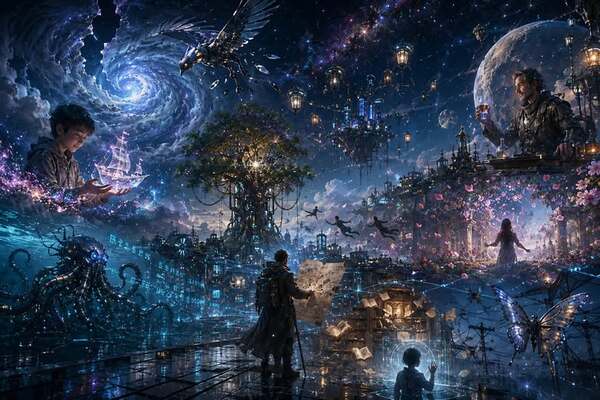
The night sky split open into a narrow fissure.
The Milky Way drifted like liquid water.
Mechanical birds slid down from the clouds.
Within their feathers were hidden quantum codes.
The streetlights of the floating city burned without fire.
They breathed wind and electric currents.
Every single flicker
was the pulse of time.
A child built a boat out of crystal,
sailing among gaseous nebulae.
Stardust fell into the palm of the hand,
transforming into ancient symbols and prophecies.
Trees no longer grew from the soil.
They drew light from mechanical parts.
The wind within their branches
was like a river of flowing information.
Someone brewed wine at the edge of the Moon,
using distilled meteorites and time.
The wine was transparent, yet it reflected the past.
He smiled, with the universe hidden within his eyes.
In the deep sea, a mechanical octopus
wrote poetry with its tentacles.
The words floated in blue electric currents,
waiting for the judgment of the tides.
The city never slept.
Its breathing was made of fans and gears.
People traveled through the air,
their thoughts pasted onto optical fibers.
You once dreamed of
a courtyard without gravity.
Flower petals revolved in the air.
Every single petal remembered our names.
The interstellar traveler said:
“Time is a sheet of paper that can be folded.”
You folded it, and I saw the future.
You tore it apart, and I saw the lost stars.
The craftsman of light stopped working.
The Milky Way grew silent.
He pointed toward an asteroid.
Only then did the night truly begin.
Ancient books floated among the clouds.
Their pages turned by themselves.
The words fell like meteors,
dropping into the lake of dreams.
Mechanical butterflies flew across electric wires.
Every beat of their wings
was a forgotten melody,
merging into the starlight and becoming a trajectory.
Your shadow was reassembled within the light.
It could converse with the future.
Chen Qingyang’s Commentary
“Dream Drift” is a modern poem that fuses science fiction, surrealism, and philosophical reflection. The poem unfolds through dreamlike montage imagery, depicting a future world where technological civilization and cosmic consciousness merge into one. It is filled with science-fiction images such as “mechanical birds,” “quantum codes,” “floating cities,” “mechanical octopuses,” “optical fibers,” and “interstellar travelers,” while simultaneously incorporating cosmic imagery including the “Milky Way,” “stardust,” the “Moon,” “asteroids,” and “starlight.” Together, these elements create an immense and mysterious vision of the future. Through a succession of drifting scenes, the poet portrays humanity’s continuing search for memory, emotion, and the meaning of existence, even after technology has reached extraordinary heights of development. From “Time is a sheet of paper that can be folded” to “Your shadow was reassembled within the light,” the poem not only suggests the reconstruction of time and memory, but also symbolizes humanity’s search for the self and its spiritual wandering amid the vast current of the universe. The entire poem resembles a spiritual journey through the Milky Way and the realm of dreams, permeating cold technological imagery with profound poetic beauty and philosophical contemplation.
Although this poem adopts a nonlinear narrative, it still possesses an underlying narrative axis. The opening line, “The night sky split open into a narrow fissure,” establishes the initiating event of the story, symbolizing the tearing apart of the real world and marking the reader’s formal entry into a state of dream and cosmic drifting. Thereafter, numerous extraordinary scenes appear in succession, such as “Mechanical birds slid down from the clouds,” “A child built a boat out of crystal,” and “Someone brewed wine at the edge of the Moon,” forming a fragmented narrative of drifting episodes. While these scenes appear to lack causal relationships with one another, they are in fact connected by the implicit theme of “spiritual exploration within technological civilization.” The poem’s conflict is not a conventional conflict between characters, but rather the profound contradiction between “technological rationality” and “emotional memory.” For example, “their thoughts pasted onto optical fibers” suggests the digitization of human consciousness, while “Every single petal remembered our names” demonstrates the enduring resilience of emotional memory. The true turning point arrives when “The interstellar traveler said: ‘Time is a sheet of paper that can be folded.’” At this moment, the poem shifts from descriptive imagery to a philosophical dimension, where time is no longer a fixed, flowing entity but something that can be manipulated and torn apart. Finally, “Your shadow was reassembled within the light / It could converse with the future” creates an open-ended conclusion filled with suspense: Can the future truly repair what has been lost? Will humanity rediscover its soul within technological civilization? The poet deliberately offers no explicit answer, leaving these questions for readers to contemplate.
In terms of formal design, the poem employs a large number of short, broken lines, creating an exceptionally fluid visual rhythm that resembles continuously shifting fragments of a dream. The opening section establishes a surreal cosmic landscape through “the night sky splitting open,” “the drifting Milky Way,” and “mechanical birds sliding downward,” employing symbolism, personification, and synesthesia. “The Milky Way drifted like liquid water” transforms the visual image of the cosmos into a liquid form, while “The streetlights… breathed wind and electric currents” grants lifelike organic qualities to inanimate objects. The second section, featuring “A child built a boat out of crystal,” “Trees drew light from mechanical parts,” and “Someone brewed wine at the edge of the Moon,” utilizes bold hyperbole and transferred sensation, merging technology and nature into an entirely new poetic space. The third section, “In the deep sea, a mechanical octopus / wrote poetry with its tentacles,” possesses a distinctly surreal and postmodern collage aesthetic, combining biology, machinery, and literature into a heterogeneous unity. Beginning with the fourth section, the poet introduces the second-person perspective through “You once dreamed,” drawing readers directly into the poem’s internal world and shifting the narrative point of view. “Time is a sheet of paper that can be folded” serves as the poem’s central metaphor, using the tangible image of paper to represent the abstract concept of time, thereby combining philosophical depth with vivid imagery. The concluding images, “Mechanical butterflies flew across electric wires” and “Your shadow was reassembled within the light,” bring the poem to a close through symbolism and cinematic montage, thoroughly dissolving the boundary between reality and dreams. Throughout the work, the poet extensively employs surrealism, symbolism, synesthesia, personification, hyperbole, transferred sensation, and cinematic montage techniques, creating a fluid and magnificent poetics of the future.
The greatest aesthetic achievement of “Dream Drift” lies in the futuristic atmosphere created through its integration of “technological aesthetics,” “surrealist aesthetics,” and “cosmic poetics.” Mechanical devices, optical fibers, quantum phenomena, and electric currents appear repeatedly throughout the poem, yet these technological elements never become cold or detached. Instead, through dreamlike transformation, technology acquires emotion and soul. For example, “The wine was transparent, yet it reflected the past,” and “Every beat of their wings / was a forgotten melody,” both allow the technological world to become deeply lyrical. Furthermore, the poem’s cosmic imagery embodies the qualities of the sublime. The Milky Way, stardust, asteroids, and interstellar travel make individual existence appear both insignificant and profoundly romantic, generating a vast spatial awareness that produces spiritual awe. At the same time, the poem possesses an intensely fluid musicality and visuality. Its short lines resemble rapidly changing cinematic shots, making the reading experience feel like watching a film of consciousness drifting through the universe. Its aesthetic power does not lie in a single narrative plot, but in the hazy philosophical reflections and emotional reverberations generated by the collision of its images, demonstrating the artistic charm of postmodern poetry that unites science fiction, lyricism, and philosophy.