 Moby Dick
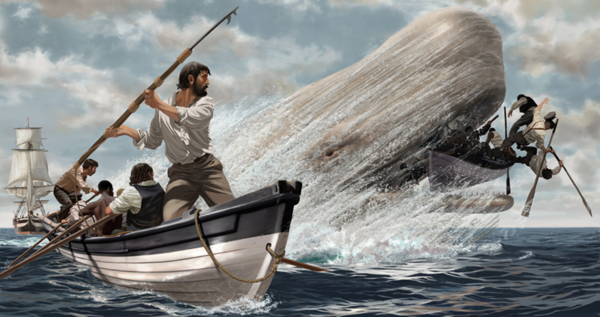
Why read Moby-Dick?
We can see it variously as an allegory of man’s struggle against malignant nature, a parable of the mystery of cosmic evil, a fictionalized autobiography of personal disillusionment ending in a death-wish, a symbolical drama of the struggle within man’s dual-ego.
https://www.youtube.com/watch?v=o00uPegCELo
The summary of video
Lincoln’s Leadership, friendship of Nathaniel Hawthorne and Herman Melville, the Gospel of the century, the Classic of mystery of skepticism and Hope
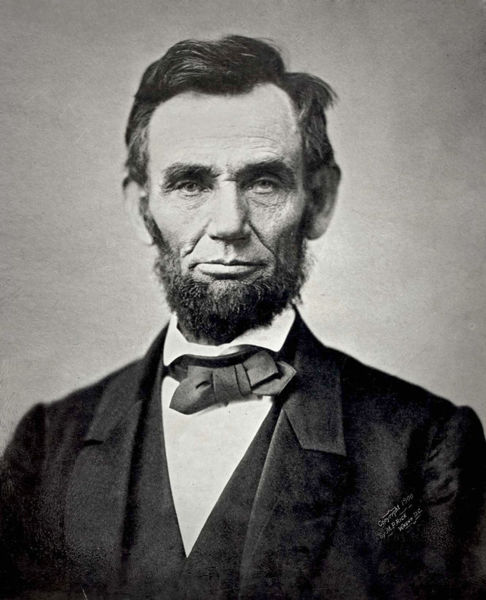
Abraham Lincoln (February 12, 1809 – April 15, 1865) was the 16th president of the United States, serving from March 1861 until his assassination in April 1865. Lincoln led the United States through its Civil War—its bloodiest war and its greatest moral, constitutional and political crisis. In doing so, he preserved the Union, abolished slavery, strengthened the federal government, and modernized the economy.
Herman Melville (1819-1891)
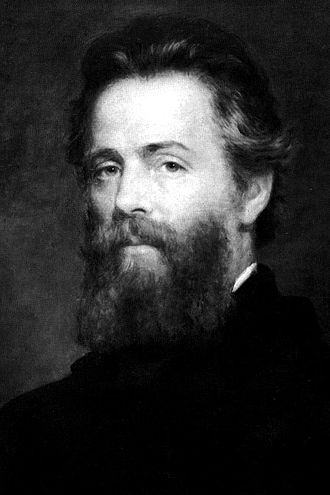
Epical, comprehensive, many-leveled, Moby Dick is unique American contribution to world fiction. Only thirty-two when it was published, Melville had poured into it all of the stuff of an adventurous life, a questing soul, and a singular genius.
Young Goodman Brown (political allegory)
"Young Goodman Brown" is a short story published in 1835 by American writer Nathaniel Hawthorne. The story takes place in 17th century Puritan New England, a common setting for Hawthorne's works, and addresses the Calvinist/Puritan belief that all of humanity exists in a state of depravity, except those who are born in a state of grace.
"Young Goodman Brown" is often characterized as an allegory about the recognition of evil and depravity as the nature of humanity. Much of Hawthorne's fiction, such as The Scarlet Letter, is set in 17th-century colonial America, particularly Salem, Massachusetts. In order to convey the setting, he used literary techniques such as specific diction, or colloquial expressions. In "Young Goodman Brown" language of the period is used to enhance the setting. Hawthorne gives the characters, specific names that depict abstract pure and wholesome beliefs, such as Young Goodman Brown, and Faith. The characters names' ultimately serve as a paradox in the conclusion of the story. The inclusion of this technique was to provide a definite contrast and irony. Hawthorne aims to critique the ideals of Puritan society and express his disdain for it, thus illustrating the difference between the appearance of those in society and their true identities.
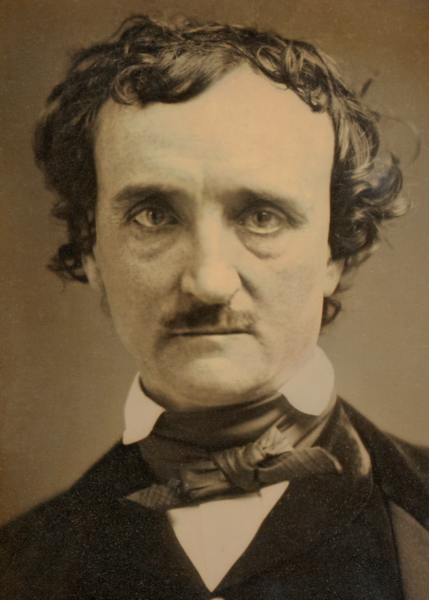
Edgar Allan Poe (January 19, 1809 – October 7, 1849) was an American author, poet, editor, and literary critic, considered part of the American Romantic Movement. Best known for his tales of mystery and the macabre, Poe was one of the earliest American practitioners of the short story, and is generally considered the inventor of the detective fiction genre. He is further credited with contributing to the emerging genre of science fiction. He was the first well-known American writer to try to earn a living through writing alone, resulting in a financially difficult life and career.
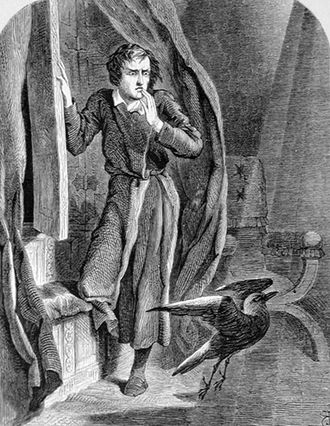
"The Raven" is a narrative poem by American writer Edgar Allan Poe. First published in January 1845, the poem is often noted for its musicality, stylized language, and supernatural atmosphere. It tells of a talking raven's mysterious visit to a distraught lover, tracing the man's slow fall into madness. The lover, often identified as being a student, is lamenting the loss of his love, Lenore. Sitting on a bust of Pallas, the raven seems to further instigate his distress with its constant repetition of the word "Nevermore". The poem makes use of a number of folk and classical references.
To Helen (青春永不回來)
"To Helen" is the first of two poems to carry that name written by Edgar Allan Poe.
Helen, thy beauty is to me
Like those Nicean barks of yore
That gently, o'er a perfumed sea,
The weary, way-worn wanderer bore
To his own native shore.
On desperate seas long wont to roam,
Thy hyacinth hair, thy classic face,
Thy Naiad airs have brought me home
To the glory that was Greece,
And the grandeur that was Rome.
Lo, in yon brilliant window-niche
How statue-like I see thee stand,
The agate lamp within thy hand,
Ah! Psyche, from the regions which
Are Holy Land!
Essay:
Poe developed three distinct kinds of narrative: tale of honor which frequently makes use of psychological abnormalities, prose-poems which are lavish with tone color and symbolism and tales of ratiocination and detection. The first of these are the most striking, stories like The Pit and the Pendulum, The Tell-Tale Heart, and The Black Cat. Good examples of the second type are Eleanora, The Masque of the Red Death, and Shadow. The last-that is, those which depend on analytic and constructive skill-include famous stories like The Gold Bug, The Murders in the Rue Morgue, The Purloined Letter, and The Mystery of Marie Roget.
限會員,要發表迴響,請先登入


