 畢業公演: Leadership and cooperation
耶誕舞會: 大三拉警報!!!穿漂亮一點,不惜踩過學妹屍體。
Walt Whitman (1819-1892) Romantic Period
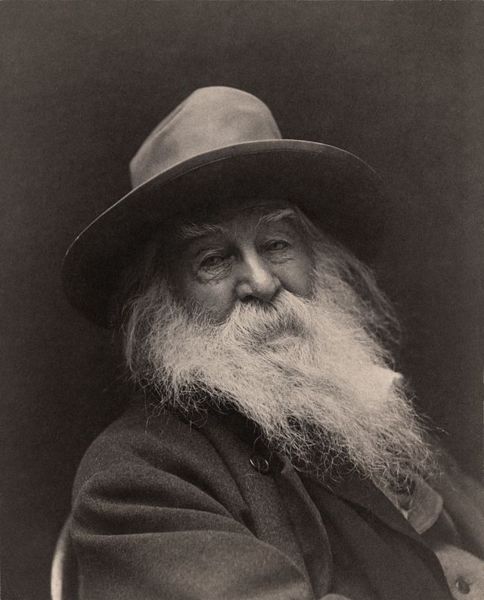
Walter "Walt" Whitman was an American poet, essayist and journalist. A humanist, he was a part of the transition between transcendentalism and realism, incorporating both views in his works. Whitman is among the most influential poets in the American canon, often called the father of free verse. His work was very controversial in its time, particularly his poetry collection Leaves of Grass, which was described as obscene for its overt sexuality.
He looked at nature with a mystical love: the stiff and drooping leaves, the brown ants, the mossy scabs on fences, the grass- “produced babe of the vegetation” and “beautiful uncut hair of graves.”
Later on he made a vast frontal attack on books in an attempt to arrive at the meaning of life: it was Emerson, he tells us, who“brought him to a boil.” From that time on, he sang America with the passionate fervor of a Yankee mystic.
Come, I will make the continent indissoluble,
I will make the most splendid race the sun ever yet shone upon;
I will make divine magnetic lands,
With the love of comrades,
With the life-long love of comrades.
I will plant companionship thick as trees along all the rivers of America, and
along the shores of the great lakes, and all over the prairies,
I will make inseparable cities with their arms about each other's necks,
By the love of comrades,
By the manly love of comrades.
For you these, from me, O Democracy, to serve you, ma femme!
For you! for you, I am trilling these songs,
In the love of comrades,
In the high-towering love of comrades.
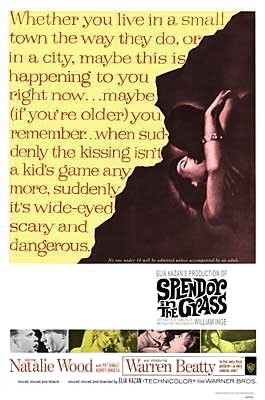
Splendor in the Grass is a 1961 Technicolor romantic drama film that tells a story of sexual repression, love, and heartbreak, from which the character Deanie suffers. Written by William Inge, who appears briefly as a Protestant clergyman and won an Oscar for his screenplay, the film was directed by Elia Kazan.
一對情侶在高中時在一起卻被家長拆散。
1928 Kansas: Wilma Dean "Deanie" Loomis (Natalie Wood) is a teenage girl who follows her mother's advice to resist her desire for sex with her boyfriend, Bud Stamper (Warren Beatty), the son of one of the most prosperous families in town. In turn, Bud reluctantly follows the advice of his father, Ace (Pat Hingle), who suggests that he find another kind of girl with whom to satisfy his desires.
最後還是有警世教化的意謂。
In the final sequence of scenes, Deanie returns home from the asylum after two years and six months, "almost to the day". Her friends drive Deanie out to meet Bud. He is now married to Angelina, and they have an infant son, "Bud Jr.", and Angelina is expecting another. Deanie lets Bud know that she is going to marry Glenn, who is now a doctor in Cincinnati. During their brief reunion, Deanie and Bud realize that both must accept what life has thrown at them, as Bud says, "What's the point? You gotta take what comes". Each says, or implies, "I don't think about happiness very much anymore."
As Deanie leaves with her friends, the scene focuses on Bud and Angelina. While Bud only seems partially satisfied by the direction his life has taken, he takes the moment to reassure Angelina, who he notices has realized that Deanie was once the love of Bud's life. Back in the car with her friends, they ask her if she is still in love with Bud. She realizes that she still loves him warmly, but that they can never recover that blazing love of youth which they once had. She does not answer her friends, but in a voice-over, Deanie recites four verses from Wordsworth's poem, from which the title of the film is taken:
'"Though nothing can bring back the hour of splendor in the grass, glory in the flower, we will grieve not; rather find strength in what remains behind." (逝者以往,來者可追。)
“Out of the cradle endlessly rocking,” and that magnificent elegy on the death of Lincoln. 追憶林肯
O Captain! My Captain! 改革的船長怎麼可以死
O Captain! my Captain! our fearful trip is done,
The ship has weather’d every rack, the prize we sought is won,
The port is near, the bells I hear, the people all exulting,
While follow eyes the steady keel, the vessel grim and daring;
But O heart! heart! heart!
O the bleeding drops of red,
Where on the deck my Captain lies,
Fallen cold and dead.
O Captain! my Captain! rise up and hear the bells;
Rise up—for you the flag is flung—for you the bugle trills,
For you bouquets and ribbon’d wreaths—for you the shores a-crowding,
For you they call, the swaying mass, their eager faces turning;
Here Captain! dear father!
This arm beneath your head!
It is some dream that on the deck,
You’ve fallen cold and dead.
My Captain does not answer, his lips are pale and still,
My father does not feel my arm, he has no pulse nor will,
The ship is anchor’d safe and sound, its voyage closed and done,
From fearful trip the victor ship comes in with object won;
Exult O shores, and ring O bells!
But I with mournful(輓歌) tread,
Walk the deck my Captain lies,
Fallen cold and dead.
Dead Poets Society 春風化雨 (在僵化的體制裡改革)
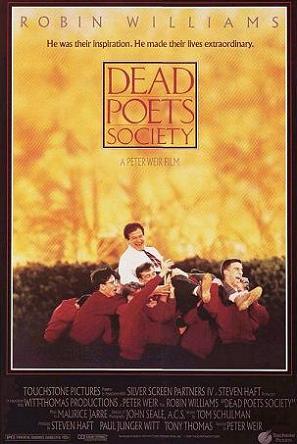
Dead Poets Society is a 1989 American drama film written by Tom Schulman, directed by Peter Weir and starring Robin Williams. Set at the conservative and aristocratic Welton Academy in the northeast United States in 1959, it tells the story of an English teacher who inspires his students through his teaching of poetry.
In English literature, an elegy is a mournful, melancholic or plaintive poem, especially a funeral song or a lament for the dead.
Funeral Blues
by W. H. Auden (1907-1973)
Stop all the clocks, cut off the telephone,
Prevent the dog from barking with the juicy bone.
Silence the pianos and, with muffled drum,
Bring out the coffin. Let the mourners come.
Let aeroplanes circle moaning overhead
Scribbling in the sky the message: “He is dead!”
Put crepe bows around the white necks of the public doves.
Let the traffic policemen wear black cotton gloves.
(戲謔的感覺)
He was my north, my south, my east and west,
My working week and Sunday rest,
My noon, my midnight, my talk, my song.
I thought that love would last forever; I was wrong.
(愛的人永遠會在)
The stars are not wanted now; put out every one.
Pack up the moon and dismantle the sun.
Pour away the ocean and sweep up the wood.
For nothing now can come to any good.
From memories of president Lincoln
When Lilacs (紫丁花) Last in the Dooryard Bloom’d (幽香暗影)
1
When lilacs last in the dooryard bloom’d,
And the great star early droop’d in the western sky in the night,
I mourn’d, and yet shall mourn with ever-returning spring.
Ever-returning spring, trinity sure to me you bring,
Lilac blooming perennial and drooping star in the west,
And thought of him I love.
2
O powerful western fallen star!
O shades of night—O moody, tearful night!
O great star disappear’d—O the black murk that hides the star!
O cruel hands that hold me powerless—O helpless soul of me!
O harsh surrounding cloud that will not free my soul.
(押頭韻)
T.S. Eliot (1888–1965). The Waste Land. 1922.
|
THE BURIAL OF THE DEAD
|
|
|
Lilacs out of the dead land, mixing |
|
|
Memory and desire, stirring |
|
|
Dull roots with spring rain. |
蘇軾的江城子有異曲同工之妙
十年生死兩茫茫。
不思量,自難忘。
千里孤墳,無處話淒涼。
縱使相逢應不識,
塵滿面,鬢如霜。
夜來幽夢忽還鄉,
小軒窗,正梳妝。
相顧無言,惟有淚千行。
料得年年腸斷處:
明月夜,短松岡。
Free verse is an open form (see Poetry analysis) of poetry. It does not use consistent meter patterns, rhyme, or any other musical pattern. It thus tends to follow the rhythm of natural speech.
Although free verse requires no meter, rhyme, or other traditional poetic techniques, a poet can still use them to create some sense of structure. A clear example of this can be found in Walt Whitman's poems, where he repeats certain phrases and uses commas to create both a rhythm and structure. Much pattern and discipline is to be found in free verse: the internal pattern of sounds, the choice of exact words, and the effect of associations give free verse its beauty. With the Imagists free verse became a discipline and acquired status as a legitimate poetic form.
Imagism(象徵主義)
Imagism was a movement in early 20th-century Anglo-American poetry that favored precision of imagery and clear, sharp language. It has been described as the most influential movement in English poetry since the activity of the Pre-Raphaelites. As a poetic style it gave Modernism its start in the early 20th century, and is considered to be the first organized Modernist literary movement in the English language. Imagism is sometimes viewed as 'a succession of creative moments' rather than any continuous or sustained period of development. René Taupin remarked that 'It is more accurate to consider Imagism not as a doctrine, nor even as a poetic school, but as the association of a few poets who were for a certain time in agreement on a small number of important principles'.
Blank verse is poetry written in regular metrical but unrhymed lines, almost always iambic pentameters. It has been described as "probably the most common and influential form that English poetry has taken since the 16th century" and Paul Fussell has estimated that "about three-quarters of all English poetry is in blank verse."
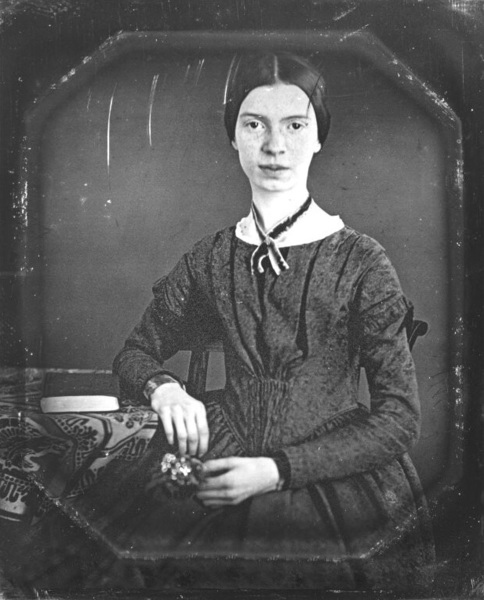
Emily Elizabeth Dickinson (December 10, 1830 – May 15, 1886) was an American poet. Born in Amherst, Massachusetts, to a successful family with strong community ties, she lived a mostly introverted and reclusive life. After she studied at the Amherst Academy for seven years in her youth, she spent a short time at Mount Holyoke Female Seminary before returning to her family's house in Amherst. Considered an eccentric by the locals, she became known for her penchant for white clothing and her reluctance to greet guests or, later in life, even leave her room. Most of her friendships were therefore carried out by correspondence.
A narrow fellow in the grass (1096) 對初夜的恐懼還有Phallic symbolic
A narrow fellow in the grass
Occasionally rides;
You may have met him—did you not
His notice sudden is,
The grass divides as with a comb,
A spotted shaft is seen,
And then it closes at your feet,
And opens further on.
Because I could not stop for Death – (479)
Because I could not stop for Death –
He kindly stopped for me –
The Carriage held but just Ourselves –
And Immortality.
We slowly drove – He knew no haste
And I had put away
My labor and my leisure too,
For His Civility –
We passed the School, where Children strove
At Recess – in the Ring –
We passed the Fields of Gazing Grain –
We passed the Setting Sun –
人生三態
Or rather – He passed Us –
The Dews drew quivering and Chill –
For only Gossamer, my Gown –
My Tippet – only Tulle –
We paused before a House that seemed
A Swelling of the Ground –
The Roof was scarcely visible –
The Cornice – in the Ground –
Since then – 'tis Centuries – and yet
Feels shorter than the Day
I first surmised the Horses' Heads
Were toward Eternity –
限會員,要發表迴響,請先登入


