Herman Melville
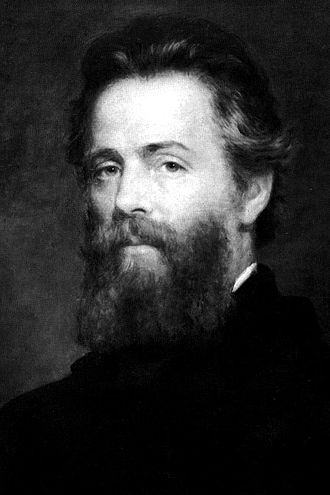
Herman Melville (August 1, 1819 – September 28, 1891) was an American novelist, writer of short stories, and poet from the American Renaissance period. The bulk of his writings were published between 1846 and 1857. Best known for his whaling novel Moby-Dick (1851), he is also legendary for having been forgotten during the last thirty years of his life. Melville's writing is characteristic for its allusivity. "In Melville's manipulation of his reading", scholar Stanley T. Williams wrote, "was a transforming power comparable to Shakespeare's".
Moby-Dick
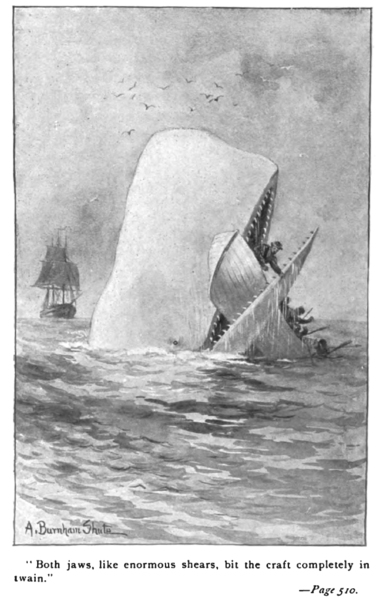
Moby-Dick; or, The Whale (1851) is a novel by Herman Melville, in which Ishmael narrates the monomaniacal quest of Ahab, captain of the whaler Pequod, for revenge on the albino sperm whale Moby Dick, which on a previous voyage destroyed Ahab's ship and severed his leg at the knee. Although the novel was a commercial failure and out of print at the time of the author's death in 1891, its reputation grew immensely during the twentieth century. D. H. Lawrence called it "one of the strangest and most wonderful books in the world," and "the greatest book of the sea ever written." Moby-Dick is considered a Great American Novel and an outstanding work of the Romantic period in America and the American Renaissance. "Call me Ishmael" is one of world literature's most famous opening sentences.
討論期中考
Term explanation
In American literature, the American Renaissance was a period during which many of the literary works most widely considered American masterpieces were produced. The period is generally defined as the mid-19th century but especially the years roughly from 1850 to 1855. Major works from those years include Ralph Waldo Emerson's Representative Men (1850), Nathaniel Hawthorne's The Scarlet Letter (1850) and The House of the Seven Gables (1851).
2. Transcendentalism (p. 169)
Transcendentalism is a religious and philosophical movement that was developed during the late 1820s and '30s. Among the transcendentalists' core beliefs was the inherent goodness of both people and nature. For example, Emerson made several: that Christianity is false; that thought is an activity and manifestation of the Over-Soul within man; and that, therefore, man must rely on himself, for in doing so he is trusting in God.
The American Dream is a national ethos of the United States, a set of ideals in which freedom includes the opportunity for prosperity and success, and an upward social mobility achieved through hard work. The idea of the American Dream is rooted in the United States Declaration of Independence which proclaims that "all men are created equal" and that they are "endowed by their Creator with certain inalienable Rights" including "Life, Liberty and the pursuit of Happiness."
In the 19th century, Manifest Destiny was the widely held belief in the United States that American settlers were destined to expand throughout the continent. Historians have for the most part agreed that there are three basic themes to Manifest Destiny: first, the special virtues of the American people and their institutions; second, America's mission to redeem and remake the west in the image of agrarian America and the last an irresistible destiny to accomplish this essential duty.
5. “Inferiority Complex” (in American Literature, p. 167)
An inferiority complex is a lack of self-worth, a doubt and uncertainty, and feelings of not measuring up to standards. It is often subconscious, and is thought to drive afflicted individuals to overcompensate, resulting either in spectacular achievement or extreme asocial behavior. In American Literature, it means that only a very youthful colonial nation, unsure in its youth, could have been so aggressively self-assertive, so proud of its lack of culture, so vocally confident in its future, and so fearful of European evils, particularly what was thought to be European effeminacy. The dominant strain right through the literature of these years is Romantic.
Essay
1. American romanticism begins with Rip Van Winkle. How does a short story that is based on borrowed ideas come to be one of the most widely read and loved pieces of American literature?
By using memorable characters to convey a message of freedom and identity to a nation that was just starting to discover both. In Rip Van Winkle, Washington Irving uses the characters to show his ideals as a romantic, and to represent the new found independence of a budding country. Irving wrote this story in 1820, a time when in a literary sense, America was still considered a replica of Britain. Romantic literature in America was just starting to grow and people were striving for more Romantic writing. This want as well as a new identity for the American people were granted when Irving wrote Rip Van Winkle, a story about a man who slept through the Revolutionary War. Just like many other great works such as The Great Gatsby, a novel in which F. Scott Fitzgerald used his characters to show the corruption of the American Dream, Irving used his characters to show his ideals as a romantic. The main character in this story, Rip Van Winkle, was himself an embodiment of the notion of Romantic freedom.
2. Thoreau makes it very clear at the opening of Walden that his stay in the wilderness was not a lifestyle choice but rather a temporary experiment, and that “At present I am a sojourner in civilized life again.” Does the short duration of Thoreau’s stay at Walden undercut the importance of his project?
In fact, Thoreau insists on telling us that his Walden project is not a life decision or a commitment to a set of ideals, but an experiment in alternative living that is unambiguously amateurish. It is more like casual play than like solemn ideology. This informality explains why, when he leaves Walden Pond in 1847, Thoreau does not admit failure; rather, he says simply that he has other lives to live. Thoreau was more of an Emersonian transcendentalist than he was a socialist: the soul mattered more to him than sociology. He was not as interested in being a model farmer as in showing how the soul could benefit from a change of scenery and occupation. Having learned the lessons that Walden Pond had to offer him, he turned to other scenes and other occupations, thus proving rather than undercutting his philosophy of life.
3. Discuss the themes we constantly find in Nathaniel Hawthorne’s works. (p. 170)
The themes of Nathaniel Hawthorne’s works are the relation between evils and good, the embrace between life in death and death in life, inherited guilt and traditional curses, the ravages of moral decay and the impermanence of beauty in a dark and alien world. For example, The Scarlet Letter carries the clear author’s inner quarrel: that the sympathetic belief of Hester Prynne, that the rebel against Purtain Sex-inhibitions, but its real impact is what suggests of guilt and moral corrosion. Another works Rappaccini’s Daughter contains references to Dante's Divine Comedy, the Garden of Eden, and Milton's Paradise Lost as it juxtaposes the scientific aspects of research (Professor Rappaccini and Professor Baglioni) with spirituality (Giovanni and Beatrice) and explores original sin. In conclusion, Hawthorne often dealt with the themes of morality, sin and redemption.
限會員,要發表迴響,請先登入


