
Unemployment (or joblessness) occurs when people are without work and actively seeking work. The unemployment rate is a measure of the prevalence of unemployment and it is calculated as a percentage by dividing the number of unemployed individuals by all individuals currently in the labor force.
 先求有,在求好。上大學已經成為必備,讀書為了求更寬廣的視野。
Edgar Allan Poe (1809-1849)
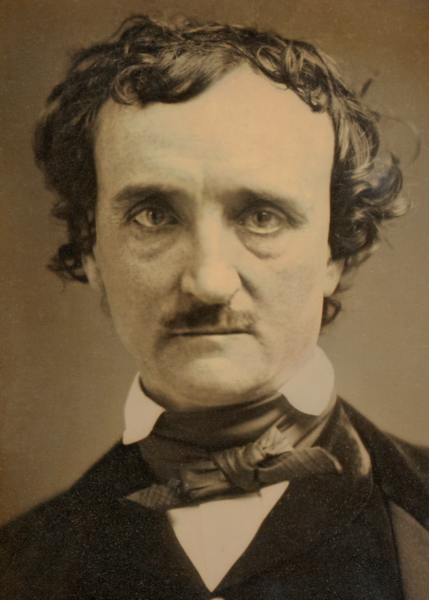
Brilliant genius in a narrow field, Poe is one of the best-known American critics, poets, and short-story writers of nineteenth century. His criticism and artistic practice are intertwined. As a keenly analytical critic, he reasoned that the end of art is beauty (ideal and supernal), nor truth. A poem, therefore, should neither moralize nor instruct. To be successful, it should be short, rhythmically creative of mood, and preferably melancholic. A short story, too, should be unified and brief enough to be read at one setting: if it catches an emotion as a flood it has done all that need be done.
Poe developed three distinct kinds of narrative: (1) tales of horror which frequently make use of psychological abnormalities, (2) prose-poems which are lavish with tone color and symbolism, (3) tales of ratiocination and detection.
…
And the Raven, never flitting, still is sitting, still is sitting
On the pallid bust of Pallas just above my chamber door;
And his eyes have all the seeming of a demon (迷濛)’s that is dreaming,
And the lamp-light o’er him streaming throws his shadow on the floor;
And my soul from out that shadow that lies floating on the floor
Shall be lifted—nevermore!
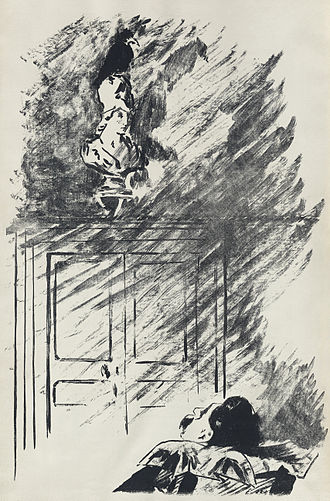
The bird again replies in the negative, suggesting that he can never be free of his memories. The narrator becomes angry, calling the raven a "thing of evil" and a "prophet". Finally, he asks the raven whether he will be reunited with Lenore in Heaven. When the raven responds with its typical "Nevermore", he is enraged, and, calling it a liar, commands the bird to return to the "Plutonian shore",—but it does not move. Presumably at the time of the poem's recitation by the narrator, the raven "still is sitting" on the bust of Pallas. The narrator's final admission is that his soul is trapped beneath the raven's shadow and shall be lifted "Nevermore".
Prophet 不死鳥
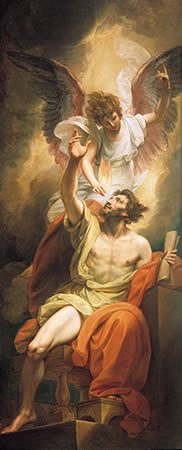
In religion, a prophet is an individual who is claimed to have been contacted by the supernatural or the divine, and to speak for them, serving as an intermediary with humanity, delivering this newfound knowledge from the supernatural entity to other people. The message that the prophet conveys is called a prophecy.
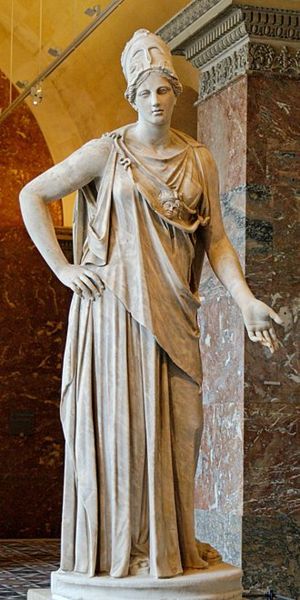
Athena or Athene, often given the epithet Pallas, was the goddess of wisdom, courage, inspiration, civilization, law and justice, strategic warfare, mathematics, strength, strategy, the arts, crafts, and skill in ancient Greek religion and mythology. Minerva is the Roman goddess identified with Athena.
Ode to the West Wind by Percy Bysshe Shelley
…
69 The trumpet of a prophecy! O Wind,
70 If Winter comes, can Spring be far behind? 孤獨感
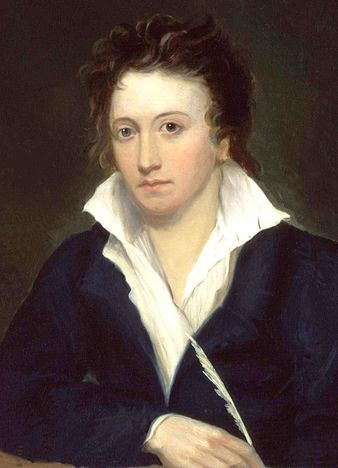
The "trumpet of prophecy" is a critical component of Shelley's closing in "Ode to the West Wind." He seeks to link the natural phenomena of storms and the natural changing of the seasons to his own hopes of achieving poetic immortality from obscurity. Essentially, through a natural experience, Shelley seeks to link it to his own evolution as both thinker and artist.
BY EDGAR ALLAN POE
…
And this was the reason that, long ago,
In this kingdom by the sea,
A wind blew out of a cloud, chilling
My beautiful Annabel Lee;
So that her highborn kinsmen came (metaphor 死神把她帶走)
And bore her away from me,
To shut her up in a sepulchre
In this kingdom by the sea.
…
"Annabel Lee" is the last complete poem composed by American author Edgar Allan Poe. Like many of Poe's poems, it explores the theme of the death of a beautiful woman. The narrator, who fell in love with Annabel Lee when they were young, has a love for her so strong that even angels are envious. He retains his love for her even after her death.
Poetic structure
"Annabel Lee" consists of six stanzas, three with six lines, one with seven, and two with eight, with the rhyme pattern differing slightly in each one. Though it is not technically a ballad, Poe referred to it as one. Like a ballad, the poem uses repetition of words and phrases purposely to create its mournful effect.
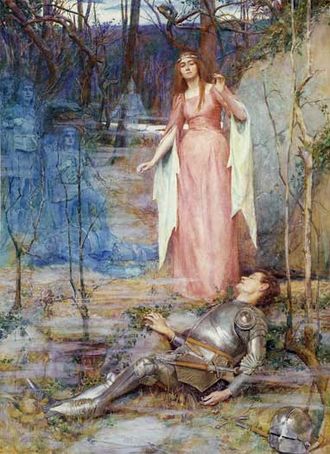
La Belle Dame sans Merci is a ballad written by the English poet John Keats.
A ballad is a form of verse, often a narrative set to music. Ballads derive from the medieval French chanson balladée or ballade, which were originally "dancing songs". Ballads were particularly characteristic of the popular poetry and song of the British Isles from the later medieval period until the 19th century and used extensively across Europe and later the Americas, Australia and North Africa. Many ballads were written and sold as single sheet broadsides. The form was often used by poets and composers from the 18th century onwards to produce lyrical ballads. In the later 19th century the term took on the meaning of a slow form of popular love song and is now often used for any love song, particularly the pop or rock power ballad.
Helen, thy beauty is to me
Like those Nicean barks of yore
That gently, o'er a perfumed sea,
The weary, way-worn wanderer bore
To his own native shore.
On desperate seas long wont to roam,
Thy hyacinth hair, thy classic face,
Thy Naiad airs have brought me home
To the glory that was Greece,
And the grandeur that was Rome.
Lo, in yon brilliant window-niche
How statue-like I see thee stand,
The agate lamp within thy hand,
Ah! Psyche, from the regions which
Are Holy Land!
Analysis
In "To Helen," Poe is celebrating the nurturing power of woman. Poe was inspired in part by Samuel Taylor Coleridge, particularly in the second line ("Like those Nicean barks of yore") which resembles a line in Coleridge's "Youth and Age" ("Like those trim skiffs, unknown of yore").
Poe revised the poem in 1845, making several improvements, most notably changing "the beauty of fair Greece, and the grandeur of old Rome" to "the glory that was Greece and the grandeur that was Rome." Poe scholar Jeffrey Meyers referred to these as "two of Poe's finest and most famous lines".
Allusions
Poe, in referring to Helen, may be alluding to the Greek goddess of light or Helen of Troy who is considered to be the most beautiful woman who ever lived, though there is not enough information given to determine for certain. He also makes a reference to Psyche, a beautiful princess who became the lover of Cupid. The "agate lamp" refers to the time when Psyche discovered the true identity of Cupid.
限會員,要發表迴響,請先登入


