P445-455
 American Literature (1820-1865)
Ironically, Americans break their dependency on the “courtly muses of Europe.”
很像台灣: 海外華文or 台灣文學???
Antebellum writing (戰前文學)
Emerson’s New England based reformism-the conviction that American literature and culture were not living up to their Revolutionary or democratic promises.
P505-508
Ralph Waldo Emerson
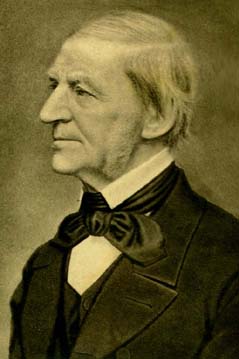
Ralph Waldo Emerson is arguably the most influential American writer of the nineteenth century-the writer with whom numerous other significant writers of the time sought to come to terms. Without Emerson’s inspirational essays on nonconformity, self-reliance, and anti-institutionalism, Henry David Thoreau’s careers may have followed different paths. There, Emerson completed his first book, Nature, which was published anonymously and at Emerson’s own expense in 1836.
Nature
“Nature is but an image or imitation of wisdom, the last thing of the soul; nature being a thing which doth only do, but not know.”
The chapters on the essay are Nature, Commodity, Language, Discipline, Idealism, Spirit and Prospects.
Chapter I Nature
Solitude才能面對自己的soul
Bliss of solitude 不怕孤單,心中還有悸動。
There I feel that nothing can befall me in life,- no disgrace, no calamity, (leaving me my eyes,) which nature cannot repair.
Chapter IV Language
1. Words are signs of natural facts.
2. Particular natural facts are symbols of particular spiritual facts.
3. Nature is the symbol of spirit.
The America Scholar
Our day of dependence, our long apprenticeship (學徒期) to the learning of other lands, draws to a close.
I. The first in time and the first in importance of the influences upon the mind is that of nature.
II. The next great influence into the spirit of the scholar, is, the mind of Past (Book/ Man thinking).
III. There goes in the world a notion that the scholar should be a recluse, a valetudinarian – practical men.
IV. Patience 學徒期很長,要有耐心,有一天會找到。
P603-606
Nathaniel Hawthorne
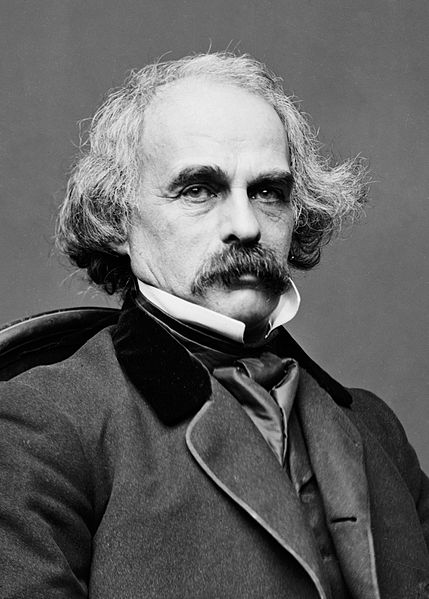
Hawthorne was born on July 4, 1804, in Salem, Massachusetts. His prominent Puritan ancestors on the Hawthorne side of the family were among the first settlers of Massachusetts and included a judge in the Salem witchcraft trials of 1692.
The Scarlet Letter
Set in 17th-century Puritan Boston, Massachusetts during the years 1642 to 1649, it tells the story of Hester Prynne, who conceives a daughter through an affair and struggles to create a new life of repentance and dignity. Throughout the book, Hawthorne explores themes of legalism, sin, and guilt.
"Dr. Heidegger's Experiment" is rooted in a rather pessimistic view of human nature. The story argues that people are, for the most part, fools. They don't learn from their mistakes, they're generally petty, and we can't expect anyone to change for the better. In this story, foolishness is particularly associated with youth, or at least a youthful state of mind. Hawthorne does provide a counter-example to his foolish characters in the form of Dr. Heidegger, but even this character has his sinister side.
Rappaccini's Daughter
It is about Giacomo Rappaccini, a medical researcher in medieval Padua who grows a garden of poisonous plants. He brings up his daughter to tend the plants, and she becomes resistant to the poisons, but in the process she herself becomes poisonous to others. There are four themes.
1. The productive and destructive powers of scientific discovery
2. Evil versus good
3. Voyeurism and adoration
4. The ways in which fantasy and reality work together and against each other to shape one's perceptions
"Rappaccini's Daughter" contains references to Dante's Divine Comedy, the Garden of Eden, and Milton's Paradise Lost as it juxtaposes the scientific aspects of research (Professor Rappaccini and Professor Baglioni) with spirituality (Giovanni and Beatrice) and explores original sin.
The themes of Nathaniel Hawthorne’s work are these.
1. The relation between evils and good
2. The embrace between life in death and death in life
3. Inherited guilt and traditional curses
4. The ravages of moral decay
5. The impermanence of beauty in a dark and alien work
限會員,要發表迴響,請先登入


