2016.11.24
🎃 Western Literature 🎃
🍙 Patronage
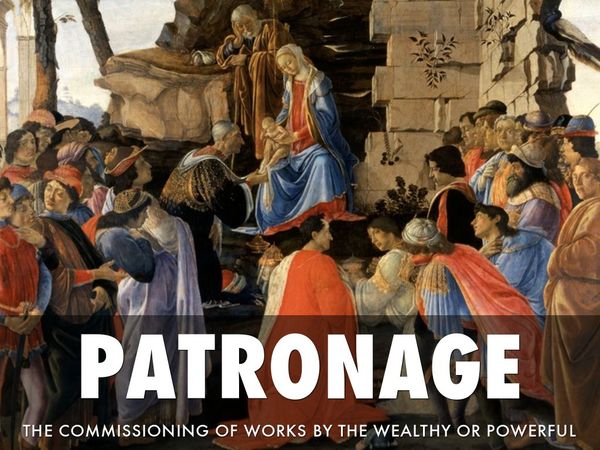
Patronage is the support, encouragement, privilege, or financial aid that an organization or individual bestows to another. In the history of art, arts patronage refers to the support that kings, popes, and the wealthy have provided to artists such as musicians, painters, and sculptors. It can also refer to the right of bestowing offices or church benefices, the business given to a store by a regular customer, and the guardianship of saints.
🍙 King Midas
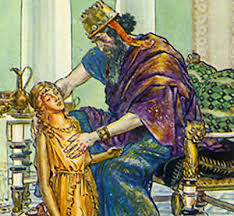
Midas is the name of at least three members of the royal house of Phrygia.The most famous King Midas is popularly remembered in Greek mythology for his ability to turn everything he touched into gold. This came to be called the golden touch, or the Midas touch.The Phrygian city Midaeum was presumably named after this Midas, and this is probably also the Midas that according to Pausanias founded Ancyra. According to Aristotle, legend held that Midas died of starvation as a result of his "vain prayer" for the gold touch. The legends told about this Midas and his father Gordias, credited with founding the Phrygian capital city Gordium and tying the Gordian Knot, indicate that they were believed to have lived sometime in the 2nd millennium BC, well before the Trojan War.
🍙 Orpheus
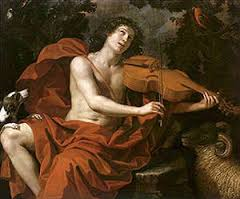
Orpheus was a legendary musician, poet, and prophet in ancient Greek religion and myth. The major stories about him are centered on his ability to charm all living things and even stones with his music, his attempt to retrieve his wife, Eurydice, from the underworld, and his death at the hands of those who could not hear his divine music.Orpheus is one of the most significant figures in the reception of classical mythology in Western culture, portrayed or alluded to in countless forms of art and popular culture including poetry, film, opera, music, and painting.
🍙 Oedipus Rex
Oedipus Rex, also known by its Greek title, Oedipus Tyrannus, or Oedipus the King, is an Athenian tragedy by Sophocles that was first performed around 429 BC.Originally, to the ancient Greeks, the title was simply Oedipus, as it is referred to by Aristotle in the Poetics. It is thought to have been renamed Oedipus Tyrannus to distinguish it from Oedipus at Colonus. In antiquity, the term “tyrant” referred to a ruler, but it did not necessarily have a negative connotation.Prior to the start of Oedipus Rex, Oedipus has become the king of Thebes while unwittingly fulfilling a prophecy that he would kill his father, Laius (the previous king), and marry his mother, Jocasta (whom Oedipus took as his queen after solving the riddle of the Sphinx). The action of Sophocles' play concerns Oedipus' search for the murderer of Laius in order to end a plague ravaging Thebes, unaware that the killer he is looking for is none other than himself. At the end of the play, after the truth finally comes to light, Jocasta hangs herself while Oedipus, horrified at his patricide and incest, proceeds to gouge out his own eyes in despair.
🍙 Sophocles
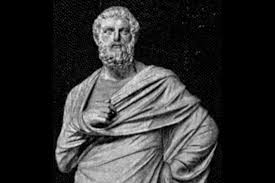
Sophocles is one of three ancient Greek tragedians whose plays have survived. Sophocles wrote 120 plays during the course of his life, but only seven have survived in a complete form: Ajax, Antigone, The Women of Trachis, Oedipus the King, Electra, Philoctetes and Oedipus at Colonus. For almost 50 years, Sophocles was the most celebrated playwright in the dramatic competitions of the city-state of Athens that took place during the religious festivals of the Lenaea and the Dionysia.The most famous tragedies of Sophocles feature Oedipus and also Antigone: they are generally known as the Theban plays, although each play was actually a part of a different tetralogy, the other members of which are now lost. Sophocles influenced the development of the drama, most importantly by adding a third actor, thereby reducing the importance of the chorus in the presentation of the plot. He also developed his characters to a greater extent than earlier playwrights such as Aeschylus.
🍙 Golden Fleece
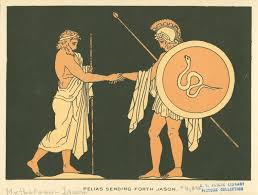
In Greek mythology, the Golden Fleece is the fleece of the gold-hair winged ram, which was held in Colchis. The fleece is a symbol of authority and kingship. It figures in the tale of the hero Jason and his band of Argonauts, who set out on a quest for the fleece by order of King Pelias, in order to place Jason rightfully on the throne of Iolcus in Thessaly. Through the help of Medea, they acquire the Golden Fleece. The story is of great antiquity and was current in the time of Homer (eighth century BC). It survives in various forms, among which the details vary.

🍙 Pelias
Pelias was king of Iolcus in Greek mythology, the son of Tyro and Poseidon. His wife is recorded as either Anaxibia, daughter of Bias, or Phylomache, daughter of Amphion. He was the father of Acastus, Pisidice, Alcestis, Pelopia, Hippothoe, Amphinome, Evadne, Asteropeia, and Antinoe.
🍙 Argonauts
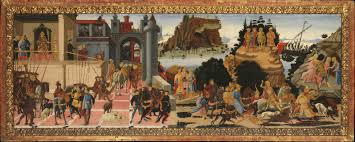
The Argonauts were a band of heroes in Greek mythology, who in the years before the Trojan War, around 1300 BC, accompanied Jason to Colchis in his quest to find the Golden Fleece. Their name comes from their ship, Argo, named after its builder, Argus. "Argonauts" literally means "Argo sailors".
🍙 Solar deity
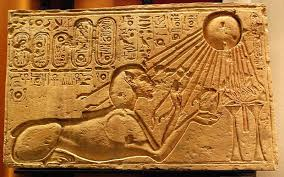
A solar deity is a sky deity who represents the Sun, or an aspect of it, usually by its perceived power and strength. Solar deities and sun worship can be found throughout most of recorded history in various forms. The Sun is sometimes referred to by its Latin name Sol or by its Greek name Helios.
限會員,要發表迴響,請先登入


