★ Genre
Genre is any category of literature, music or other forms of art or entertainment, whether written or spoken, audio or visual, based on some set of stylistic criteria. Genres are formed by conventions that change over time as new genres are invented and the use of old ones are discontinued. Often, works fit into multiple genres by way of borrowing and recombining these conventions.
Genre began as an absolute classification system for ancient Greek literature. Poetry, prose and performance had a specific and calculated style that related to the theme of the story. Speech patterns for comedy would not be appropriate for tragedy, and even actors were restricted to their genre under the assumption that a type of person could tell one type of story best. In later periods genres proliferated and developed in response to changes in audiences and creators. Genre became a dynamic tool to help the public make sense out of unpredictable art. Because art is often a response to a social state, in that people write/paint/sing/dance about what they know about, the use of genre as a tool must be able to adapt to changing meanings. In fact as far back as ancient Greece, new art forms were emerging that called for the evolution of genre, for example the tragicomedy.
★ William Shakespeare

William Shakespeare was an English poet, playwright, and actor, widely regarded as the greatest writer in the English language and the world's pre-eminent dramatist. He is often called England's national poet, and the "Bard of Avon". His extant works, including collaborations, consist of approximately 38 plays, 154 sonnets, two long narrative poems, and a few other verses, some of uncertain authorship. His plays have been translated into every major living language and are performed more often than those of any other playwright.
Shakespeare produced most of his known work between 1589 and 1613. His early plays were primarily comedies and histories, and these are regarded as some of the best work ever produced in these genres. He then wrote mainly tragedies until about 1608, including Hamlet, Othello, King Lear, and Macbeth, considered some of the finest works in the English language. In his last phase, he wrote tragicomedies, also known as romances, and collaborated with other playwrights.
Many of his plays were published in editions of varying quality and accuracy during his lifetime. In 1623, John Heming and Henry Condell, two friends and fellow actors of Shakespeare, published the First Folio, a posthumous collected edition of his dramatic works that included all but two of the plays now recognized as Shakespeare's. It was prefaced with a poem by Ben Jonson, in which Shakespeare is hailed, presciently, as "not of an age, but for all time". In the 20th and 21st centuries, his works have been repeatedly adapted and rediscovered by new movements in scholarship and performance. His plays remain highly popular, and are constantly studied, performed, and reinterpreted in diverse cultural and political contexts throughout the world.
★ Italian Renaissance
The Italian Renaissance was the earliest manifestation of the general European Renaissance, a period of great cultural change and achievement that began in Italy during the 14th century and lasted until the 16th century, marking the transition between Medieval and Early Modern Europe. The term Renaissance is in essence a modern one that came into currency in the 19th century, in the work of historians such as Jules Michelet and Jacob Burckhardt. Although the origins of a movement that was confined largely to the literate culture of intellectual endeavor and patronage can be traced to the earlier part of the 14th century, many aspects of Italian culture and society remained largely medieval; the Renaissance did not come into full swing until the end of the century. The French word renaissance (Rinascimento in Italian) means "Rebirth", and the era is best known for the renewed interest in the culture of classical antiquity after the period that Renaissance humanists labeled the Dark Ages.
★ Augustine of Hippo

Augustine of Hippo, also known as Saint Augustine or Saint Austin, and also sometimes as Blessed Augustine in the Eastern Orthodox Church, was an early Christian theologian and philosopher whose writings influenced the development of Western Christianity and Western philosophy. He was the bishop of Hippo, located in Numidia (Roman province of Africa). He is viewed as one of the most important Church Fathers in Western Christianity for his writings in the Patristic Era. Among his most important works are The City of God and Confessions.
In the summer of 386, at the age of 31, after having heard and been inspired and moved by the story of Ponticianus's and his friends' first reading of the life of Saint Anthony of the Desert, Augustine converted to Christianity. As Augustine later told it, his conversion was prompted by a childlike voice he heard telling him to "take up and read", which he took as a divine command to open the Bible and read the first thing he saw. Augustine read from Paul's Epistle to the Romans – the so-called "Transformation of Believers" section, consisting of chapters 12 through 15 – wherein Paul outlines how the Gospel transforms believers, and the believers' resulting behaviour. The specific part to which Augustine opened his Bible was Romans chapter 13, verses 13 and 14, to wit:
"Not in rioting and drunkenness, not in chambering and wantonness, not in strife and envying,
but put on the Lord Jesus Christ, and make no provision for the flesh to fulfill the lusts thereof. "
He later wrote an account of his conversion – his very transformation, as Paul described – in his Confessions (Latin: Confessiones), which has since become a classic of Christian theology and a key text in the history of autobiography. This work is an outpouring of thanksgiving and penitence. Although it is written as an account of his life, the Confessions also talks about the nature of time, causality, free will, and other important philosophical topics.
➥ conversion (n.)
(1) Change from one state, or from one religion, to another. 變換;(宗教信仰之)改變;皈依。
➥ confession (n.)
(1) The act of acknowledging or admitting.
(2) The act of making known one's sins to a priest. 告解;懺悔。
(3) Profession of belief.
★ Bible
The Bible is a collection of texts sacred in Judaism and Christianity. There is no single canonical "Bible": many Bibles have evolved, with overlapping and diverging contents. Various religious traditions have produced different recensions with different selections of texts. These do largely overlap however, creating a common core. With estimated total sales of over 5 billion copies, the Bible is widely considered to be the best-selling book of all time, has estimated annual sales of 100 million copies, and has been a major influence on literature and history, especially in the West where the Gutenberg Bible was the first mass-printed book. It was the first book ever printed using movable type.
The appropriate term to describe Judaism's scriptures is Tanakh, although the terms Bible and Old Testament are commonly used by non-Jews to describe Judaism's scriptures. While there is just one Jewish Bible, collected together and preserved as the sacred books of the Jewish people, the contents of each of the Christian compilations of canonical texts of the Old Testament vary between different Christian traditions. Jewish scripture was (and is) originally written in Hebrew, the Christian Old and New Testaments were originally written in Koine Greek. The Tanakh has 24 books, the various versions of the Old Testament have more and contain the original 24 books of the Tanakh in a different order.
★ Ovid
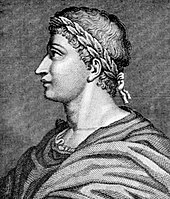
Publius Ovidius Naso; 20 March 43 BC – AD 17/18), known as Ovid in the English-speaking world, was a Roman poet who lived during the reign of Augustus. He was a contemporary of Virgil and Horace. He is best known for the Metamorphoses, a 15-book continuous mythological narrative written in the meter of epic, and for collections of love poetry in elegiac couplets, especially the Amores ("Love Affairs") and Ars Amatoria ("The Art of Love"). His poetry was much imitated during Late Antiquity and the Middle Ages, and greatly influenced Western art and literature. The Metamorphoses remains one of the most important sources of classical mythology.
★ Sophocles

Sophocles is one of three ancient Greek tragedians whose plays have survived. His first plays were written later than those of Aeschylus, and earlier than or contemporary with those of Euripides. Sophocles wrote 120 plays during the course of his life, but only seven have survived in a complete form: Ajax, Antigone, The Women of Trachis, Oedipus the King, Electra, Philoctetes and Oedipus at Colonus. For almost 50 years, Sophocles was the most-fêted playwright in the dramatic competitions of the city-state of Athens that took place during the religious festivals of the Lenaea and the Dionysia. He competed in 30 competitions, won 18, and was never judged lower than second place. Aeschylus won 14 competitions, and was sometimes defeated by Sophocles, while Euripides won 5 competitions.
The most famous tragedies of Sophocles feature Oedipus and also Antigone: they are generally known as the Theban plays, although each play was actually a part of a different tetralogy, the other members of which are now lost. Sophocles influenced the development of the drama, most importantly by adding a third actor, thereby reducing the importance of the chorus in the presentation of the plot. He also developed his characters to a greater extent than earlier playwrights such as Aeschylus.
★ Euripides

Euripides was a tragedian of classical Athens. He is one of the few whose plays have survived, with the others being Aeschylus, Sophocles, and potentially Euphorion. Some ancient scholars attributed 95 plays to him but according to the Suda it was 92 at most. Of these, 18 or 19 have survived more or less complete (there has been debate about his authorship of Rhesus, largely on stylistic grounds) and there are also fragments, some substantial, of most of the other plays. More of his plays have survived intact than those of Aeschylus and Sophocles together, partly due to mere chance and partly because his popularity grew as theirs declined—he became, in the Hellenistic Age, a cornerstone of ancient literary education, along with Homer, Demosthenes and Menander.
Euripides is identified with theatrical innovations that have profoundly influenced drama down to modern times, especially in the representation of traditional, mythical heroes as ordinary people in extraordinary circumstances. This new approach led him to pioneer developments that later writers adapted to comedy, some of which are characteristic of romance. Yet he also became "the most tragic of poets", focusing on the inner lives and motives of his characters in a way previously unknown. He was "the creator of...that cage which is the theatre of Shakespeare's Othello, Racine's Phèdre, of Ibsen and Strindberg," in which "...imprisoned men and women destroy each other by the intensity of their loves and hates", and yet he was also the literary ancestor of comic dramatists as diverse as Menander and George Bernard Shaw.
★ Dionysus

Dionysus is the god of the grape harvest, winemaking and wine, of ritual madness, fertility, theatre and religious ecstasy in Greek mythology. Alcohol, especially wine, played an important role in Greek culture with Dionysus being an important reason for this life style. He is a major, popular figure of Greek mythology and religion, and is included in some lists of the twelve Olympians. Dionysus was the last god to be accepted into Mt. Olympus. He was the youngest and the only one to have a mortal mother. His festivals were the driving force behind the development of Greek theatre. Modern scholarship categorizes him as a dying-and-rising god.
★ Dionysia
The Dionysia was a large festival in ancient Athens in honor of the god Dionysus, the central events of which were the theatrical performances of dramatic tragedies and, from 487 BC, comedies. It was the second-most important festival after the Panathenaia. The Dionysia actually consisted of two related festivals, the Rural Dionysia and the City Dionysia, which took place in different parts of the year. They were also an essential part of the Dionysian Mysteries.
★ Dithyramb
The dithyramb was an ancient Greek hymn sung and danced in honor of Dionysus, the god of wine and fertility; the term was also used as an epithet of the god: Plato, in The Laws, while discussing various kinds of music mentions "the birth of Dionysus, called, I think, the dithyramb." Plato also remarks in the Republic that dithyrambs are the clearest example of poetry in which the poet is the only speaker. Plutarch contrasted the dithyramb's wild and ecstatic character with the paean. According to Aristotle, the dithyramb was the origin of Athenian tragedy. A wildly enthusiastic speech or piece of writing is still occasionally described as dithyrambic.
★ Apollo

Apollo is one of the most important and complex of the Olympian deities in classical Greek and Roman religion and Greek and Roman mythology. The ideal of the kouros (a beardless, athletic youth), Apollo has been variously recognized as a god of music, truth and prophecy, healing, the sun and light, plague, poetry, and more. Apollo is the son of Zeus and Leto, and has a twin sister, the chaste huntress Artemis. Apollo is known in Greek-influenced Etruscan mythology as Apulu.
 Detachment

--------------------------------------------------------------------------------
Youth
by Samuel Ullman
Youth is not a time of life; it is a state of mind; it is not a matter of rosy cheeks, red lips and supple knees; it is a matter of the will, a quality of the imagination, a vigor of the emotions; it is the freshness of the deep springs of life.
Youth means a temperamental predominance of courage over timidity of the appetite, for adventure over the love of ease. This often exists in a man of sixty more than a boy of twenty. Nobody grows old merely by a number of years. We grow old by deserting our ideals.
Years may wrinkle the skin, but to give up enthusiasm wrinkles the soul. Worry, fear, self-distrust bows the heart and turns the spirit back to dust.
Whether sixty or sixteen, there is in every human being’s heart the lure of wonder, the unfailing child-like appetite of what’s next, and the joy of the game of living. In the center of your heart and my heart there is a wireless station; so long as it receives messages of beauty, hope, cheer, courage and power from men and from the Infinite, so long are you young.
When the aerials are down, and your spirit is covered with snows of cynicism and the ice of pessimism, then you are grown old, even at twenty, but as long as your aerials are up, to catch the waves of optimism, there is hope you may die young at eighty.


