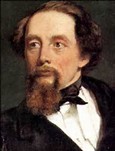
Charles John Huffam Dickens (7 February 1812 – 9 June 1870) was an English writer and social critic. He created some of the world's best-known fictional characters and is regarded as the greatest novelist of the Victorian era. His works enjoyed unprecedented popularity during his lifetime, and by the twentieth century critics and scholars had recognized him as a literary genius. His novels and short stories enjoy lasting popularity.
ð A Tale of Two Cities (1859): is a novel by Charles Dickens, set in London and Paris before and during the French Revolution. The novel depicts the plight of the French peasantry demoralized by the French aristocracy in the years leading up to the revolution, the corresponding brutality demonstrated by the revolutionaries toward the former aristocrats in the early years of the revolution, and many unflattering social parallels with life in London during the same period.
ð A Christmas Carol (1843): tells the story of a bitter old miser named Ebenezer Scrooge and his transformation into a gentler, kindlier man after visitations by the ghost of his former business partner Jacob Marley and the Ghosts of Christmas Past, Present and Yet to Come.
ð Oliver Twist: is the second novel by Charles Dickens, and was first published as a serial 1837–39. The story is of the orphan Oliver Twist, who starts his life in a workhouse and is then sold into apprenticeship with an undertaker. He escapes from there and travels to London, where he meets the Artful Dodger, a member of a gang of juvenile pickpockets led by the elderly criminal Fagin.
․ The Western Canon: The Books and School of the Ages
The Western Canon: The Books and School of the Ages is a 1994 book by Harold Bloom on Western literature, in which he defends the concept of the Western canon by discussing 26 writers whom he sees as central to the canon. The Western Canon is Bloom's best-known book alongside The Anxiety of Influence, and was a surprise bestseller upon its release in the United States.
ð Harold Bloom (born July 11, 1930): is an American literary critic and Sterling Professor of Humanities at Yale University. Since the publication of his first book in 1959, Bloom has written more than 20 books of literary criticism, several books discussing religion, and a novel. Bloom came to public attention in the United States as a commentator during the Canon wars of the early 1990s.
ð Western canon: The Western canon is the body of books, music and art that scholars generally accept as the most important and influential in shaping Western culture. It includes works of fiction, non-fiction, poetry, drama, music, art and sculpture generally perceived as being of major artistic merit and representing the high culture of Europe.
․ The difference between Cathedral and Chapel
|
Cathedral |
A cathedral is a Christian church which contains the seat of a bishop, thus serving as the central church of a diocese, conference, or episcopate. |
|
Chapel |
A chapel is a religious place of fellowship, prayer and worship that is attached to a larger, often nonreligious institution or that is considered an extension of a primary religious institution. It may be part of a larger structure or complex, located on board a military or commercial ship, or it may be an entirely free-standing building, sometimes with its own grounds. |
Edith Wharton (January 24, 1862 – August 11, 1937) was a Pulitzer Prize-winning American novelist, short story writer, and designer. She was nominated for the Nobel Prize in Literature in 1927, 1928 and 1930. Wharton combined her insider's view of America's privileged classes with a brilliant, natural wit to write humorous, incisive novels and short stories of social and psychological insight. She was well acquainted with many of her era's other literary and public figures, including Theodore Roosevelt.
ð “Roman Fever”: is a short story by American writer Edith Wharton. It was first published in the magazine Liberty in 1934, and was later included in Wharton's last short-story collection, The World Over.
․ Vocabulary
- exemplary (adj.)
providing a good example for people to copy
- asperity (n.)
the fact of being rough or severe, especially in the way you speak to or treat somebody
- dynamic (adj.)
having a lot of energy and a strong personality; always changing and making progress; describing an action rather than a state.
|
|
death |
|
|
Mor- |
||
that lives or lasts for ever.
building in which dead bodies are kept before they are buried or cremated (= burned); a place where dead bodies that have been found are kept until they can be identified |
||
|
|
to set a limit |
|
|
-eum |
||
Colosseum is an oval amphitheater in the century of the city of Rome, Italy. It was used for gladiatorial contests and public spectacles |
||


