"Kubla Khan; or, A Vision in a Dream: A Fragment" is a poem written by Samuel Taylor Coleridge. According to Coleridge's Preface to "Kubla Khan", the poem was composed one night after he experienced an opium-influenced dream after reading a work describing Xanadu, the summer palace of the Mongol ruler and Emperor of China Kublai Khan.
In Greek mythology snakes are often associated with deadly and dangerous antagonists, but this is not to say that snakes are symbolic of evil; in fact, snakes are a chthonic symbol, roughly translated as 'earthbound'.

ð Lernaean Hydra: was a serpentine water monster in Greek and Roman mythology. Its lair was the lake of Lerna in the Argolid, which was also the site of the myth of the Danaids. Lerna was reputed to be an entrance to the Underworld and archaeology has established it as a sacred site older than Mycenaean Argos. In the canonical Hydra myth, the monster is killed by Heracles, using sword and fire, as the second of his Twelve Labors.

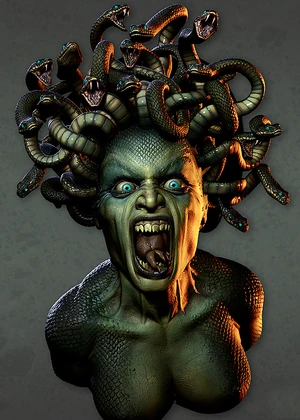
ð Medusa: was a monster in Greek mytholoyg, a Gorgon, generally described as a winged human female with a hideous face and living venomous snakes in place of hair.
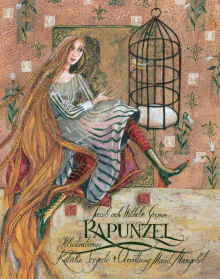
․ Rapunzel
"Rapunzel" is a German fairy tale in the collection assembled by the Brothers Grimm. The Grimm Brothers' story is an adaptation of the fairy tale Rapunzel by Friedrich Schulz published in 1790. The Schulz version is based on Persinette by Charlotte-Rose de Caumont de La Force originally published in 1698 which in turn was influenced by an even earlier tale, Petrosinella by Giambattista Basile, published in 1634. Its plot has been used and parodied in various media and its best known line ("Rapunzel, Rapunzel, let down your hair") is an idiom of popular culture.
An onomatopoeia is a word that phonetically imitates, resembles or suggests the source of the sound that it describes. It refers to the property of such words. Although in the English language, the term onomatopoeia means "the imitation of a sound," the compound word onomatopoeia (ονοματοποιία) in the Greek language means "making or creating names."
This is a list of words used in the English language to represent the noises of particular animals, especially noises used by animals for communication.
Alliteration is a stylistic literary device identified by the repeated sound of the first consonant in a series of multiple words, or the repetition of the same sounds in stressed syllables of a phrase. "Alliteration" from the Latin word “litera”, meaning “letters of the alphabet”, and the first known use of the word to refer to a literary device occurred around 1624. Alliteration narrowly refers to the repetition of a consonant in any syllables that, according to the poem's meter, are stressed,
"To Helen" is the first of two poems to carry that name written by Edgar Allan Poe. The 15-line poem was written in honor of Jane Stanard, the mother of a childhood friend. It was first published in 1831 collection Poems of Edgar A. Poe. In "To Helen," Poe is celebrating the nurturing power of woman. Poe was inspired in part by Samuel Taylor Coleridge, particularly in the second line ("Like those Nicean barks of yore") which resembles a line in Coleridge's "Youth and Age"
Anne Boleyn (c. 1501– 19 May 1536) was Queen of England from 1533 to 1536 as the second wife of King Henry VIII, and Marquess of Pembroke in her own right. Henry's marriage to Anne, and her subsequent execution by beheading, made her a key figure in the political and religious upheaval that was the start of the English Reformation.


