A Doll's House (also translated as A Doll House) is a three-act play in prose by Henrik Ibsen. The play is significant for its critical attitude toward 19th-century marriage norms. It aroused great controversy at the time, as it concludes with the protagonist, Nora, leaving her husband and children because she wants to discover herself. Ibsen was inspired by the belief that "a woman cannot be herself in modern society," since it is "an exclusively male society, with laws made by men and with prosecutors and judges who assess feminine conduct from a masculine standpoint."
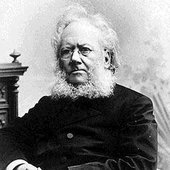
ð Henrik Ibsen (20 March 1828 – 23 May 1906): was a major 19th-century Norwegian playwright, theatre director, and poet. He is often referred to as "the father of realism" and is one of the founders of Modernism in theatre.
Heart of Darkness (1899) is a novella by Polish-British novelist Joseph Conrad, about a voyage up the Congo River into the Congo Free State, in the heart of Africa, by the story's narrator Marlow. Marlow tells his story to friends aboard a boat anchored on the River Thames, London, England. This setting provides the frame for Marlow's story of his obsession with the ivory trader Kurtz, which enables Conrad to create a parallel between London and Africa as places of darkness.
"Ode to the West Wind" is an ode, written by Percy Bysshe Shelley in 1819 near Florence, Italy. Some have interpreted the poem as the speaker lamenting his inability to directly help those in England owing to his being in Italy. At the same time, the poem expresses the hope that its words will inspire and influence those who read or hear it.
․ Sonnet
A sonnet is a poetic form which originated in Italy; Giacomo Da Lentini is credited with its invention. The term sonnet is derived from the Italian word sonetto. By the thirteenth century it signified a poem of fourteen lines that follows a strict rhyme scheme and specific structure.
Artistic license is a colloquial term, sometimes a euphemism, used to denote the distortion of fact, alteration of the conventions of grammar or language, or rewording of pre-existing text made by an artist in the name of art.
A figure of speech or rhetorical figure is figurative language in the form of a single word or phrase. It can be a special repetition, arrangement or omission of words with literal meaning, or a phrase with a specialized meaning not based on the literal meaning of the words.
Personification is the related attribution of human form and characteristics to abstract concepts such as nations, emotions and natural forces likes seasons and the weather.
․ “I Wandered Lonely as a Cloud”
"I Wandered Lonely as a Cloud" (also commonly known as "Daffodils") is a lyric poem by William Wordsworth. It is Wordsworth's most famous work. The poem is commonly seen as a classic of English romantic poetry, although Poems in Two Volumes, in which it first appeared, was poorly reviewed by Wordsworth's contemporaries.

Herman Melville (August 1, 1819 – September 28, 1891) was an American novelist, short story writer. He developed a complex, baroque style: the vocabulary is rich and original, a strong sense of rhythm infuses the elaborate sentences, the imagery is often mystical or ironic, and the abundance of allusion extends to Scripture, myth, philosophy, literature, and the visual arts.
ð Bartleby, the Scrivener: is a short story by the American writer Herman Melville. A Wall Street lawyer hires a new clerk who—after an initial bout of hard work—refuses to make copy and any other task required of him, with the words "I would prefer not to". The lawyer cannot bring himself to remove Bartleby from his premises, and decides instead to move his office, but the new proprietor removes Bartleby to prison, where he perishes.
․ Satire
Satire is a genre of literature, and sometimes graphic and performing arts, in which vices, follies, abuses, and shortcomings are held up to ridicule, ideally with the intent of shaming individuals, corporations, government or society itself, into improvement. Although satire is usually meant to be humorous, its greater purpose is often constructive social criticism, using wit to draw attention to both particular and wider issues in society. A feature of satire is strong irony or sarcasm—"in satire, irony is militant"—but parody, burlesque, exaggeration, juxtaposition, comparison, analogy, and double entendre are all frequently used in satirical speech and writing.
ð Sarcasm: is the use of irony to mock or convey contempt.
A scarecrow or hay-man is a decoy in the shape of a human. It is usually dressed in old clothes and placed in open fields to discourage birds such as crows or sparrows from disturbing and feeding on recently cast seed and growing crops.

Hyperbole is the use of exaggeration as a rhetorical device or figure of speech. In rhetoric, it is also sometimes known as auxesis. In poetry and oratory, it emphasizes, evokes strong feelings, and creates strong impressions. As a figure of speech, it is usually not meant to be taken literally.
․ Raven
A raven is one of several larger-bodied members of the genus Corvus. These species do not form a single taxonomic group within the genus, but share similar characteristics and appearances that generally separate them from other crows. The largest raven species are the common raven and the thick-billed raven.

․ Vocabular
- iambic (adj.)
(of rhythm in poetry) in which one weak or short syllable is followed by one strong or long syllable
- sextet (n.)
a group of six musicians or singers who play or sing together
|
|
broken |
|
|
fra- |
||
a small part of something that has broken off or comes from something larger
weakness and poor health; weakness in a person’s character or moral standards |
||
|
|
writing |
|
|
-cri- |
||
a lawyer who writes legal documents for his clients
an official piece of paper on which a doctor writes the type of medicine you should have, and which enables you to get it from a chemist’s shop/drugstore |
||


