★ Gen 字根
✎ generate (v.t.)
(1) To produce, as offspring.
➜ The human race was generated by Adam.
(2) To cause; originate, as steam form a boiler.
➜ Stagnant water generates various diseases.
(3) To trace out or form by motion.
➜ A moving point generates a line.
✎ genetics (n.)
(1) The branch of biology dealing with heredity.
✎ genius (n.)
(1) In Roman religion, the guardian spirit.
(2) Hence, the attending spirit of a place or person.
(3) Remarkable ability for some special pursuit.
(4) Also, one possessing it.
(5) Peculiar nature or quality, as of a nation or language.
(6) A strong leaning or inclination; a decided taste.
(7) In Mohammedan lore, a spirit, often under magic control.
✎ genocide (n.)
(1) Deliberate extermination of a race or nation.
★ fair
(adj.)
(1) Pleasing to the sight. 美麗的。
(2) Hence, female. ➜ the fair sex 女性
(3) Not dark in color or complexion; blond.
(4) Without blemish; spotless; clean. ➜ fair fame 美譽
(5) Not cloudy; fine; said of the weather
(6) Giving promise; favorable.
(7) Moderately satisfactory; pretty good.
(8) Not partial; just.
(9) According to regulations. . ➜ a fair victory 正當的勝利
(10) Allowing lawful pursuit.
(11) Distinct; unobstructed; clear.
❀ Phrases
˙ fair and square
(a) 真誠地;公正地。(b)直截地。
˙ fair enough
【口】正當的或合理的。
˙ fair to middling
【口】普通的;尚可的;相當的;中等的。
˙ be in a fair way
(a) 很可能。(b)有希望。
˙ by fair means or foul
不擇手段。
(n.)
(1) Woman kind. 【詩】女流。
(2) Justice.
(3) A fathering at a fixed time and place, for the sale or exhibition of farm products, etc.
【美】市集;商展;博覽會(=【英】exhibition)
(4) A sale of useful and fancy goods, as for charity. 義賣會。
❀ Phrases
˙ for fair
【口】的確;完全。
˙ no fair
不應該之事。
˙ through fair and foul
不論時機好壞;不論任何情況。
(adv.)
(1) In a manner courteously pleasant or agreeable.
(2) Honestly; justly.
(3) According to rules.
(4) Directly.
(5) Clearly.
❀ Phrases
˙ bid fair
有...的希望。
˙ play fair
以誠實無欺的態度對人。
★ vanity (n.)
(1) The state or quality of being vain or futile.
(2) Shallow pride, as in one's appearance or attainments; conceit.
➜ He is mad with wounded vanity.
(3)A trivial or worthless thing.
★ patron
(n.)
(1) A guardian or protector.
(2) An upholder or supporter.
(3) In business, a regular customer.
(adj.)
(1) Aiding, or acting as guardian.
★ patronage (n.)
(1) Special support; guardianship or protection.
(2) The act of buying goods regularly at one store.
(3) Offices and jobs given out by a politician in return for political loyalty and support.
(為回報別人政治上的忠誠或支持而給予的)職位。
(4) The power to make appointments to government jobs, esp. for political advantage. (為了政治上的利益而)委派官職的權力。
★ arbitrary (n.)
(1) Not fixed by rule or law.
(2) Capricious; unreasonable.
(3) Imperious; despotic.
★ paraphrase
(v.t.)
(1) To make a free translation of; explain in one's own words.
(v.i.)
(1) To make a free translation; put something into one's own words.
(n.)
(1) A free translation or explanation of a text, etc. giving the meaning in another form.
(2) A hymn based on some Scriptural passage.
★ dictator (n.)
(1) One who tells another what to write.
(2) One invested with absolute powers of government.
★ manipulate (v.t.)
(1) To operate or work skillfully by means of the hands, as tools.
(2) To treat; influence artfully; control the action of, by skillful management.
(3) To falsify, as books in bookkeeping.
★ affair (n.)
(1) An event; proceeding.
(2) That which is done, or is to be done.
(3) Amorous episode. 戀情;風流韻事。
(4) A matter, occasioning public anxiety, controversy, or scandal.
(5) Business of any kind. (常用複數)事務。
★ The difference between “duty” and “responsibility
Duty
✒ Duty is a term that conveys a sense of moral commitment or obligation to someone or something. The moral commitment should result in action; it is not a matter of passive feeling or mere recognition. When someone recognizes a duty, that person theoretically commits themselves to its fulfillment without considering their own self-interest.
Responsibility
✒ A duty or obligation to satisfactorily perform or complete a task (assigned by someone, or created by one's own promise or circumstances) that one must fulfill, and which has a consequent penalty for failure.
★ Vanity of vanity, all is vanity.
A statement at the beginning of the Book of Ecclesiastes in the Old Testament. The pointlessness of human activity is the major theme of the book. The author, however, like Job, insists that God's laws must be kept, whether keeping them results in happiness or sorrow.
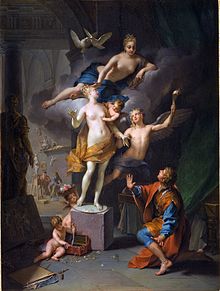
★ Pygmalion and Galatea
In Ovid's narrative, Pygmalion was a Cypriot sculptor who carved a woman out of ivory. According to Ovid, after seeing the Propoetides he was "not interested in women", but his statue was so fair and realistic that he fell in love with it.
In time, Aphrodite's festival day came, and Pygmalion made offerings at the altar of Aphrodite. There—too scared to admit his desire—he quietly wished for a bride who would be "the living likeness of my ivory girl". When he returned home, he kissed his ivory statue, and found that its lips felt warm. He kissed it again, and found that the ivory had lost its hardness. Aphrodite had granted Pygmalion's wish.
Pygmalion married the ivory sculpture changed to a woman under Aphrodite's blessing. In Ovid's narrative, they had a son, Paphos, from whom the city's name is derived.
★ Pygmalion effect
The Pygmalion effect, or Rosenthal effect, is the phenomenon whereby higher expectations lead to an increase in performance. The effect is named after the Greek myth of Pygmalion, a sculptor who fell in love with a statue he had carved.
A corollary of the Pygmalion effect is the golem effect, in which low expectations lead to a decrease in performance; both effects are forms of self-fulfilling prophecy. By the Pygmalion effect, people internalize their positive labels, and those with positive labels succeed accordingly. The idea behind the Pygmalion effect is that increasing the leader's expectation of the follower's performance will result in better follower performance. Within sociology, the effect is often cited with regard to education and social class.
 Bicentennial Man
"Bicentennial Man," follows the life and times of the title character, an android, who is purchased as a household robot programmed to perform menial tasks. The Martin family quickly learns that they don't have an ordinary robot as Andrew begins to experience emotions and creative thought. In a story that spans two centuries, Andrew learns the intricacies of humanity, life and love.

Miss teaches Andrew how to play the piano
My fair lady
A misogynistic and snobbish phonetics professor agrees to a wager that he can take a flower girl and make her presentable in high society.


