★ inaugurate (v.t.)
(1.) To admit or introduce into office with appropriate ceremonies; invest with office in a formal manner. 舉行就職典禮;正式就職。
➜ John F Kennedy was inaugurated as president in 1961.
(2.) To make a formal beginning of; begin, as a new policy. 正式開始;發軔(如實行新政策)。
➜ The introduction of free milk inaugurated a period of better health for children.
(3.) To celebrate the first public use of by some opening ceremony; dedicate, as a public building.慶祝開幕;行落成禮(如公共建築物)。
➜ The governor inaugurated the new bridge by being in the first car to drive across it.
★ inauspicious (adj.)
(1.) Unlucky; ill-omened; unfavorable. 不幸的;不吉利的;不利的。
➜ an inauspicious sign
★ Drama

Drama is the specific mode of narrative, typically fictional, represented in performance. The term comes from the Greek word δρᾶμα, drama, meaning action, which is derived from the verb δράω, draō, meaning to do or to act. The enactment of drama in theatre, performed by actors on a stage before an audience, presupposes collaborative modes of production and a collective form of reception.
➥ Classical Greek drama
Western drama originates in classical Greece. The theatrical culture of the city-state of Athens produced three genres of drama: tragedy, comedy, and the satyr play. Their origins remain obscure, though by the 5th century BC they were institutionalized in competitions held as part of festivities celebrating the god Dionysus. Historians know the names of many ancient Greek dramatists, not least Thespis, who is credited with the innovation of an actor ("hypokrites") who speaks (rather than sings) and impersonates a character (rather than speaking in his own person), while interacting with the chorus and its leader ("coryphaeus"), who were a traditional part of the performance of non-dramatic poetry (dithyrambic, lyric and epic).
Only a small fraction of the work of five dramatists, however, has survived to this day: we have a small number of complete texts by the tragedians Aeschylus, Sophocles and Euripides, and the comic writers Aristophanes and, from the late 4th century, Menander. Aeschylus' historical tragedy The Persians is the oldest surviving drama, although when it won first prize at the City Dionysia competition in 472 BC, he had been writing plays for more than 25 years. The competition ("agon") for tragedies may have begun as early as 534 BC; official records ("didaskaliai") begin from 501 BC, when the satyr play was introduced. Tragic dramatists were required to present a tetralogy of plays (though the individual works were not necessarily connected by story or theme), which usually consisted of three tragedies and one satyr play (though exceptions were made, as with Euripides' Alcestis in 438 BC). Comedy was officially recognized with a prize in the competition from 487 to 486 BC. Five comic dramatists competed at the City Dionysia (though during the Peloponnesian War this may have been reduced to three), each offering a single comedy. Ancient Greek comedy is traditionally divided between "old comedy" (5th century BC), "middle comedy" (4th century BC) and "new comedy" (late 4th century to 2nd BC).
★ Semele

Semele, in Greek mythology, daughter of the Boeotian hero Cadmus and Harmonia, was the mortal mother of Dionysus by Zeus in one of his many origin myths.
Certain elements of the cult of Dionysos and Semele came from the Phrygians. These were modified, expanded and elaborated by the Ionian Greek invaders and colonists. Herodotus, who gives the account of Cadmus, estimates that Semele lived sixteen hundred years before his time, or around 2000 BCE In Rome, the goddess Stimula was identified as Semele.
★ Greek chorus

A Greek chorus is a homogeneous, non-individualized group of performers in the plays of classical Greece, who comment with a collective voice on the dramatic action. The chorus consisted of between 12 and 50 players, who variously danced, sang or spoke their lines in unison and sometimes wore masks. Plays of the ancient Greek theatre always included a chorus that offered a variety of background and summary information to help the audience follow the performance. They commented on themes, and, as August Wilhelm Schlegel proposed in the early 19th century to subsequent controversy, demonstrated how the audience might react to the drama. In many of these plays, the chorus expressed to the audience what the main characters could not say, such as their hidden fears or secrets. The chorus often provided other characters with the insight they needed.
Some historians argue that the chorus was itself considered to be an actor. Scholars have considered Sophocles to be superior to Euripides in his choral writing. Of the two, Sophocles also won more dramatic contests. His chorus passages were more relevant to the plot and more integrated in tragedies, whereas the Euripi dean choruses seemingly had little to do with the plot and were often bystanders.
❀ Tragedians
☸ Aeschylus
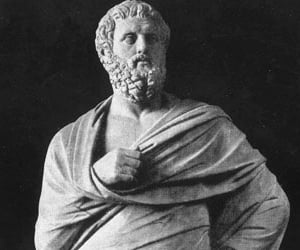
Aeschylus was an ancient Greek tragedian. He is also the first whose plays still survive; the others are Sophocles and Euripides. He is often described as the father of tragedy: critics and scholars' knowledge of the genre begins with his work, and understanding of earlier tragedies is largely based on inferences from his surviving plays. According to Aristotle, he expanded the number of characters in theater to allow conflict among them, whereas characters previously had interacted only with the chorus. He was probably the first dramatist to present plays as a trilogy; his Oresteia is the only ancient example of the form to have survived
☸ Sophocles
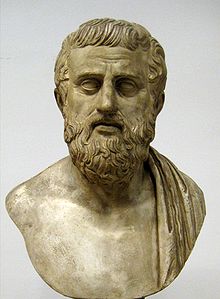
Sophocles is one of three ancient Greek tragedians whose plays have survived. His first plays were written later than those of Aeschylus, and earlier than or contemporary with those of Euripides. Sophocles wrote 120 plays during the course of his life, but only seven have survived in a complete form: Ajax, Antigone The Women of Trachis, Oedipus the King, Electra, Philoctetes and Oedipus at Colonus. For almost 50 years, Sophocles was the most-fêted playwright in the dramatic competitions of the city-state of Athens that took place during the religious festivals of the Lenaea and the Dionysia. He competed in 30 competitions, won 18, and was never judged lower than second place. Aeschylus won 14 competitions, and was sometimes defeated by Sophocles, while Euripides won 5 competitions.
The most famous tragedies of Sophocles feature Oedipus and also Antigone: they are generally known as the Theban plays, although each play was actually a part of a different tetralogy, the other members of which are now lost. Sophocles influenced the development of the drama, most importantly by adding a third actor, thereby reducing the importance of the chorus in the presentation of the plot. He also developed his characters to a greater extent than earlier playwrights such as Aeschylus.
☸ Euripides

Euripides was a tragedian of classical Athens. He is one of the few whose plays have survived, with the others being Aeschylus, Sophocles, and potentially Euphorion. Some ancient scholars attributed 95 plays to him but according to the Suda it was 92 at most. Of these, 18 or 19 have survived more or less complete (there has been debate about his authorship of Rhesus, largely on stylistic grounds) and there are also fragments, some substantial, of most of the other plays. More of his plays have survived intact than those of Aeschylus and Sophocles together, partly due to mere chance and partly because his popularity grew as theirs declined—he became, in the Hellenistic Age, a cornerstone of ancient literary education, along with Homer, Demosthenes and Menander.
Euripides is identified with theatrical innovations that have profoundly influenced drama down to modern times, especially in the representation of traditional, mythical heroes as ordinary people in extraordinary circumstances. This new approach led him to pioneer developments that later writers adapted to comedy, some of which are characteristic of romance. Yet he also became "the most tragic of poets", focusing on the inner lives and motives of his characters in a way previously unknown.
❀ Comic writers
☸ Aristophanes

Aristophanes, son of Philippus, of the deme Cydathenaeum, was a comic playwright of ancient Athens. Eleven of his thirty plays survive virtually complete. These, together with fragments of some of his other plays, provide the only real examples of a genre of comic drama known as Old Comedy, and they are used to define the genre. Also known as the Father of Comedy and the Prince of Ancient Comedy, Aristophanes has been said to recreate the life of ancient Athens more convincingly than any other author.
☸ Menander
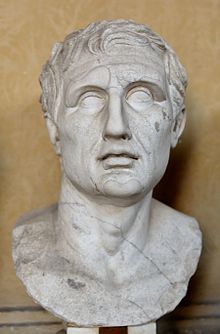
Menander was a Greek dramatist and the best-known representative of Athenian New Comedy. He was the author of more than a hundred comedies, and took the prize at the Lenaia festival eight times. His record at the City Dionysia is unknown but may well have been similarly spectacular.
One of the most popular writers of antiquity, his work was lost in the Middle Ages and is known in modernity in highly fragmentary form, much of which was discovered in the 20th century. Only one play, Dyskolos, has survived almost entirely.
★ Peloponnesian War

The Peloponnesian War (431–404 BC) was an ancient Greek war fought by Athens and its empire against the Peloponnesian League led by Sparta.
The Peloponnesian War reshaped the ancient Greek world. On the level of international relations, Athens, the strongest city-state in Greece prior to the war's beginning, was reduced to a state of near-complete subjection, while Sparta became established as the leading power of Greece. The economic costs of the war were felt all across Greece; poverty became widespread in the Peloponnese, while Athens found itself completely devastated, and never regained its pre-war prosperity. The war also wrought subtler changes to Greek society; the conflict between democratic Athens and oligarchic Sparta, each of which supported friendly political factions within other states, made civil war a common occurrence in the Greek world.
Greek warfare, meanwhile, originally a limited and formalized form of conflict, was transformed into an all-out struggle between city-states, complete with atrocities on a large scale. Shattering religious and cultural taboos, devastating vast swathes of countryside, and destroying whole cities, the Peloponnesian War marked the dramatic end to the fifth century BC and the golden age of Greece.
❀ Comedy
In a modern sense, comedy refers to any discourse or work generally intended to be humorous or to amuse by inducing laughter, especially in theatre, television, film and stand-up comedy. The origins of the term are found in Ancient Greece. In the Athenian democracy, the public opinion of voters was influenced by the political satire performed by the comic poets at the theaters. The theatrical genre of Greek comedy can be described as a dramatic performance which pits two groups or societies against each other in an amusing agon or conflict. Northrop Frye depicted these two opposing sides as a "Society of Youth" and a "Society of the Old". A revised view characterizes the essential agon of comedy as a struggle between a relatively powerless youth and the societal conventions that pose obstacles to his hopes. In this struggle, the youth is understood to be constrained by his lack of social authority, and is left with little choice but to take recourse in ruses which engender very dramatic irony which provokes laughter. Satire and political satire use comedy to portray persons or social institutions as ridiculous or corrupt, thus alienating their audience from the object of their humor. Parody subverts popular genres and forms, critiquing those forms without necessarily condemning them.
A comedy of manners typically takes as its subject a particular part of society (usually upper class society) and uses humor to parody or satirize the behavior and mannerisms of its members.
☸ Old Comedy
Old Comedy (archaia) is the first period of the ancient Greek comedy, according to the canonical division by the Alexandrian grammarians. The most important Old Comic playwright is Aristophanes – whose works, with their daring political commentary and abundance of sexual innuendo, effectively define the genre today. Aristophanes satirized and lampooned the most prominent personalities and institutions of his time, as can be seen, for example, in his scurrilous portrayal of Socrates in The Clouds, and in his racy anti-war farce Lysistrata. Aristophanes was only one of a large number of comic poets, however, working in Athens in the late 5th century BC; his biggest rivals were Hermippus and Eupolis.
The Old Comedy subsequently influenced later European writers such as François Rabelais, Miguel de Cervantes, Jonathan Swift, and Voltaire. They took particular inspiration from Aristophanes' disguising of political attacks as buffoonery. The cultural impact of Old Comedy can be seen today in political satires such as Dr. Strangelove (1964) and in the televised buffoonery of Monty Python and Saturday Night Live
☸ Middle Comedy
The line between Old and Middle Comedy is not clearly marked chronologically, Aristophanes and others of the latest writers of the Old Comedy being sometimes regarded as the earliest Middle Comic poets. For ancient scholars, the term may have meant little more than "later than Aristophanes and his contemporaries, but earlier than Menander". Middle Comedy is generally seen as differing from Old Comedy in three essential particulars: the role of the chorus was diminished to the point where it had no influence on the plot; public characters were not impersonated or personified onstage; and the objects of ridicule were general rather than personal, literary rather than political. For at least a time, mythological burlesque was popular among the Middle Comic poets.
Because no complete Middle Comic plays have been preserved, it is impossible to offer any real assessment of their literary value or "genius". But many Middle Comic plays appear to have been revived in Sicily and Magna Graecia in this period, suggesting that they had considerable widespread literary and social influence.
☸ New Comedy
New Comedy followed the death of Alexander the Great in 323 and lasted throughout the reign of the Macedonian rulers, ending about 260 BC. It is comparable to situation comedy and comedy of manners. The three best-known playwrights belonging to this genre are Menander, Philemon and Diphilus.
❀ Tragedy
Tragedy is a form of drama based on human suffering that invokes an accompanying catharsis or pleasure in audiences. While many cultures have developed forms that provoke this paradoxical response, the term tragedy often refers to a specific tradition of drama that has played a unique and important role historically in the self-definition of Western civilization. That tradition has been multiple and discontinuous, yet the term has often been used to invoke a powerful effect of cultural identity and historical continuity—"the Greeks and the Elizabethans, in one cultural form; Hellenes and Christians, in a common activity," as Raymond Williams puts it
➥ Catharsis
Catharsis (from Greek κάθαρσις katharsis meaning "purification" or "cleansing") is the purification and purgation of emotions—especially pity and fear—through art or any extreme change in emotion that results in renewal and restoration.
☸ Elizabethan drama
The renaissance theatre in England saw the coming of the Elizabethan drama. The renaissance theatres were those that were opened during the time between Reformation and the closing down of theatres. Queen Elizabeth ruled England from 1558 - 1603, hence the drama of this era came to be known as Elizabethan drama.
Earlier, dramas were based on the bible stories, mystery, or had a moral attached to it and even tried to recreate Greek or Italian drama. However, during the Elizabethan period, drama branched out to political plays, comedy and historical content. It veered away from bible stories and tackled the reality. The unique feature of Elizabethan drama is that one play was not played twice and certainly not within the same week. A new play was belted out almost every day.
The theme of Elizabethan drama ranged from history of monarchs or the country including various European countries, tragedy, comedy and something called revenge drama emerged which the audience quite liked.


The Great Gatsby is a 1925 novel written by American author F. Scott Fitzgerald that follows a cast of characters living in the fictional town of West Egg on prosperous Long Island in the summer of 1922. The story primarily concerns the young and mysterious millionaire Jay Gatsby and his quixotic passion and obsession for the beautiful former debutante Daisy Buchanan. Considered to be Fitzgerald's magnum opus, The Great Gatsby explores themes of decadence, idealism, resistance to change, social upheaval, and excess, creating a portrait of the Jazz Age or the Roaring Twenties that has been described as a cautionary tale regarding the American Dream.
 The Great Gatsby

The Great Gatsby - Young and Beautiful


