The Aegean Sea; Turkish: Ege Denizi Turkish pronunciation: is an elongated embayment of the Mediterranean Sea located between the Greek and Anatolian peninsulas, i.e., between the mainland of Greece and Turkey. In the north, it is connected to the Marmara Sea and Black Sea by the Dardanelles and Bosporus. The Aegean Islands are within the sea and some bound it on its southern periphery, including Crete and Rhodes.

․ Cupid
In classical mythology, Cupid (Latin Cupido, meaning "desire") is the god of desire, erotic love, attraction and affection. He is often portrayed as the son of the love goddess Venus and the war god Mars, and is known in Latin also as Amor ("Love"). His Greek counterpart is Eros. Although Eros is in Classical Greek art as a slender winged youth, during the Hellenistic period, he was increasingly portrayed as a chubby boy. During this time, his iconography acquired the bow and arrow that represent his source of power: a person, or even a deity, who is shot by Cupid's arrow is filled with uncontrollable desire.
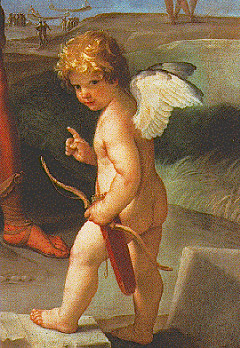
ð Cupid's arrows: Cupid carries two kinds of arrows, one with a sharp golden point, and the other with a blunt tip of lead. A person wounded by the golden arrow is filled with uncontrollable desire, but the one struck by the lead feels aversion and desires only to flee.
9 A Midsummer Night's Dream (plot):
In a parallel plot line, Oberon, king of the fairies, and Titania, his queen, have come to the forest outside Athens. Titania tells Oberon that she plans to stay there until she has attended Theseus and Hippolyta's wedding. Oberon and Titania are estranged because Titania refuses to give her Indian changeling to Oberon for use as his "knight" or "henchman", since the child's mother was one of Titania's worshipers. Oberon seeks to punish Titania's disobedience. He calls upon Robin "Puck" Goodfellow, his "shrewd and knavish sprite", to help him concoct a magical juice derived from a flower called "love-in-idleness", which turns from white to purple when struck by Cupid's arrow.
This dramatic device was probably first used by Thomas Kyd in The Spanish Tragedy around 1587, where the play is presented before an audience of two of the characters, who comment upon the action. From references in other contemporary works, Kyd is also assumed to have been the writer of an early, lost version of Hamlet (the so-called Ur-Hamlet), with a play-within-a-play interlude.
․
|
|
|
||
|
Theseus: was the mythical king of Athens and was the son of Aethra by two fathers: Aegeus and Poseidon. Theseus was a founding hero, considered by Athenians as their own great reformer: his name comes from the same root as ("thesmos"), Greek for "The Gathering". The myths surrounding Theseus—his journeys,exploits, and family—have provided material for fiction throughout the ages.
|
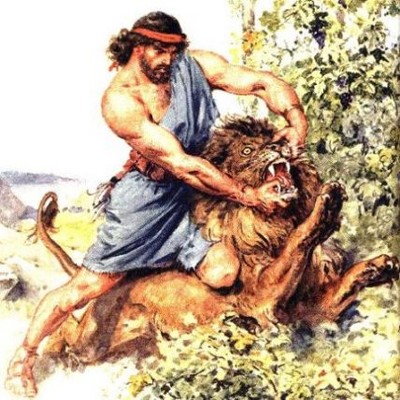
Heracles: was a divine hero in Greek mythology, the son of Zeus and Alcmene, foster son of Amphitryon and great-grandson/half-brother of Perseus. He was the greatest of the Greek heroes, a paragon of masculinity, the ancestor of royal clans who claimed to be Heracleidae and a champion of the Olypian order against chthonic monsters.
|
||