Marguerite Donnadieu, known as Marguerite Duras (4 April 1914 – 3 March 1996), was a French novelist, playwright, scriptwriter, essayist and experimental filmmaker. She is best known for writing the 1959 film Hiroshima mon amour, which earned her a nomination for Best Original Screenplay at the Academy Awards. After her father’s death, her mother, a teacher, remained in Indochina with her three children. The family lived in relative poverty after her mother made a bad investment in an isolated property and area of farmland in Cambodia. The difficult life that the family experienced during this period was highly influential on Marguerite's later work. An affair between the teenaged Marguerite and Huynh Thuy Le, the son of a rich Sa Dec merchant, was to be treated several times (described in quite contrasting ways) in her subsequent memoirs and fiction. She also reported being beaten by both her mother and her older brother during this period.
ð Hiroshima mon amour: is a 1959 drama film directed by French film director Alain Resnais, with a screenplay by Marguerite Duras. It is the documentation of an intensely personal conversation between a French-Japanese couple about memory and forgetfulness.



Khan Academy is a non-profit educational organization created in 2006 by educator Salman "Sal" Khan with the aim of providing a "free, world-class education for anyone, anywhere". The organization produces short lectures in the form of YouTube videos. In addition to micro lectures, the organization's website features practice exercises and tools for educators. All resources are available for free to anyone around the world. The main language of the website is English, but the content is also available in other languages.
ð Muslim: relates to a person who follows the religion of Islam, a monotheistic and Abrahamic religion based on the Quran. Muslims consider the Quran to be the verbatim word of God as revealed to the Islamic prophet and messenger Muhammad.
As a literary genre of high culture, romance or chivalric romance is a type of prose and verse narrative that was popular in the aristocratic circles of High Medieval and Early Modern Europe. They were fantastic stories about marvel-filled adventures, often of a knight-errant portrayed as having heroic qualities, who goes on a quest, yet it is "the emphasis on love and courtly manners distinguishes it from the chanson de geste and other kinds of epic, in which masculine military heroism predominates."
ð Courtly love: was a medieval European literary conception of love that emphasized nobility and chivalry. Medieval literature is filled with examples of knights setting out on adventures and performing various services for ladies because of their "courtly love".
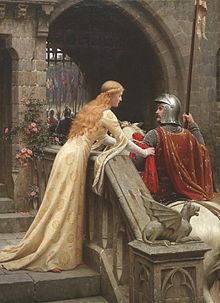
Romanticism (also the Romantic era or the Romantic period) was an artistic, literary, musical and intellectual movement that originated in Europe toward the end of the 18th century and in most areas was at its peak in the approximate period from 1800 to 1850. Romanticism was characterized by its emphasis on emotion and individualism as well as glorification of all the past and nature, preferring the medieval rather than the classical.
Emily Elizabeth Dickinson (December 10, 1830 – May 15, 1886) was an American poet. Dickinson was born in Amherst, Massachusetts. Although part of a prominent family with strong ties to its community, Dickinson lived much of her life highly introverted. Dickinson's poems are unique for the era in which she wrote; they contain short lines, typically lack titles, and often use slant rhyme as well as unconventional capitalization and punctuation. Many of her poems deal with themes of death and immortality, two recurring topics in letters to her friends.

The Tempest is a play by William Shakespeare, believed to have been written in 1610–11, and thought by many critics to be the last play that Shakespeare wrote alone. It is set on a remote island, where the sorcerer Prospero, rightful Duke of Milan, plots to restore his daughter Miranda to her rightful place using illusion and skillful manipulation. He conjures up a storm, the eponymous tempest, to lure his usurping brother Antonio and the complicit King Alonso of Naples to the island. There, his machinations bring about the revelation of Antonio's lowly nature, the redemption of the King, and the marriage of Miranda to Alonso's son, Ferdinand.
․ Perseus
In Greek mythology, Perseus, the legendary founder of Mycenae and of the Perseid dynasty of Danaans, was, alongside Cadmus and Bellerophon, the greatest Greek hero and slayer of monsters before the days of Heracles. Perseus beheaded the Gorgon Medusa and saved Andromeda from the sea monster Cetus. Perseus was the son of the mortal Danaë and the god Zeus. He was also the great grandfather of Heracles, also a son of Zeus.
․ Sphinx

The sphinx is a mythical creature with, at a minimum, the head of a human and the body of a lion. In Greek tradition, it has the head of a human, the haunches of a lion, and sometimes the wings of a bird. It is mythicised as treacherous and merciless. Those who cannot answer its riddle suffer a fate typical in such mythological stories, as they are killed and eaten by this ravenous monster. This deadly version of a sphinx appears in the myth and drama of Oedipus.
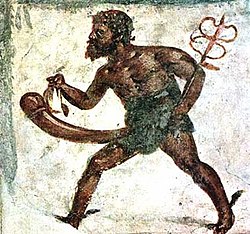
․ Phallus
A phallus is a penis, especially when erect, an object that resembles a penis, or a mimetic image of an erect penis. Any object that symbolically — or, more precisely, ironically — resembles a penis may also be referred to as a phallus; however, such objects are more often referred to as being phallic (as in "phallic symbol"). Such symbols often represent fertility and cultural implications that are associated with the male sexual organ, as well as the male orgasm.
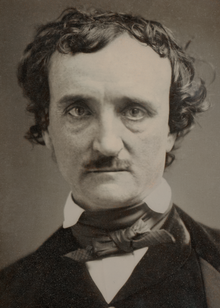
Edgar Allan Poe (January 19, 1809 – October 7, 1849) was an American writer, editor, and literary critic. Poe is best known for his poetry and short stories, particularly his tales of mystery and the macabre. He is widely regarded as a central figure of Romanticism in the United States and American literature as a whole, and he was one of the country's earliest practitioners of the short story. Poe is generally considered the inventor of the detective fiction genre and is further credited with contributing to the emerging genre of science fiction. He was the first well-known American writer to try to earn a living through writing alone, resulting in a financially difficult life and career.
ð “The Raven” : is a narrative poem by American writer Edgar Allan Poe. It tells of a talking raven's mysterious visit to a distraught lover, tracing the man's slow fall into madness. The lover, often identified as being a student, is lamenting the loss of his love, Lenore. Sitting on a bust of Pallas, the raven seems to further instigate his distress with its constant repetition of the word "Nevermore". The poem makes use of a number of folk, mythological, religious, and classical references.


