Spring Break
1. What is Spring Break?
Spring break is a U.S. phenomenon and an academic tradition which started during the 1930s in the United States and is observed in some other western countries. Spring break is also a vacational period in early spring at universities and schools in various countries in the world, where it is known by names such as Easter vacation, Easter holiday, April break, spring vacation, mid-term break, study week, reading week, reading period, or Easter week, depending on regional conventions. However, these vacations differ from spring break in the United States.
2. History and Timing
Asia
Japan
In Japan, the spring break starts with the end of the academic year in March and ends on April 1 with the beginning of a new academic year.
South Korea
In South Korea, the spring break starts in mid-February (the end of the academic year) and ends on March 1 (a national holiday) with the beginning of a new academic year.
Europe
Czech Republic
In the Czech Republic, only primary and secondary school students have a spring break. The break is one week long and the date of the break differs from county to county to avoid overcrowding of the break destinations in the Czech Republic (Czechs usually travel to the mountains to ski there). The counties are divided into six groups, each group containing counties evenly distributed across the country. The first group starts the holiday on the first Monday of February, the last group starts the holiday five weeks later (usually in early March). The last group of counties becomes the first one to have the spring break the next year.
Portugal
In Portugal, spring break is mostly known as "Easter Holidays" and it gives two weeks to all students around the country.
Russia
Before 1917 there was an Easter Break in schools. In the USSR, spring break was always from 24 to 31 of March. Now, many schools in Russia still have the spring break, but the exact date is decided by the school itself.
Sweden
In Sweden, primary school students typically have winter sports holiday for one week in February as well as Easter holidays for one week in April, during Easter.
Spain
In Spain, there is not a spring break proper. Instead, the Holy Week is celebrated and students usually have holidays during these days.
United Kingdom
The Easter break in the United Kingdom is either one or two weeks (depending on the local council) and fits around Easter.
North America
Canada
Canada gives a week-long break to its elementary school and secondary school students in the month of March, with the time varying from province to province; New Brunswick and Quebec, for example, place their March breaks during the first week of March; Ontario, Nova Scotia, and British Columbia schedule theirs during the second or third week, and is usually a week long; the break in Alberta and Manitoba usually occurs in the last week of March. Post-secondary students in Ontario and Alberta usually get a week off in mid-February.
Mexico
In Mexico, spring break takes place during the Holy Week and the one after it.
United States
In the United States, spring break at the college and university level can occur from March to April, depending on term dates and when Easter holiday falls. Usually, spring break is about one week long, but many K–12 institutions in the United States schedule a two-week-long break known as "Easter Break," "Easter Holidays", or "Easter Vacation", as they generally take place in the weeks before or after Easter. However, in the states of Massachusetts and Maine, schools typically schedule spring break for the week of the third Monday in April to coincide with Patriots' Day.
South America
Colombia
In Colombia, spring break takes place the first week of April, during the Holy Week until the second week.
3. Spring Break Festival
Panama City Beach, Florida
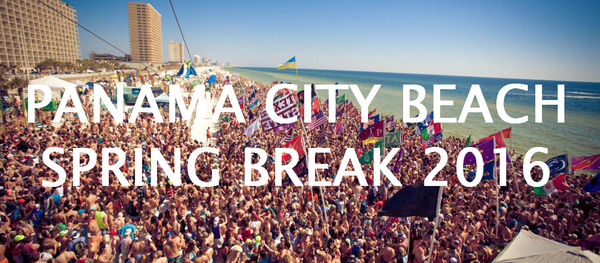
Starting in the late 90's, Panama City Beach began advertising the destination hoping to attract crowds that had formerly gone to Fort Lauderdale and then Daytona before those communities enacted restrictions. From 2010-2016 an estimated 300,000 students traveled to the destination. The spawn of social media and digital marketing helped propel the beach town into a student mecca during March. Following well publicized shootings and a gang rape in 2015, several new ordinances were put into effect prohibiting drinking on the beach and establishing a bar closing time of 2 a.m. Central Time. Reports show a drop in Panama City Beach's spring break turnout in March 2016 followed by increased family tourism in April 2016. Both are credited/blamed on the new ordinances by the Bay County Community Development Corporation.
Fort Lauderdale, Florida
Fort Lauderdale's reputation as a spring break destination for college students started when the Colgate University men's swim team arrived to practice there over Christmas break in 1934. Attracting approximately 20,000 college students in the 1950s, spring break was still known as 'spring vacation' and was a relatively low key affair. This began to change when Glendon Swarthout’s novel, ‘Where the Boys Are’ was published in 1958, effectively ushering in modern spring break. Swarthout’s 1958 novel was quickly made into a movie of the same title in 1960 Where the Boys Are, in which college girls met boys while on spring break there. The number of visiting college students immediately jumped to over 50,000. By the early 1980s, Ft. Lauderdale was attracting between 250,000-350,000 college students per year during spring break. Residents of the Fort Lauderdale area became so upset at the damage done by college students that the local government passed laws restricting parties in 1985. At the same time, the National Minimum Drinking Age Act was enacted in the United States, requiring that Florida raise the minimum drinking age to 21 and inspiring many underage college vacationers to travel to other locations in the United States for spring break. By 1989, the number of college students traveling to Fort Lauderdale fell to 20,000, a far cry from the 350,000 who went four years prior.
限會員,要發表迴響,請先登入


