Class Notes:
1. Rapunzel
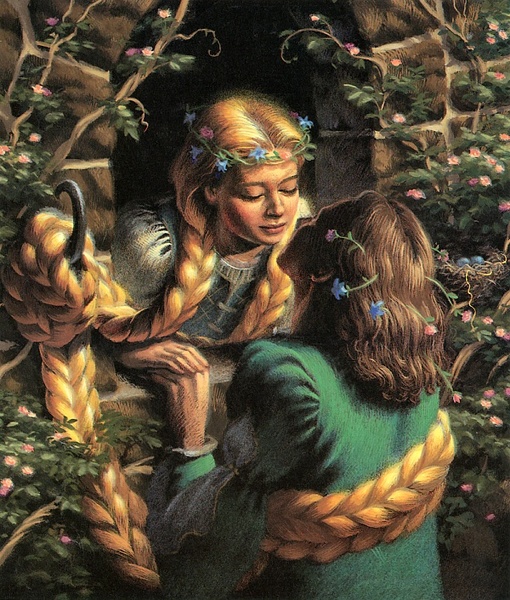
"Rapunzel" is a German fairy tale in the collection assembled by the Brothers Grimm, and first published in 1812 as part of Children's and Household Tales. The Grimm Brothers' story is an adaptation of the fairy tale Rapunzel by Friedrich Schulz published in 1790. The Schulz version is based on Persinette by Charlotte-Rose de Caumont de La Force originally published in 1698 which in turn was influenced by an even earlier tale, Petrosinella by Giambattista Basile, published in 1634.
Rapunzel is a fairy tale about the love between a young prince and a girl with long, blond hair that conquered all of the Witch’s evil intentions. They were persistent in their intentions on being happy together, and the Witch was their biggest obstacle. Years passed by, and their love grew stronger. The evil Witch tried everything to split them up, but she didn’t accomplish her goals. Even though they were separated for years, the prince managed to find his Rapunzel, and he never separated from her again. Love won again.
Its plot has been used and parodied in various media and its best known line ("Rapunzel, Rapunzel, let down your hair") is an idiom of popular culture.
* Tangled
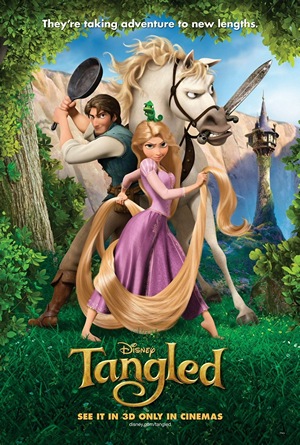
Tangled is a 2010 American 3D computer-animated musical fantasy-comedy film produced by Walt Disney Animation Studios and released by Walt Disney Pictures. Loosely based on the German fairy tale "Rapunzel" in the collection of folk tales published by the Brothers Grimm, it is the 50th Disney animated feature film. Featuring the voices of Mandy Moore and Zachary Levi, the film tells the story of a lost, young princess with long magical hair who yearns to leave her secluded tower. Against her mother's wishes, she accepts the aid of a handsome intruder to take her out into the world which she has never seen.
2. The Wolf and the Seven Young Goats
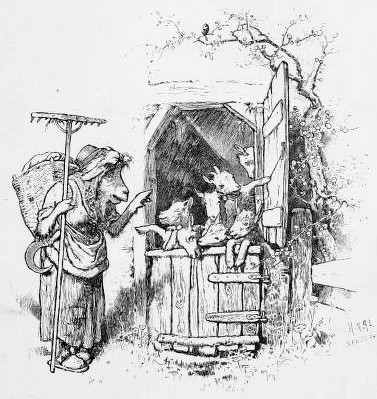
"The Wolf and the Seven Young Goats" is a fairy tale collected by the Brothers Grimm, tale number 5.
A mother goat leaves her seven children at home while she ventures into the forest to find food. Before she leaves, she warns her young about the Big Bad Wolf who will try to sneak into the house and gobble them up. The wolf will pretend to be their mother and convince the kids to open the door. The young children will be able to recognize their true mother by her white feet and sweet voice.
The mother goat leaves and the seven kids stay in the house. Before long, they hear a voice at the door that says "Let me in children, your mother has something for each and every one of you". His gruff voice betrays him and the kids do not let him in. The wolf goes to a market and steals some honey to soften his voice. A little while later, the kids hear another voice at the door: "Let me in children, your mother has something for each and every one of you". This time the voice is high and sweet like their mother's. They are about to let him in when the youngest kid looks under the crack in the door and notices the wolf's big, black feet. They refuse to open the door, and the wolf goes away again.
The wolf goes to the bakery and steals some flour, smearing it all over his coat, turning his black feet white. He returns to the children's house, and says "Let me in children, your mother has something for each and every one of you". The kids see his white feet and hear his sweet voice, so they open the door. The wolf jumps into the house and gobbles up six of the kids. The youngest child hides from the wolf in the grandfather clock and does not get eaten.
Later that day, the mother goat returns home from the forest. She is distraught to find the door wide open and all but one of her children missing. She looks around and sees the wolf, fast asleep under a tree. He had eaten so much, he could not move. The mother goat calls to her youngest child to quickly get her a pair of scissors, a needle and some thread. She cuts open the wolf's belly and the six children spring out miraculously unharmed. They fill the wolf's belly with rocks, and the mother sews it back up again. When the wolf wakes up, he is very thirsty. He goes to the river to drink, but falls in and drowns under the weight of the rocks. The Family lived happily ever after.
3. Old King Cole
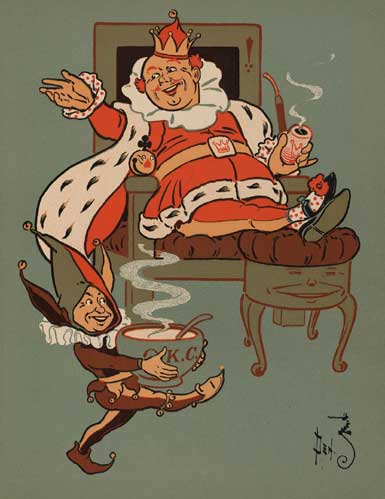
"Old King Cole" is a British nursery rhyme first attested in 1708. Though there is much speculation about the identity of King Cole, it is unlikely that he can be identified reliably as any historical figure.
Old King Cole was a merry old soul,
And a merry old soul was he;
He called for his pipe, and he called for his bowl,
And he called for his fiddlers three.
Every fiddler he had a fiddle,
And a very fine fiddle had he;
Oh there's none so rare, as can compare,
With King Cole and his fiddlers three.
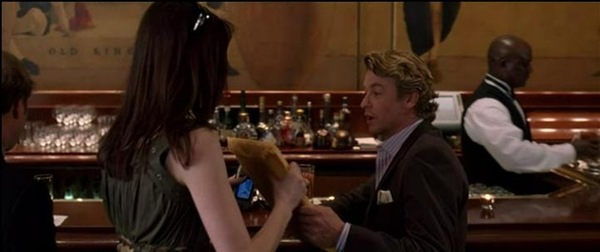
* The King Cole Bar

4. To the Virgins, to Make Much of Time
"To the Virgins, to Make Much of Time" is a poem written by English Cavalier poet Robert Herrick in the 17th century. The poem is in the genre of carpe diem, Latin for seize the day. It goes as follows:
Gather ye rosebuds while ye may,
Old Time is still a-flying;
And this same flower that smiles today
To-morrow will be dying.
The glorious lamp of heaven, the sun,
The higher he's a-getting,
The sooner will his race be run,
And nearer he's to setting.
That age is best which is the first,
When youth and blood are warmer;
But being spent, the worse, and worst
Times still succeed the former.
Then be not coy, but use your time,
And, while ye may, go marry:
For having lost but once your prime,
You may forever tarry.
* Carpe Diem
Literally, " seize the day" in Latin, a common them of literary works that emphasize the brevity of life and the need to make the most of the present. Andrew Marvell's poem " To His Coy Mistress" is a well-known example.
限會員,要發表迴響,請先登入


