Class Notes
1. Lyric poetry
Lyric poetry is a formal type of poetry which expresses personal emotions or feelings, typically spoken in the first person.The term derives from a form of Ancient Greek literature, the lyric, which was defined by its musical accompaniment, usually on a stringed instrument known as a lyre.The term owes its importance in literary theory to the division developed by Aristotle between three broad categories of poetry: lyrical, dramatic and epic. One of the most famous lyric poetry is " I Wandered Lonely as a Cloud".

I wandered lonely as a cloud
That floats on high o'er vales and hills,
When all at once I saw a crowd,
A host, of golden daffodils;
Beside the lake, beneath the trees,
Fluttering and dancing in the breeze.
Continuous as the stars that shine
And twinkle on the milky way,
They stretched in never-ending line
Along the margin of a bay:
Ten thousand saw I at a glance,
Tossing their heads in sprightly dance.
The waves beside them danced; but they
Out-did the sparkling waves in glee:
A poet could not but be gay,
In such a jocund company:
I gazed—and gazed—but little thought
What wealth the show to me had brought:
For oft, when on my couch I lie
In vacant or in pensive mood,
They flash upon that inward eye
Which is the bliss of solitude;
And then my heart with pleasure fills,
And dances with the daffodils.
2. Ode
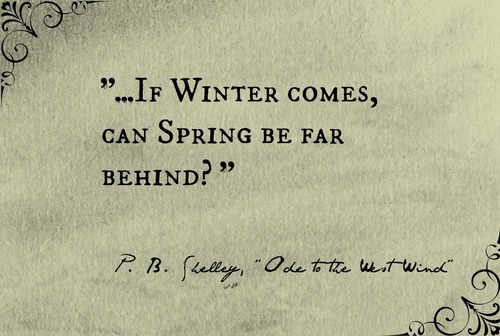
A lyric poem characterized by a serous topic and formal tone but without a prescribed formal pattern in which the speaker talks about, and often to, an especially revered person or thing. Examples include Shelley's " Ode to the West Wind".
3. Elegy
Since the Reinaissance, usually a formal lament on the death of a particular person, but focusing mainly on the speaker's effort to come to terms with his or her grief; more broadly, any lyric in sorrowful mood that takes death as its primary subject. An example is W.H.Auden's " Stop all the clocks, cut off the telephone".
4. Persona
The voice or the figure of the author who tells and structures the work and who may or may not share the values of the actual author.
5. Romance
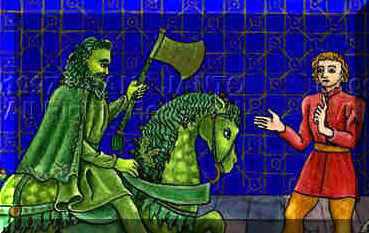
Originally, a long medieval narrative in verse or prose written in one of the Romance languages( Freanch, Spanish, Italian, ect) and depicting the quest of knights and other chivalric heroes and the vicissitudes of courtly love: also known as chivalric romance. A good example is Sir Gawain and the Green Knight.
6. Ballad
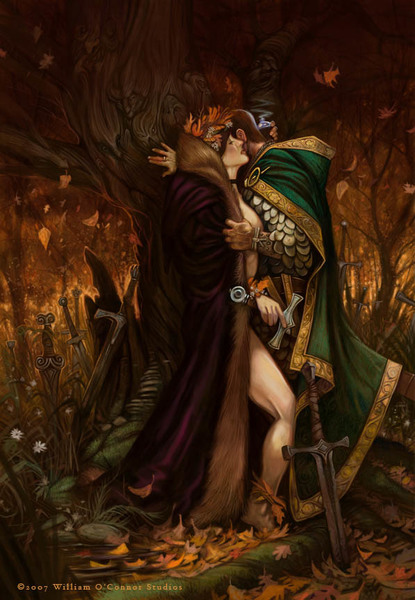
A verse narrative that is, or originally was, meant to be sung. Ballads were originally a folk creation, transmitted orally from person to person and age to age and characterized by relatively simple diction, meter, and rhyme scheme; by stock imagery; and by repetition; and often by a refrain. An example is " La Belle Dame Sans Merci" by John Keats.
7. The Tyger
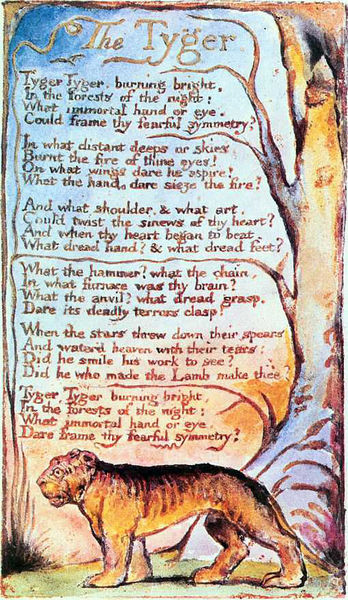
The poem begins with the speaker asking a fearsome tiger what kind of divine being could have created it: “What immortal hand or eye/ Could frame they fearful symmetry?” Each subsequent stanza contains further questions, all of which refine this first one. From what part of the cosmos could the tiger’s fiery eyes have come, and who would have dared to handle that fire? What sort of physical presence, and what kind of dark craftsmanship, would have been required to “twist the sinews” of the tiger’s heart? The speaker wonders how, once that horrible heart “began to beat,” its creator would have had the courage to continue the job. Comparing the creator to a blacksmith, he ponders about the anvil and the furnace that the project would have required and the smith who could have wielded them. And when the job was done, the speaker wonders, how would the creator have felt? “Did he smile his work to see?” Could this possibly be the same being who made the lamb?
8. Metaphysical Poetry
(1) what is metaphysical poetry
The term metaphysical poets was coined by the critic Samuel Johnson to describe a loose group of 17th-century English poets whose work was characterized by the inventive use of conceits, and by a greater emphasis on the spoken rather than lyrical quality of their verse. These poets were not formally affiliated and few were highly regarded until 20th century attention established their importance.
(2) conceit
In literature, a conceit is an extended metaphor with a complex logic that governs a poetic passage or entire poem. By juxtaposing, usurping and manipulating images and ideas in surprising ways, a conceit invites the reader into a more sophisticated understanding of an object of comparison. Extended conceits in English are part of the poetic idiom of Mannerism, during the late sixteenth and early seventeenth century.
(3) John Donne
John Donne was an English poet and cleric in the Church of England.
He is considered the pre-eminent representative of the metaphysical poets. His works are noted for their strong, sensual style and include sonnets, love poems, religious poems, Latin translations, epigrams, elegies, songs, satires and sermons. His poetry is noted for its vibrancy of language and inventiveness of metaphor, especially compared to that of his contemporaries. Donne's style is characterised by abrupt openings and various paradoxes, ironies and dislocations. These features, along with his frequent dramatic or everyday speech rhythms, his tense syntax and his tough eloquence, were both a reaction against the smoothness of conventional Elizabethan poetry and an adaptation into English of European baroque and mannerist techniques.
(4) Death, be not proud
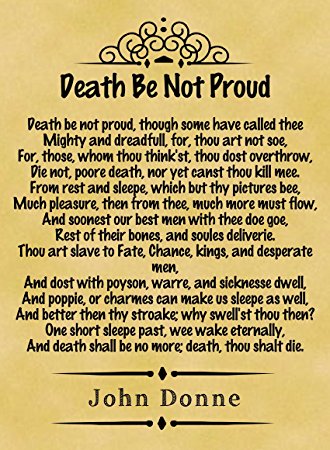
Death is personified as a male braggart, like a soldier boasting of all the men he’s slain. There is also a suggestion of a Donne1male lover bragging about all of his conquests between the sheets: Donne liked the double meaning of ‘die’ as both ‘expire’ and ‘orgasm’, and the idea that ‘those, whom thou think’st, thou dost overthrow, / Die not’ hides the suggestion that ‘you may think all those women you conquer are overcome with pleasure, but they’re faking it’. (This faint suggestion of an erotic subtext is also borne out by the line, ‘Much pleasure, then from thee, much more must flow’.)
‘Stroake’, too, is ambiguous: it ostensibly refers to the stroke of an axe or a sword that ends somebody’s life, but it is also alive to the other, more tender, meaning of stroking somebody in a caress, such as in lovemaking. ‘Why swell’st thou then?’ Well, quite – tumescence is uncalled for, since you’re not ‘all that’ as a lover, Death. Note the monosyllables of the last line, which hammer out in ten short words the matter-of-fact declaration that the speaker will beat death through being born again in heaven.
‘Death, be not proud’ is rightly viewed as one of Donne’s finest poems, and certainly one of his greatest sonnets. Like the best of Donne’s poetry it fuses religious and erotic imagery and ideas, bringing the physical and the metaphysical together.
(5) No Man Is an Island
No man is an island,
Entire of itself;
Every man is a piece of the continent,
A part of the main.
If a clod be washed away by the sea,
Europe is the less,
As well as if a promontory were:
As well as if a manor of thy friend's
Or of thine own were.
Any man's death diminishes me,
Because I am involved in mankind.
And therefore never send to know for whom the bell tolls;
It tolls for thee.
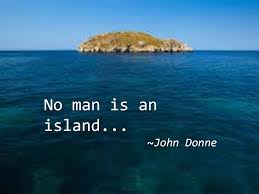
The phrase “No man is an island (unto himself)” has percolated into popular parlance, and the suggestive thought of man’s interconnectedness overruling the dictum of his individuality (or even insularity) is hardly a new thought for us. But in the Elizabethan age when John Donne had composed the meditation “No Man Is An Island”, the poem is structured in a peculiar fashion such that the resultant effect on reading it is not merely a realization of the universal humanity Donne is hinting at. Instead, it is the lifecycle of each mortal being, being propelled towards his inevitable death, and even God’s schemes which undermine that imagined community of men. Rather than being dismissed as a utopia, the meditation stresses the urgency of how man thrives in the company of his fellow human beings, and how he is but an insignificant component of the entire scheme, equipped with his own intrinsic set of functionalities and dispensations in the world-order.
限會員,要發表迴響,請先登入


