Class Notes
1. William Faulkner
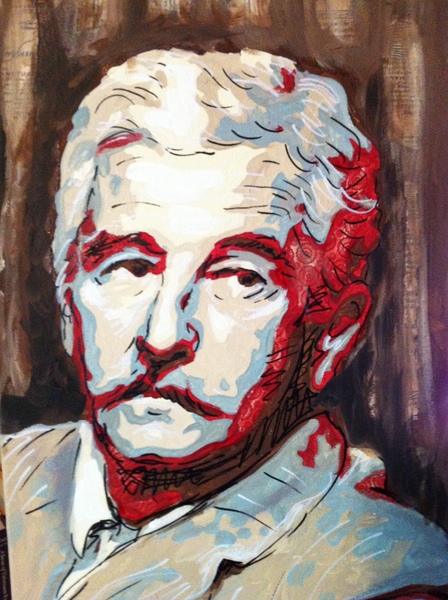
William Faulkner was an American writer and Nobel Prize laureate from Oxford, Mississippi. Faulkner wrote novels, short stories, a play, poetry, essays, and screenplays. He is primarily known for his novels and short stories set in the fictional Yoknapatawpha County, based on Lafayette County, Mississippi, where he spent most of his life. His notable works are "A Rose for Emily", "As I Lay Dying", and " The Sound and the Fury". Here is a paragraph of his Nobel Prize speech:
" I feel that this award was not made to me as a man, but to my work — a life’s work in the agony and sweat of the human spirit, not for glory and least of all for profit, but to create out of the materials of the human spirit something which did not exist before."
2. The Sound and the Fury
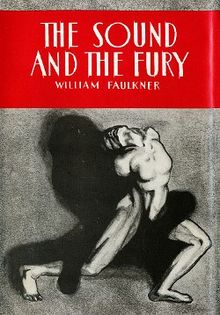
"A Rose for Emily" describes a story that took place in Jefferson, Mississippi, so dose " The Sound and the Fury". "The Sound and the Fury" is set in Jefferson, Mississippi. The novel centers on the Compson family, former Southern aristocrats who are struggling to deal with the dissolution of their family and its reputation. Over the course of the 30 years or so related in the novel, the family falls into financial ruin, loses its religious faith and the respect of the town of Jefferson, and many of them die tragically.
3. "A Rose for Emily"
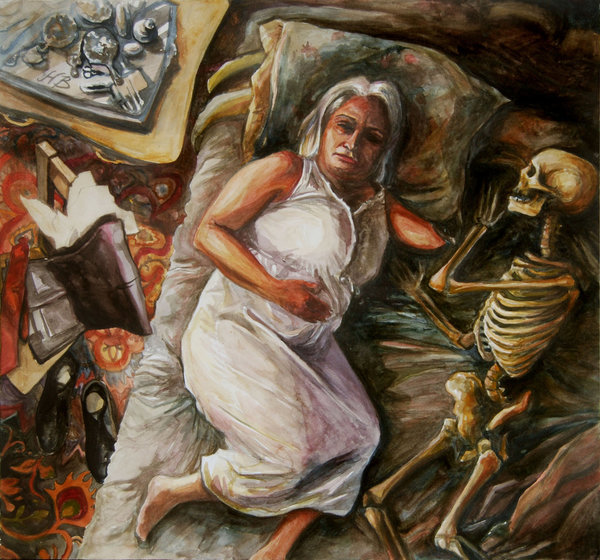
Through the mysterious figure of Emily Grierson, Faulkner conveys the struggle that comes from trying to maintain tradition in the face of widespread, radical change. Jefferson is at a crossroads, embracing a modern, more commercial future while still perched on the edge of the past, from the faded glory of the Grierson home to the town cemetery where anonymous Civil War soldiers have been laid to rest. Emily herself is a tradition, steadfastly staying the same over the years despite many changes in her community. She is in many ways a mixed blessing. As a living monument to the past, she represents the traditions that people wish to respect and honor; however, she is also a burden and entirely cut off from the outside world, nursing eccentricities that others cannot understand.
Emily lives in a timeless vacuum and world of her own making. Refusing to have metallic numbers affixed to the side of her house when the town receives modern mail service, she is out of touch with the reality that constantly threatens to break through her carefully sealed perimeters. Garages and cotton gins have replaced the grand antebellum homes. The aldermen try to break with the unofficial agreement about taxes once forged between Colonel Sartoris and Emily. This new and younger generation of leaders brings in Homer’s company to pave the sidewalks. Although Jefferson still highly regards traditional notions of honor and reputation, the narrator is critical of the old men in their Confederate uniforms who gather for Emily’s funeral. For them as for her, time is relative. The past is not a faint glimmer but an ever-present, idealized realm. Emily’s macabre bridal chamber is an extreme attempt to stop time and prevent change, although doing so comes at the expense of human life.
Death hangs over “A Rose for Emily,” from the narrator’s mention of Emily’s death at the beginning of the story through the description of Emily’s death-haunted life to the foundering of tradition in the face of modern changes. In every case, death prevails over every attempt to master it. Emily, a fixture in the community, gives in to death slowly. The narrator compares her to a drowned woman, a bloated and pale figure left too long in the water. In the same description, he refers to her small, spare skeleton—she is practically dead on her feet. Emily stands as an emblem of the Old South, a grand lady whose respectability and charm rapidly decline through the years, much like the outdated sensibilities the Griersons represent. The death of the old social order will prevail, despite many townspeople’s attempts to stay true to the old ways.
Emily attempts to exert power over death by denying the fact of death itself. Her bizarre relationship to the dead bodies of the men she has loved—her necrophilia—is revealed first when her father dies. Unable to admit that he has died, Emily clings to the controlling paternal figure whose denial and control became the only—yet extreme—form of love she knew. She gives up his body only reluctantly. When Homer dies, Emily refuses to acknowledge it once again—although this time, she herself was responsible for bringing about the death. In killing Homer, she was able to keep him near her. However, Homer’s lifelessness rendered him permanently distant. Emily and Homer’s grotesque marriage reveals Emily’s disturbing attempt to fuse life and death. However, death ultimately triumphs.
4. "The Lady with the Dog"
The Lady with the Dog is perhaps Chekhov's best known and certainly one of his best-loved stories. It exemplifies the author's subtle yet powerful style, as Chekhov is economical with language and never says more than he needs. He conveys emotional complexity in just a few words, thus preserving the intensity of his characters' feelings. For example, on first seeing Anna at the theater in her hometown, Chekhov expresses Dmitri's romantic yearning with the passage: "she, this little woman, in no way remarkable, lost in a provincial crowd, with a vulgar lornette in her hand, filled his whole life now, was his sorrow and his joy … He thought and dreamed." The author writes as though he is painting a canvas, producing a work that is grand in scope yet intimate in feel. The author uses colors to convey both the changing spirits and feelings of the characters, as they veer from the grandly impressive to the muted and prosaic. For example, the aging Dmitri's hair is described as graying, and he often wears gray suits, whereas the sea at Yalta is suffused with color as "the water was of a soft warm lilac hue, and there was a golden streak from the moon upon it." Chekhov presents Yalta as a romantic oasis for Anna and Dmitri, a place of color, freedom, and intimacy that they cannot hope to recreate elsewhere. The lovers worry about what they mean to one another—Anna frets that Dmitri thinks of her only as a "common woman," while Dmitri thinks that Anna is beguiled by a false impression of him as a "kind, exceptional, lofty" man—because both recognize that their relationship is founded on past disappointments and future hopes, as well as on present desires. Chekhov thus plays with our implicit belief that characters do not exist beyond their narrative framework: clearly, Anna and Dmitri are people defined by the past and their dreams for the future, as much as they are by the short period of their lives conveyed here. As the editor Donald Rayfield has noted, The Lady with the Dog talks more about beginnings than it does endings. There is no straightforward linear progression in Chekhov's narrative: readers are called to question what has happened outside of its bounds and to wonder at the lives its characters will continue to lead.
Indeed, in order to understand this tale, we have to guess at what has happened before the events described and what will happen after them. Dmitri may be interpreted as an aging seducer entering the twilight his womanizing years, who dupes Anna just as he realizes that he has deceived himself for many years. However, the protagonist could also be understood as a man searching for conviction, as someone who is enchanted and ultimately redeemed by the innocent romanticism of his young lover. The tale itself is riddled with ambiguity: we see that Anna rekindles Dmitri's desire for life but also that Dmitri's love for her complicates as well as tarnishes his view of home. Because Dmitri remembers the vistas of Yalta as being boundless in their magnificence and beauty, so Moscow seems to him endlessly dreary, as though he were cooped up in a "madhouse or in penal servitude." Chekhov suggests that, for Dmitri, the world of love and of women is not straightforward, and, indeed, Dmitri's devotion to the female sex or "lower race" is rewarded by confusion and a faint hope in future salvation. The story ends on a typical note of ambiguity, as Dmitri recognizes that he is living two lives: "one open, seen and known by all who cared to know" and another "running its course in secret." The only way the couple can resolve their fears is to acknowledge that they are poised at the beginning of a "new and splendid life," albeit one that they will not openly enjoy for a long time to come.
After reading " The Lady with the Dog", I thought of the opening line of Anna Karenina-- All happy families are alike, each unhappy family is unhappy in its own way. Anna and Gurov know that they love each other, but their future is uncertain and bleak.

限會員,要發表迴響,請先登入


