It’s the most wonderful time of the year

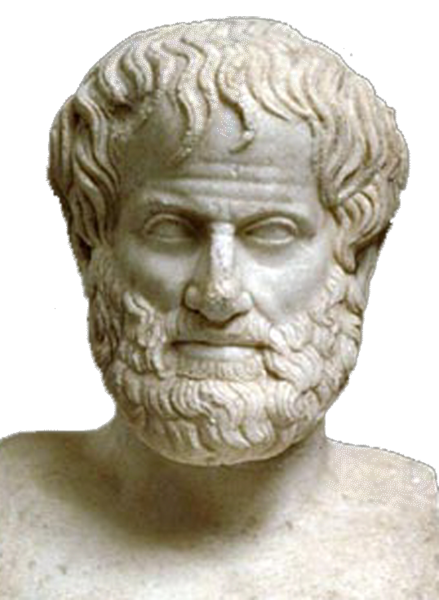
Aristotle's Poetics is the earliest surviving work of dramatic theory and the first extant philosophical treatise to focus on literary theory. This has been the traditional view for centuries. However, recent work is now challenging whether Aristotle focuses on literary theory per se (given that not one poem exists in the treatise) or whether he focuses instead on dramatic musical theory that only has language as one of the elements.
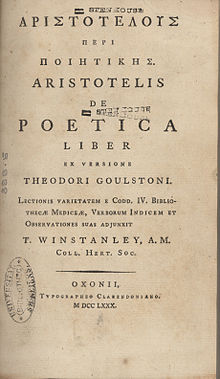
The term hamartia derives from the Greek ἁμαρτία, from ἁμαρτάνειν hamartánein, which means "to miss the mark" or "to err". It is most often associated with Greek tragedy, although it is also used in Christian theology.Hamartia as it pertains to dramatic literature was first used by Aristotle in his Poetics. In tragedy, hamartia is commonly understood to refer to the protagonist’s error or flaw that leads to a chain of plot actions culminating in a reversal from their good fortune to bad. What qualifies as the error or flaw can include an error resulting from ignorance, an error of judgement, a flaw in character, or sin. The spectrum of meanings has invited debate among critics and scholars, and different interpretations among dramatists.
Mimesis is a critical and philosophical term that carries a wide range of meanings, which include imitation, representation, mimicry, imitatio, receptivity, nonsensuous similarity, the act of resembling, the act of expression, and the presentation of the self.
The classical unities, Aristotelian unities, or three unities are rules for drama derived from a passage in Aristotle's Poetics.In their neoclassical form they are as follows:
1. unity of action: a play should have one action that it follows, with minimal subplots.
2. unity of time: the action in a play should occur over a period of no more than 24 hours.
3. unity of place: a play should exist in a single physical space and should not attempt to compress geography, nor should the stage represent more than one place.
Enlightenment refers to the "full comprehension of a situation". It is commonly used to denote the Age of Enlightenment,but is also used in Western cultures in a religious context.
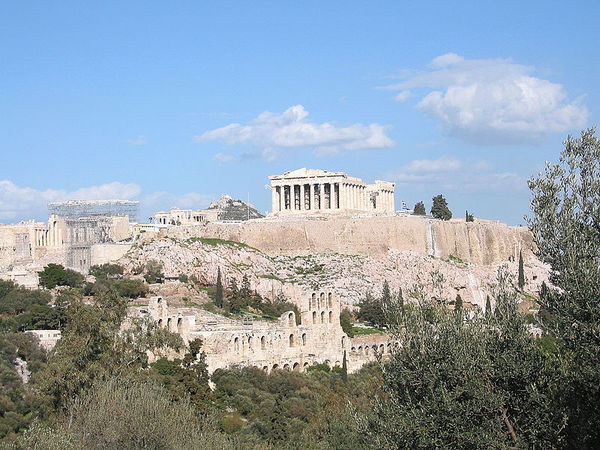
A civilization (or civilisation, see spelling differences) is any complex society characterized by urban development, social stratification, symbolic communication forms (typically, writing systems), and a perceived separation from and domination over the natural environment by a cultural elite.
TWO roads diverged in a yellow wood,
And sorry I could not travel both
And be one traveler, long I stood
And looked down one as far as I could
To where it bent in the undergrowth;
Then took the other, as just as fair,
And having perhaps the better claim,
Because it was grassy and wanted wear;
Though as for that the passing there
Had worn them really about the same,
And both that morning equally lay
In leaves no step had trodden black.
Oh, I kept the first for another day!
Yet knowing how way leads on to way,
I doubted if I should ever come back.
I shall be telling this with a sigh
Somewhere ages and ages hence:
Two roads diverged in a wood, and I—
I took the one less traveled by,
And that has made all the difference.
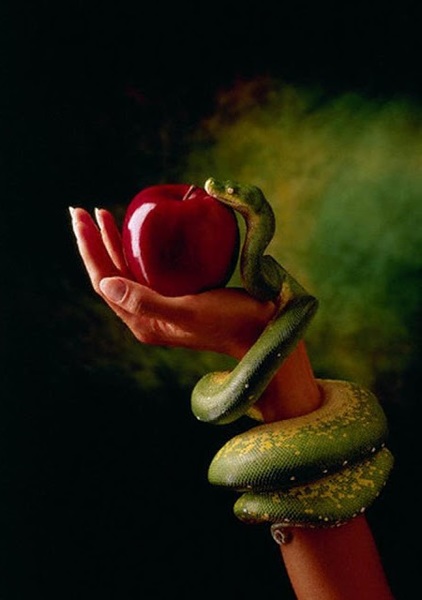
Forbidden fruit is a phrase that originates from Genesis concerning Adam and Eve in Genesis . In the narrative, Adam and Eve ate the fruit of good and evil in the Garden of Eden, which they had been commanded not to do by God. As a metaphor, the phrase typically refers to any indulgence or pleasure that is considered illegal or immoral.
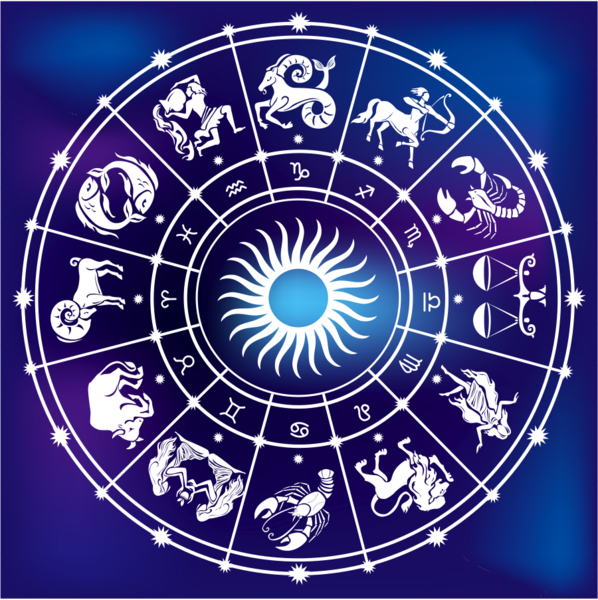
In Western astrology, astrological signs are the twelve 30° sectors of the ecliptic, starting at the vernal equinox (one of the intersections of the ecliptic with the celestial equator), also known as the First Point of Aries. The order of the astrological signs is Aries, Taurus, Gemini, Cancer, Leo, Virgo, Libra, Scorpio, Sagittarius, Capricorn, Aquarius and Pisces.
限會員,要發表迴響,請先登入


