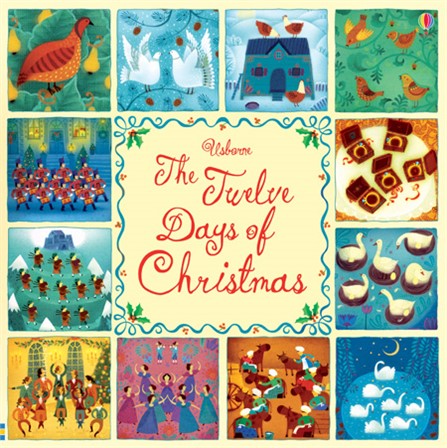
"The Twelve Days of Christmas" is an English Christmas carol that enumerates in the manner of a cumulative song a series of increasingly grand gifts given on each of the twelve days of Christmas. The song, published in England in 1780 without music as a chant or rhyme, is thought to be French in origin."The Twelve Days of Christmas" has a Roud Folk Song Index number of 68. The tunes of collected versions vary.
John Denver&The Muppets 12 Days of Christmas

Sex and the city:the movie-auld cangsyne
Make a fuss (over someone or something)
Definition:To worry about or make a bother about someone or something.
Please don't make a fuss over who gets the last cookie.

The Canterbury Tales is a collection of 24 stories that runs to over 17,000 lines written in Middle English by Geoffrey Chaucer. In 1386, Chaucer became Controller of Customs and Justice of Peace and, three years later, Clerk of the King's work in 1389. It was during these years that Chaucer began working on his most famous text, The Canterbury Tales.
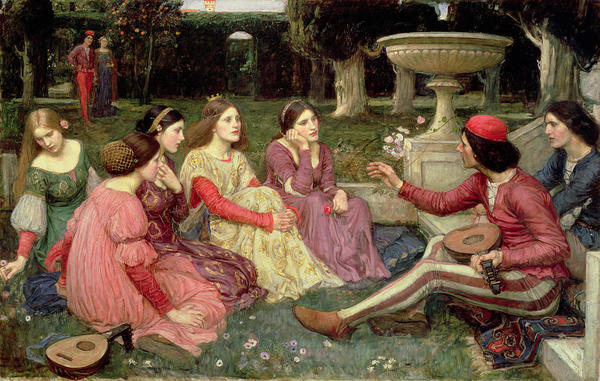
The Decameron is a collection of novellas by the 14th-century Italian author Giovanni Boccaccio (1313–1375). The book is structured as a frame story containing 100 tales told by a group of seven young women and three young men sheltering in a secluded villa just outside Florence to escape the Black Death, which was afflicting the city. Boccaccio probably conceived the Decameron after the epidemic of 1348, and completed it by 1353. The various tales of love in The Decameron range from the erotic to the tragic. Tales of wit, practical jokes, and life lessons contribute to the mosaic.

Niccolò Machiavelli was an Italian Renaissance historian, politician, diplomat, philosopher, humanist, and writer. He has often been called the founder of modern political science. He was for many years a senior official in the Florentine Republic, with responsibilities in diplomatic and military affairs. He also wrote comedies, carnival songs, and poetry. His personal correspondence is renowned in the Italian language.
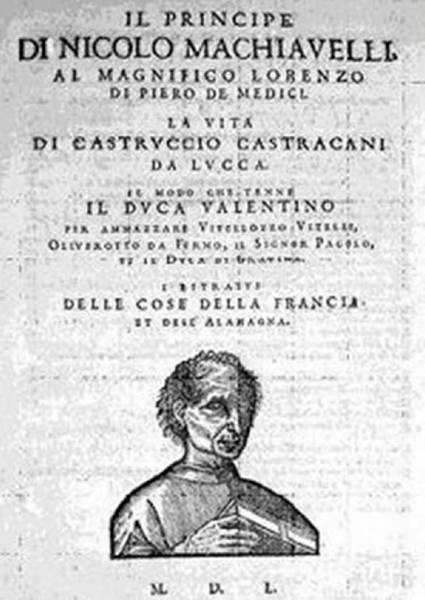
The Prince is a 16th-century political treatise, by the Italian diplomat and political theorist, Niccolò Machiavelli. From correspondence a version appears to have been distributed in 1513, using a Latin title, De Principatibus (About Principalities). However, the printed version was not published until 1532, five years after Machiavelli's death.
As cunning as a fox

Definition:To be as cunning as a fox means to be very clever at getting what you want, especially by tricking someone.
You can't fool Jack. He's as cunning as a fox.
1. Malicious(adj)
Definition:Having the nature of or resulting from malice.
She described thecharges as malicious.
2. Villain(n)
Definition:A wicked or evil person.
His villainy was well known.
3. Quarantine(n)
Definition:If a person or animal is in quarantine, they are being kept separate from other people or animals for a set period of time, usually because they have or may have a disease.
The dog was kept in quarantine for six months.
4. Florist(n)
Definition:One in the business of raising or selling flowers and ornamental plants.
The florist bunched the flowers up.
5. Quarantine(n)
Definition:If a person or animal is in quarantine, they are being kept separate from other people or animals for a set period of time, usually because they have or may have a disease.
The dog was kept in quarantine for six months.
6. Florist(n)
Definition:One in the business of raising or selling flowers and ornamental plants.
The florist bunched the flowers up.
see assets.
1530s, "sufficient estate," from Anglo-French asetz (singular), from Old French assez (11c.) "sufficiency, satisfaction; compensation," noun use of adverb meaning "enough, sufficiently; very much, a great deal," from Vulgar Latin *ad satis "to sufficiency," from Latin ad "to" (see ad-) + satis "enough" (see sad).
Beginning as a legal term, "sufficient estate" (to satisfy debts and legacies), it passed into general use; meaning "any property that theoretically can be converted to ready money" is from 1580s. Asset is a 19c. artificial singular. Asset stripping attested from 1972.
prodigious (adj.)
1550s, "ominous," from Middle French prodigieux and directly from Latin prodigiosus "strange, wonderful, marvelous, unnatural," from prodigium (see prodigy). Meaning "vast, enormous" is from c. 1600. Related: Prodigiously; prodigiosity.
expedite (v.)
c. 1500 (implied in past participle expedit "accomplished"), from Latin expeditus, past participle of expedire "extricate, disengage, liberate; procure, make ready, put in order, make fit, prepare; explain, make clear," literally "free the feet from fetters," hence to liberate from difficulties, from ex "out" (see ex-) + *pedis "fetter, chain for the feet," related to pes (genitive pedis) "foot," from PIE root *ped- (1) "a foot" (see foot (n.)). Compare Greek pede "fetter." Related: Expedited; expediting.
celerity (n.)
late 15c., from Old French celeritee (14c., Modern French célérité), from Latin celeritatem (nominative celeritas) "swiftness," from celer "swift," from possible PIE root *kel- (3) "to drive, set in swift motion" (source also of Sanskrit carati "goes," Greek keles "fast horse or ship," keleuthos "journey, road," Lithuanian sulys "a gallop," Old High German scelo "stallion").
usurp (v.)
early 14c., from Old French usurper "to (wrongfully) appropriate" (14c.), from Latin usurpare "make use of, seize for use," in later Latin "to assume unlawfully, trespass on," from usus "a use" (see use (v.)) + rapere "to seize" (see rapid (adj.)). Related: Usurped; usurping.
paltry (adj.)
1560s, probably an adjectival use of noun paltry "worthless thing" (1550s), associated with dialectal palt, pelt "trash," cognate with Middle Low German and East Frisian palte "rag," Middle Dutch palt "broken or torn fragment." Similar formation in Low German paltrig "rubbishy," East Frisian palterig "ragged, torn."
condone (v.)
1857, from Latin condonare "to give up, remit, permit," from com-, intensive prefix (see com-), + donare "to give" (see donation). Originally a legal term in the Matrimonial Causes Act, which made divorce a civil matter in Britain. Related: Condoned; condoning.
trivial (adj.)
"ordinary" (1580s); "insignificant, trifling" (1590s), from Latin trivialis "common, commonplace, vulgar," literally "of or belonging to the crossroads," from trivium "place where three roads meet," in transferred use, "an open place, a public place," from tri- "three" (see three) + via "road" (see via). The sense connection is "public," hence "common, commonplace."
The earliest use of the word in English was early 15c., a separate borrowing in the academic sense "of the trivium" (the first three liberal arts -- grammar, rhetoric, and logic); from Medieval Latin use of trivialis in the sense "of the first three liberal arts," from trivium, neuter of the Latin adjective trivius "of three roads, of the crossroads." Related: Trivially. For sense evolution to "pertaining to useless information," see trivia.
bizarre (adj.)
1640s, from French bizarre "odd, fantastic" (16c.), from Italian bizarro "irascible, tending to quick flashes of anger" (13c.), from bizza "fit of anger, quick flash of anger" (13c.). The sense in Italian evolved to "unpredictable, eccentric," then "strange, weird," in which sense it was taken into French and then English. Older derivation from Basque bizar "a beard" is no longer considered tenable.
menial (adj.)
late 14c., "pertaining to a household," from Anglo-French meignial, from Old French mesnie "household," earlier mesnede, from Vulgar Latin *mansionata, from Latin mansionem "dwelling" (see mansion). Sense of "lowly, humble, suited to a servant" is recorded by 1670s.
(n.)
"domestic servant," late 14c., meynyal; see menial (adj.).
venerable (adj.)
early 15c., "worthy of respect," from Old French venerable and directly from Latin venerabilis "worthy of reverence or respect," from venerari "to worship, revere" (see veneration). As a title, used in reference to ecclesiastics (in the Anglican church, specifically of archdeacons) or those who had obtained the first degree of canonization. Related: Venerably; venerability.
extraneous (adj.)
1630s, from Latin extraneus "external, strange," literally "that is without, from without" (as a noun, "a stranger"), from extra "outside of" (see extra-). A doublet of strange. Related: Extraneously.
ambiguous (adj.)
1520s, from Latin ambiguus "having double meaning, shifting, changeable, doubtful," adjective derived from ambigere "to dispute about, contend, debate," literally "to wander, go about, go around," figuratively "hesitate, waver, be in doubt," from ambi- "about" (see ambi-) + agere "drive, lead, act" (see act (n.)). First attested in Sir Thomas More (1528); related ambiguity dates to c. 1400. Related: Ambiguously; ambiguousness.
succinct (adj.)
early 15c., "having one's belt fastened tightly," from Middle French succincte, from Latin succinctus "prepared, ready; contracted, short," past participle of succingere "tuck up (clothes for action), gird from below," from assimilated form of sub "up from under" (see sub-) + cingere "to gird" (see cinch (n.)). Sense of "brief, concise" first recorded 1530s. Related: Succinctness.
archaic (adj.)
1810, from or by influence of French archaique (1776), ultimately from Greek arkhaikos "old-fashioned," from arkhaios "ancient," from arkhe "beginning" (see archon). Archaical is attested from 1799.
emulate (v.)
1580s, back-formation from emulation, or else from Latin aemulatus, past participle of aemulari "to rival." Related: Emulated; emulating; emulable; emulative.
facetious (adj.)
1590s, from French facétieux (16c.), from facétie "a joke" (15c.), from Latin facetiae "jests, witticisms" (singular facetia), from facetus "witty, elegant, fine, courteous," which is of unknown origin, perhaps related to facis "torch."
Formerly often in a good sense, "witty, amusing," but later implying a desire to be amusing that is often intrusive or ill-timed. Related: Facetiously; facetiousness. "Facetiæ in booksellers' catalogues, is, like curious, a euphemism for erotica."
rabid (adj.)
1610s, "furious, raving," from Latin rabidus "raging, furious, enraged; inspired; ungoverned; rabid," from rabere "be mad, rave" (see rage (v.)). Meaning "made mad by rabies" in English first recorded 1804. Related: Rabidly; rabidness.
salubrious (adj.)
1540s, from Latin salubris "promoting health, healthful," from salus (genitive salutis) "welfare, health" (see salute (v.)). Related: Salubriously; salubriousness.
complacent (adj.)
1650s, "pleasing," from Latin complacentem (nominative complacens) "pleasing," present participle of complacere "be very pleasing" (see complacence). Meaning "pleased with oneself" is from 1767. Related: Complacently.
somber (adj.)
1760 "gloomy, shadowy" (earlier sombrous, c. 1730), from French sombre "dark, gloomy," from Old French sombre (14c.), from an adjective from Late Latin subumbrare "to shadow," from sub "under" (see sub-) + umbra "shade, shadow," perhaps from a suffixed form of PIE *andho- "blind, dark" (see umbrage). Related: Somberly; somberness.
限會員,要發表迴響,請先登入


