2016.10.27
🎃 Western Literature 🎃
🍙 Ceres(mythology)
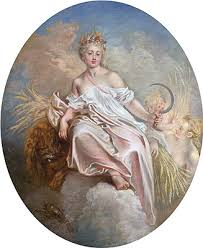
In ancient Roman religion, Ceres was a goddess of agriculture, grain crops, fertility and motherly relationships.She was originally the central deity in Rome's so-called plebeian or Aventine Triad, then was paired with her daughter Proserpina in what Romans described as "the Greek rites of Ceres".Ceres is the only one of Rome's many agricultural deities to be listed among the Dii Consentes, Rome's equivalent to the Twelve Olympians of Greek mythology. The Romans saw her as the counterpart of the Greek goddess Demeter, whose mythology was reinterpreted for Ceres in Roman art and literature.
🍙 Demeter
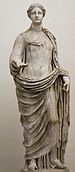
In ancient Greek religion and Greek mythology, Demeter is the goddess of the harvest and agriculture, who presided over grains and the fertilityof the earth.Though Demeter is often described simply as the goddess of the harvest, she presided also over the sacred law, and the cycle of life and death. She and her daughter Persephone were the central figures of the Eleusinian Mysteries that predated the Olympian pantheon. In the Linear B Mycenean Greek tablets of circa 1400–1200 BC found at Pylos, the "two mistresses and the king" may be related with Demeter, Persephone and Poseidon. Her Roman equivalent is Ceres.
🍙 Persephone
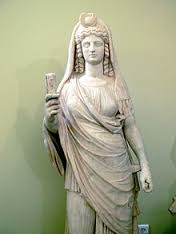
In Greek mythology, Persephone , also called Kore or Cora, is the daughter of Zeus and the harvest goddess Demeter, and is the queen of the underworld. Homer describes her as the formidable, venerable majestic princess of the underworld, who carries into effect the curses of men upon the souls of the dead. Persephone was married to Hades, the god-king of the underworld.The myth of her abduction represents her function as the personification of vegetation, which shoots forth in spring and withdraws into the earth after harvest; hence, she is also associated with spring as well as the fertility of vegetation.
>>Goddess of the underworld, springtime, flowers, vegetation
🍙 Nausicaa
Nausicaa is a character in Homer's Odyssey. She is the daughter of King Alcinous and Queen Arete of Phaeacia. Her name, in Greek, means "burner of ships". She is young and very pretty; Odysseus says that she resembles a goddess, particularly Artemis. Nausicaä is known to have several brothers. According to Aristotle and Dictys of Crete, Nausicaä later married Telemachus, the son of Odysseus, and had a son named Ptoliporthus.

🍙 Circe
Circe was a powerful sorceress—variously described as a goddess, nymph, or witch—in Greek myth and legend.Circe was renowned for her vast knowledge of potions and herbs. Through the use of magical potions and a wand or a staff, she transformed her enemies, or those who offended her, into animals.
🍙 Calypso
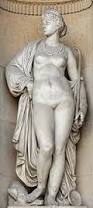
Calypso was a nymph in Greek mythology, who lived on the island of Ogygia, where she detained Odysseus for several years. She is generally said to be the daughter of the Titan Atlas.Calypso is remembered most for her role in Homer's Odyssey, in which she keeps the fabled Greek hero Odysseus on her island to make him her immortal husband.

🍙 Moirae
In Greek mythology, the Moirai or Moerae (Ancient Greek: Μοῖραι, "apportioners"), often known in English as the Fates (Latin: Fatae), were the white-robed incarnations of destiny; their Romanequivalent was the Parcae (euphemistically the "sparing ones"). Their number became fixed at three: Clotho(spinner), Lachesis (allotter) and Atropos (unturnable).They controlled the mother thread of life of every mortal from birth to death. They were independent, at the helm of necessity, directed fate, and watched that the fate assigned to every being by eternal laws might take its course without obstruction. The gods and men had to submit to them, although Zeus's relationship with them is a matter of debate.

🍙 Iris
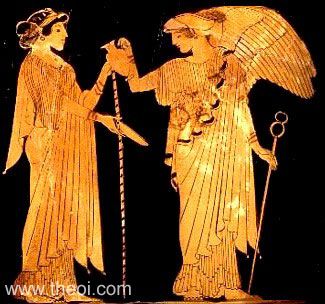
In Greek mythology, Iris is the personification of the rainbow and messenger of the gods. She is also known as one of the goddesses of the sea and the sky. Iris links the gods to humanity. She travels with the speed of wind from one end of the world to the other, and into the depths of the sea and the underworld.
🍙 Eris
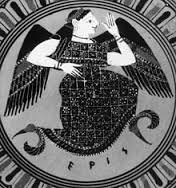
Eris is the Greek goddess of strife and discord. Her name is the equivalent of Latin Discordia, which means "discord". Eris' Greek opposite is Harmonia, whose Latin counterpart is Concordia. Homer equated her with the war-goddess Enyo, whose Roman counterpart is Bellona. The dwarf planet Eris is named after the goddess, as is the religion Discordianism.
>>Goddess of chaos, strife and discord
限會員,要發表迴響,請先登入


