Week 10
1.
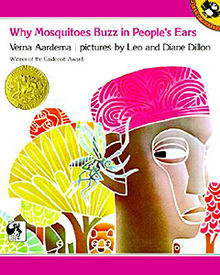
Why Mosquitoes Buzz in People's Ears
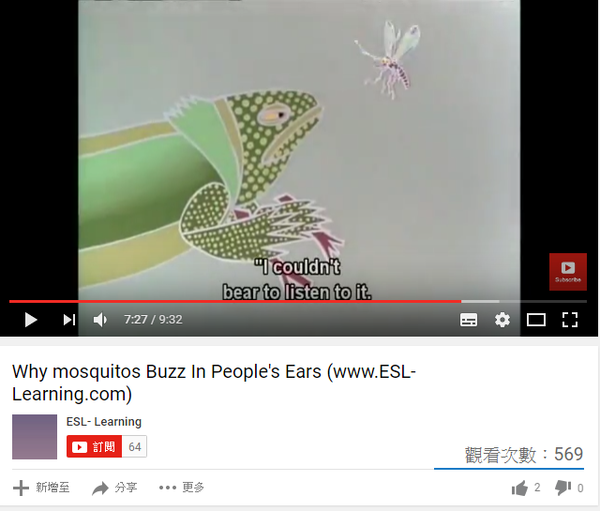
-is a picture book by Verna Aardema and illustrated by Leo and Diane Dillon told in the form of a cumulative tale written for young children, which tells an African legend. In this origin story, the mosquito lies to a lizard, who puts sticks in his ears and ends up frightening another animal, which down a long line causes a panic. In the end, an owlet is killed and the owl is too sad to wake the sun until the animals hold court and find out who is responsible. The mosquito is eventually found out, but it hides in order to escape punishment. So now it constantly buzzes in people's ears to find out if everyone is still angry at it.
This story is a resource for teachers to teach the skill cause and effect: "A cause is something that makes something else happen; An effect is what happens as a result of the cause" The idea that the mosquito is to blame for the unfortunate death of the owlet is an example of cause and effect.The actions from the other animals also offers several more examples of cause and effect as each animal does something that causes the next animal to do something. This chain of events finally causes the owlet to die.
The Author of Why Mosquitoes Buzz in People's Ears- Verna Aardema
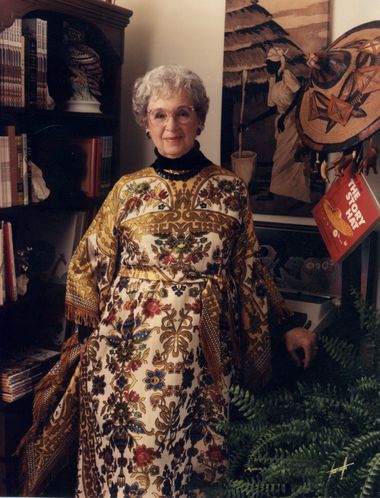
- was an American writer of children's books. Verna Norberg was born in New Era, Michigan. She graduated from Michigan State University with a B.A. of Journalism in 1934. She worked as a grade school teacher from 1934 to 1973 and became a correspondent for the Muskegon Chronicle in 1951, a job that lasted until 1972, the year before she retired from teaching. Her book, Why Mosquitoes Buzz in People's Ears (1975), illustrated by Leo and Diane Dillon, received the Caldecott Medal in 1976 and the Brooklyn Art Books for Children Award in 1977. Who's in Rabbit's House? 1977 was the 1977 School Library Journal Best Book of the Year and a Lewis Carroll Shelf Award winner in 1978.
The Illustrator of Why Mosquitoes Buzz in People's Ears- Leo and Diane Dillon
- were American illustrators of children's books and adult paperback book and magazine covers. One obituary of Leo called the work of the husband-and-wife team "a seamless amalgam of both their hands". In more than 50 years they created more than 100 speculative fiction book and magazine covers together as well as much interior artwork. Essentially all of their work in that field was joint.
2.
cultural diversity- is the quality of diverse or different cultures, as opposed to monoculture, the global monoculture, or a homogenization of cultures, akin to cultural decay. The phrase cultural diversity can also refer to having different cultures respect each other's differences. The phrase "cultural diversity" is also sometimes used to mean the variety of human societies or cultures in a specific region, or in the world as a whole. Globalization is often said to have a negative effect on the world's cultural diversity.
social diversity- social diversity is all of the ways that people within a single culture are set apart from each other. Elements of social diversity can include ethnicity, lifestyle, religion, language, tastes and preferences. n general, ideas of social diversity are expanding, in part because global interaction and communication are becoming easier and more common. Worldwide, the standard of living is generally improving too. Scholars believe that there is a correlation between healthier lifestyles and the willingness of people to accept diversity as a positive element within culture. The more people are exposed to certain elements of culture, the more likely those elements are to be absorbed into it.
3. Term Explanation and Vocabulary
(1)
pythia- commonly known as the Oracle of Delphi, was the name given to the High Priestess of the Temple of Apollo at Delphi who also served as the oracle. The name Pythia is derived from Pytho, which in myth was the original name of Delphi. In etymology the Greeks derived this place name from the verb "to rot", which refers to the sickly sweet smell of the decomposition of the body of the monstrous Python after he was slain by Apollo. Pythia was the House of Snakes.
python- a large heavy-bodied non-venomous snake occurring throughout the Old World tropics, killing prey by constriction and asphyxiation.
(2)
guilty- culpable of or responsible for a specified wrongdoing or Justly chargeable with a particular fault or error.
conscience- a person's moral sense of right and wrong, viewed as acting as a guide to one's behavior.
(3) di- apart, away
divorce– the legal dissolution of a marriage by a court or other competent body.
diversity- the state of being diverse or a range of different things.