1.
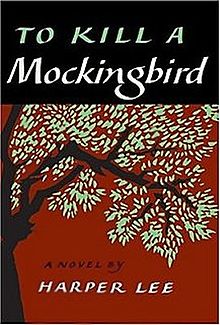
To Kill a Mockingbird
- is a novel by Harper Lee published in 1960. It was immediately successful, winning the Pulitzer Prize, and has become a classic of modern American literature. The plot and characters are loosely based on the author's observations of her family and neighbors, as well as on an event that occurred near her hometown in 1936, when she was 10 years old. The novel is renowned for its warmth and humor, despite dealing with the serious issues of rape and racial inequality. One critic explains the novel's impact by writing, "In the twentieth century, To Kill a Mockingbird is probably the most widely read book dealing with race in America, and its protagonist, Atticus Finch, the most enduring fictional image of racial heroism."
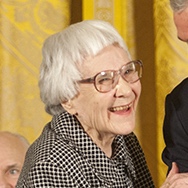
The Author of To Kill a Mockingbird- Harper Lee
- was an American novelist widely known for To Kill a Mockingbird, published in 1960. Immediately successful, it won the 1961 Pulitzer Prize and has become a classic of modern American literature. Though Lee had only published this single book, in 2007 she was awarded the Presidential Medal of Freedom for her contribution to literature. Additionally, Lee received numerous honorary degrees, though she declined to speak on those occasions. She was also known for assisting her close friend Truman Capote in his research for the book In Cold Blood (1966). Capote was the basis for the character Dill in To Kill a Mockingbird. The plot and characters of To Kill a Mockingbird are loosely based on Lee's observations of her family and neighbors, as well as an event that occurred near her hometown in 1936, when she was 10 years old. The novel deals with the irrationality of adult attitudes towards race and class in the Deep South of the 1930s, as depicted through the eyes of two children. The novel was inspired by racist attitudes in her hometown of Monroeville, Alabama.
2.
integration- the action or process of integrating.
segregation- the action or state of setting someone or something apart from others or the separation of pairs of alleles at meiosis and their independent transmission via separate gametes.
3.
benefit- an advantage or profit gained from something or a payment made by the state or an insurance scheme to someone entitled to receive it.
beneficiary- a person who derives advantage from something, especially a trust, will, or life insurance policy.
4.
pun- is a form of word play that suggests two or more meanings, by exploiting multiple meanings of words, or of similar-sounding words, for an intended humorous or rhetorical effect. These ambiguities can arise from the intentional use of homophonic, homographic, metonymic, or figurative language. A pun differs from a malapropism in that a malapropism is an incorrect variation on a correct expression, while a pun involves expressions with multiple correct interpretations. Puns may be regarded as in-jokes or idiomatic constructions, as their usage and meaning are specific to a particular language and its culture.
bumpy- uneven, with many patches raised above the rest.
5.
male- of or denoting the sex that produces gametes, especially spermatozoa, with which a female may be fertilized or inseminated to produce offspring.
malevolent- having or showing a wish to do evil to others.
malicious- characterized by malice; intending or intended to do harm.
malignant- evil in nature or effect; malevolent or (of a disease) very virulent or infectious.
malignancy- is the tendency of a medical condition to become progressively worse. Malignancy is most familiar as a characterization of cancer. A malignant tumor contrasts with a non-cancerous benign tumor in that a malignancy is not self-limited in its growth, is capable of invading into adjacent tissues, and may be capable of spreading to distant tissues. A benign tumor has none of those properties.
6.
bene- good, well
benevolent- well meaning and kindly.