1.
Understanding the genre: drama
-is the specific mode of narrative, typically fictional, represented in performance. The term comes from the Greek word δρᾶμα, drama, meaning action, meaning to do or to act. The term "drama" can refer to any kind of dramatic performance, including film, radio play, television play, and closet drama, however, this article is concerned solely with the enactment of a play in a theatre, performed by actors, on a stage, before an audience. Unlike other forms of literature the structure of dramatic texts is directly influenced by this collaborative mode of production and a collective form of reception.
2.
''Dover Beach'' by Matthew Arnold
-is a lyric poem by the English poet Matthew Arnold. It was first published in 1867 in the collection New Poems, but surviving notes indicate its composition may have begun as early as 1849. The most likely date is 1851. The title, locale and subject of the poem's descriptive opening lines is the shore of the English ferry port of Dover, Kent, facing Calais, France, at the Strait of Dover, the narrowest part (21 miles) of the English Channel, where Arnold honeymooned in 1851.
3.
Carpe Diem- is a Latin aphorism, usually translated "seize the day", taken from book 1 of the Roman poet Horace's work Odes (23 BC). In Horace, the phrase is part of the longer "carpe diem, quam minimum credula postero", which can be translated as "Seize the day, put very little trust in tomorrow (the future)". The ode says that the future is unforeseen and that one should not leave to chance future happenings, but rather one should do all one can today to make one's future better. This phrase is usually understood against Horace's Epicurean background. The meaning of "carpe diem" as used by Horace is not to ignore the future, but rather not to trust that everything is going to fall into place for you and taking action for the future today.
vocabulary:
aphorism- a short pithy saying expressing a general truth; maxim.
seize- to grasp suddenly and forcibly; take or grab.
4.
speaker- is the process or act of performing a presentation (a speech) focused around an individual directly speaking to a live audience in a structured, deliberate manner in order to inform, influence, or entertain them. Public speaking is commonly understood as the formal, face-to-face talking of a single person to a group of listeners.
narrator- one who tells a story or recounts a series of events, aloud or in writing or one who provides spoken commentary for a film, television program, etc.
paraphrase-is a restatement of the meaning of a text or passage using other words. The term itself is derived via Latin paraphrasis from Greek, meaning "additional manner of expression". The act of paraphrasing is also called "paraphrasis". A paraphrase typically explains or clarifies the text that is being paraphrased. For example, "The signal was red" might be paraphrased as "The train was not allowed to pass because the signal was red". A paraphrase is usually introduced with verbum dicendi—a declaratory expression to signal the transition to the paraphrase.
5.
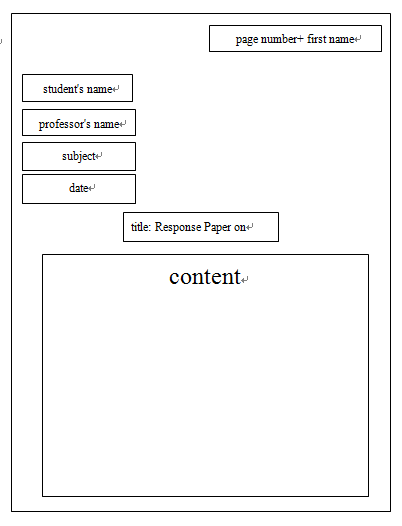
Sample Writing: Response Paper (P.777)
(1) No page number on first page.
(2) No need to make cover.
(3) the head of page: page number+ first name
(4) paragraph 1→hypothesis, motivation, what's about