1.
'' I celebrate myself, and sing myself.'' (p.721)
-Walt Whitman
I celebrate myself, and sing myself,
And what I assume you shall assume,
For every atom belonging to me as good belongs to you.
I loaf and invite my soul,
I lean and loafe at my ease observing a spear of summer grass.
My tongue, every atom of my blood, form'd from this soil, this air,
Born here of parents born here from parents the same, and their parents the same,
I, now thirty-seven years old in perfect health begin,
Hoping to cease not till death.
Creeds and schools in abeyance,
Retiring back a while sufficed at what they are, but never forgotten,
I harbor for good or bad, I permit to speak at every hazard,
Nature without check with original energy.
2.
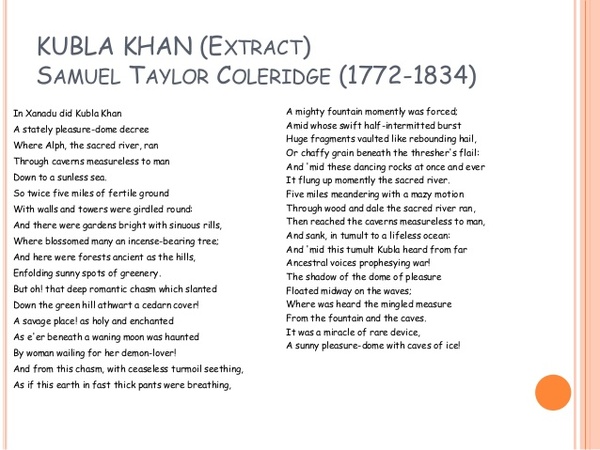
'' Kubla Khan''
-is a poem written by Samuel Taylor Coleridge, completed in 1797 and published in 1816. According to Coleridge's Preface to "Kubla Khan", the poem was composed one night after he experienced an opium-influenced dream after reading a work describing Xanadu, the summer palace of the Mongol ruler and Emperor of China Kublai Khan. Upon waking, he set about writing lines of poetry that came to him from the dream until he was interrupted by a person from Porlock. The poem could not be completed according to its original 200–300 line plan as the interruption caused him to forget the lines. He left it unpublished and kept it for private readings for his friends until 1816 when, at the prompting of Lord Byron, it was published.
3.
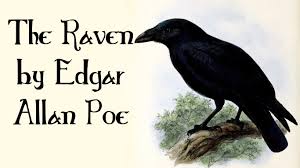
'' The Raven''
- is a narrative poem by American writer Edgar Allan Poe. First published in January 1845, the poem is often noted for its musicality, stylized language, and supernatural atmosphere. It tells of a talking raven's mysterious visit to a distraught lover, tracing the man's slow fall into madness. The lover, often identified as being a student, is lamenting the loss of his love, Lenore. Sitting on a bust of Pallas, the raven seems to further instigate his distress with its constant repetition of the word "Nevermore". The poem makes use of a number of folk, mythological, religious, and classical references.
4.
Islam- is a monotheistic and Abraham religion articulated by the Qur'an, a religious text considered by its adherents to be the verbatim word of God, and, for the vast majority of adherents, by the teachings and normative example of Muhammad (c. 570–8 June 632 CE). An adherent of Islam is called a Muslim(sometimes spelled "Moslem").Muslims believe that God is one and incomparable and that the purpose of existence is to worship God. Nearly all Muslims consider Muhammad to be the last prophet of God.
Muslim- relates to a person who follows the religion of Islam, a monotheistic and Abraham based on the Quran. Muslims consider the Quran to be the verbatim word of God as revealed to the Islamic prophet and messenger Muhammad. They also follow the sunnah teachings and practices of Muhammad as recorded in traditional accounts called hadith. "Muslim" is an Arabic word meaning "one who submits (to God)".
5.
Onomatopoeia- is a word that phonetically imitates, resembles or suggests the source of the sound that it describes. Onomatopoeia (as an uncountable noun) refers to the property of such words. Common occurrences of onomatopoeias include animal noises such as "oink", "miaow" (or "meow"), "roar" or "chirp". Onomatopoeias are not the same across all languages; they conform to some extent to the broader linguistic system they are part of; hence the sound of a clock may be tick tock in English, dī dā in Mandarin. (擬聲法)