1.
Psalm- commonly referred to simply as Psalms or "the Psalms", is the first book of the Ketuvim ("Writings"), the third section of the Hebrew Bible, and a book of the Christian Old Testament. The title is derived from the Greek translation, meaning "instrumental music" and, by extension, "the words accompanying the music." The book is an anthology of individual psalms, with 150 in the Jewish and Western Christian tradition and more in the Eastern Christian churches. Many of the psalms are linked to the name of King David, although his authorship is not accepted by modern Bible scholars.
Psalm 23- in the Hebrew Bible/Old Testament, the writer describes God as his Shepherd. The text, beloved by Jews and Christians alike, is often alluded to in popular media and has been set to music many times.
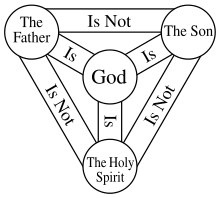
Trinity- defines God as three consubstantial persons, expressions, or hypostases: the Father, the Son (Jesus Christ), and the Holy Spirit; "one God in three persons". The three persons are distinct, yet are one "substance, essence or nature". In this context, a "nature" is what one is, while a "person" is who one is. According to this central mystery of most Christian faiths, there is only one God in three persons: while distinct from one another in their relations of origin (as the Fourth Lateran Council declared, "it is the Father who generates, the Son who is begotten, and the Holy Spirit who proceeds") and in their relations with one another, they are stated to be one in all else, co-equal, co-eternal and consubstantial, and "each is God, whole and entire".
The Old Testament was first written in Hebrew.
The New Testament was first written in Greek.
Catholicism- and its adjectival form Catholic are used as broad terms for describing specific traditions in the Christian churches in theology, doctrine, liturgy, ethics, and spirituality. "Catholicism" and "Catholic" in this sense refer to the practices of several Christian churches. This sense is to be distinguished from the use of these words to refer to the Roman Catholic Church, that which is in full communion with the Holy See, as well as the Orthodox Catholic Church (commonly called the "Orthodox Church" or the "Eastern Orthodox Church"), which also considers itself the universal and apostolic church.
Christian- is a person who adheres to Christianity, an Abrahamic, monotheistic religion based on the life and teachings of Jesus Christ. "Christian" derives from the Koine Greek word Christós (Χριστός), a translation of the Biblical Hebrew term mashiach.
Catholic vulgate- is a late fourth-century Latin translation of the Bible that became, during the 16th century, the Catholic Church's officially promulgated Latin version of the Bible. The translation was largely the work of St. Jerome, who, in 382, was commissioned by Pope Damasus I to revise the Vetus Latina ("Old Latin") collection of biblical texts in Latin then in use by the Church. Once published, it was widely adopted and eventually eclipsed theVetus Latina and, by the 13th century, was known as the "versio vulgata" (the "version commonly-used") or, more simply, in Latin as vulgata or in Greek as βουλγάτα ("Vulgate").
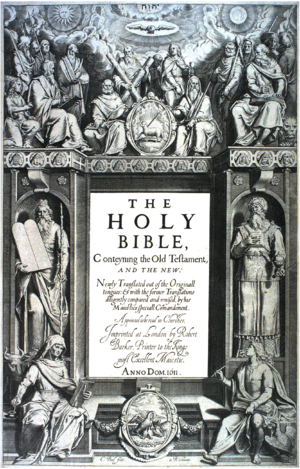
King James version- also known as the Authorized Version (AV) or King James Bible (KJB), is an English translation of the Christian Bible for the Church of England that begun in 1604 and completed in 1611. First printed by the King's Printer Robert Barker, this was the third translation into English to be approved by the English Church authorities. The first was the Great Bible commissioned in the reign of King Henry VIII (1535), and the second was the Bishops' Bible of 1568. In January 1604, James I convened the Hampton Court Conference where a new English version was conceived in response to the perceived problems of the earlier translations as detected by the Puritans, a faction within the Church of England. The translation is widely considered a towering achievement in English literature, as both beautiful and scholarly.
2.
Term Explanation
protestant-a member of a Western Christian church whose faith and practice are
founded on the principles of the Reformation, especially in theacceptance of the Bible as the sole source of revelation, in justification by faith alone, and in the universal priesthood of all the believers.
Sistine Chapel- is a chapel in the Apostolic Palace, the official residence of the Pope, in Vatican City. Originally known as the Cappella Magna, the chapel takes its name from Pope Sixtus IV, who restored it between 1477 and 1480. Since that time, the chapel has served as a place of both religious and functionary papal activity. Today it is the site of the Papal conclave, the process by which a new pope is selected.
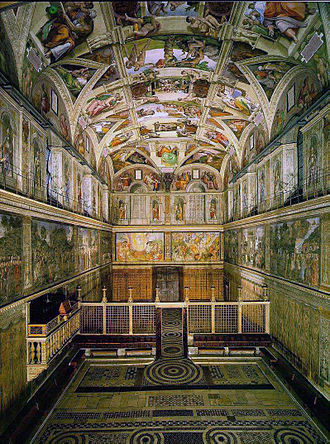
fig leaves- is widely used figuratively to convey the covering up of an act or an object that is embarrassing or distasteful with something of innocuous appearance, a metaphorical reference to the Biblical Book of Genesis, in which Adam and Eve used fig leaves to cover their nudity after eating the fruit from the tree of the knowledge of good and evil.

olive leaves- is the leaf of the olive tree (Olea europaea). Although olive oil is well known for its flavor and health benefits, the leaf has been used medicinally in various times and places. Olive leaf and olive leaf extracts (OLE), are now marketed as anti-aging, immunostimulator, antioxidant, cardio protective, blood sugar regulating, anti-inflammatory and antibiotic agents.

free will- is the ability to choose between different possible courses of action. It is closely linked to the concepts of responsibility, praise, guilt, sin, and other judgments which apply only to actions that are freely chosen. It is also connected with the concepts of advice, persuasion, deliberation, and prohibition. Traditionally, only actions that are freely willed are seen as deserving credit or blame.
3.
mor- death
morgue-a place in which the bodies of persons found dead are kept until identified
and claimed or until arrangements for burial have been made.
-a reference file in a newspaper or magazine office.
mortician- one whose business is the management of funerals.
mortify- to cause to experience shame, humiliation, or wounded pride.
-to discipline (one's of the body and the appetites) by self-denial or self-inflicted
privation, especially for religious reasons.