parody
A parody is a work created to imitate, make fun of, or comment on an original work—its subject, author, style, or some other target—by means of satiric or ironic imitation. As the literary theorist Linda Hutcheon puts it, "parody … is imitation, not always at the expense of the parodied text." Another critic, Simon Dentith, defines parody as "any cultural practice which provides a relatively polemical allusive imitation of another cultural production or practice." Parody may be found in art or culture, including literature, music (although "parody" in music has an earlier, somewhat different meaning than for other art forms),animation, gaming, and film.

Cathedral
A cathedral is a Christian church which contains the seat of a bishop, thus serving as the central church of a diocese, conference, or episcopate. The counterpart term for such a church in German is Dom from Latin domus ecclesiae or domus episcopalis; also Italian Duomo, Dutch Domkerk and cognates in many other European languages. Churches with the function of "cathedral" are usually specific to those Christian denominations with an episcopal hierarchy, such as the Roman Catholic, Anglican, Orthodox, and some Lutheran and Methodist churches. Church buildings embodying the functions of a cathedral first appear in Italy, Gaul, Spain and North Africa in the 4th century, but cathedrals did not become universal within the Western Catholic Churchuntil the 12th century, by which time they had developed architectural forms, institutional structures and legal identities distinct from parish churches, monastic churches and episcopal residences.
An Affair to Remember
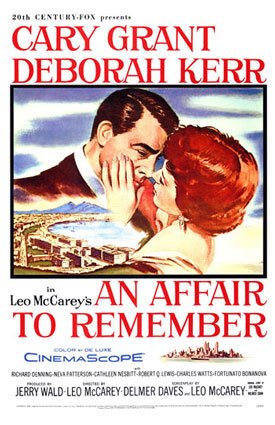
An Affair to Remember is a 1957 American romance film starring Cary Grant and Deborah Kerr, directed by Leo McCarey and filmed in CinemaScope and DeLuxe Color. It was distributed by 20th Century Fox. The film is considered one of the most romantic movies of all time, according to the American Film Institute. The film was a remake of McCarey's 1939 film Love Affair, starring Irene Dunne and Charles Boyer.
Plot
Nickie Ferrante , a well-known playboy and dilettante in the arts, meets Terry McKay aboard the Transatlantic ocean liner SS Constitution en route from Europe to New York. Each is involved with someone else. After a series of chance meetings aboard the ship, they establish a friendship. When Terry joins Nickie on a brief visit to his grandmother when the ship anchors near her home at Villefranche-sur-Mer on the Mediterranean coast, she sees Nickie with new eyes and their feelings blossom into love. During their visit, it is revealed that Nickie has had a talent for painting, but has dropped said trait due to his critical attitude towards his own art. As the ship returns to New York City, they agree to reunite at the top of the Empire State Building in six months' time, if they have succeeded in ending their relationships and starting new careers.
On the day of their rendezvous, Terry, in her haste to reach the Empire State Building, is struck down by a car while crossing a street. Gravely injured, she is rushed to the hospital. Meanwhile, Nickie, waiting for her at the observation deck at the top of the building, is unaware of the accident and, after many hours, finally concedes at midnight that she will not arrive, believing that she has rejected him.
After the accident Terry, now unable to walk, refuses to contact Nickie, wanting to conceal her disability. Instead, she finds work as a music teacher. Nickie has pursued his talent as a painter and has his work displayed by an old friend, an art shop owner. Six months after the accident, she sees Nickie with his former fiancée at the ballet, which she herself is attending with her former boyfriend. Nickie does not notice her condition because she is seated and only says hello as he passes her.
Nickie finally learns Terry's address and, on Christmas Eve, makes a surprise visit to her. Although he steers the conversation to make her explain her actions, Terry merely dodges the subject, never leaving the couch on which she sits. He gives her a shawl that his grandmother left for Terry after she died. As he is leaving, Nickie mentions a painting that he had been working on when they originally met, and that it was just given away at the art shop to a woman who liked it but had no money. He is about to say that the woman was in a wheelchair when he pauses, suddenly suspecting why Terry has been sitting unmoving on the couch. He walks into her bedroom and sees his painting hanging on the wall, and a wheelchair concealed there. He now knows why she did not keep their appointment. The film ends with the two in a tight embrace, each realizing that the other's love endures. In closing, Terry says, "If you can paint, I can walk; anything can happen, don't you think?"
Compact Cassetle
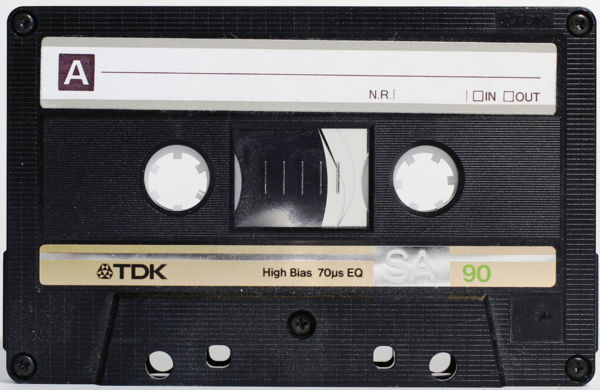
The Compact Cassette or Musicassette (MC), also commonly called cassette tape, audio cassette, or simply tape or cassette, is an analog magnetic tape recording format for audio recording and playback. It was released by Philips in 1962, having been developed in Hasselt, Belgium. Compact cassettes come in two forms, either already containing content as a pre-recorded cassette, or as a fully recordable "blank" cassette. It was designed originally for dictation machines, but improvements in fidelity led the Compact Cassette to supplant the Stereo 8-track cartridge and reel-to-reel tape recording in most non-professional applications. Its uses ranged from portable audio to home recording to data storage for early microcomputers. The first cassette player (although mono) designed for use in car dashes was introduced in 1968.Between the early 1970s and the early 2000s, the cassette was one of the two most common formats for prerecorded music, first alongside the LP record and later the compact disc (CD).
限會員,要發表迴響,請先登入


