To the Virgins, to Make Much of Time
BY ROBERT HERRICK
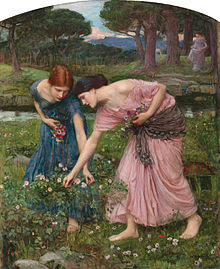
Gather ye rose-buds while ye may,
Old Time is still a-flying;
And this same flower that smiles today
Tomorrow will be dying.
The glorious lamp of heaven, the sun,
The higher he’s a-getting,
The sooner will his race be run,
And nearer he’s to setting.
That age is best which is the first,
When youth and blood are warmer;
But being spent, the worse, and worst
Times still succeed the former.
Then be not coy, but use your time,
And while ye may, go marry;
For having lost but once your prime,
You may forever tarry.
Summary
From the title, we can tell that the speaker is addressing this poem to a group of virgins. He's telling them that they should gather their "rosebuds" while they can, because time is quickly passing. He drives home this point with some images from nature, including flowers dying and the sun setting. He thinks that one's youth is the best time in life, and the years after that aren't so great. The speaker finishes off the poem by encouraging these young virgins to make good use of their time by getting married, before they're past their prime and lose the chance.
Analysis
“To the Virgins, to Make Much of Time” is a short lyric poem that at first reading seems to be simply a call to young women to enjoy life, particularly its physical pleasures, while they are young.
Robert Herrick is considered one of the circle of poets (sometimes called the “sons of Ben”) that gathered around poet and playwright Ben Jonson in London in the early seventeenth century. Herrick became a country pastor in 1629, but when upon the advent of the English Civil War he remained loyal to his king, he was ousted from his post by the Puritans, who closed the theaters and taverns—and eventually executed the king. This political exile deprived Herrick of his living and cut him off from the possibility of returning to London. It is hard to tell when Herrick poems such as “Delight in Disorder,” “Upon Julia’s Clothes,” and this one were actually written, but since they were published together in 1648, only a year after Herrick was removed from his post, they may constitute a kind of challenge to Puritan strictures.
The title of the poem begins the address to the virgins. To “make much of time” is both to make something happen while time is passing and to pay attention to its passage. In the first stanza, one use to be made of time is to collect flowers before they are yet in full bloom, because time passes so quickly that soon new flowers will be withered on the vine.
The idea of the passage of time is given a new image as the second stanza describes the movement of the sun. By casting its circuit through the sky in terms of a “race,” the sense of how quickly time passes is emphasized; in the same way that the passing away of the “smile” of the flower is inherent in its bud, the setting of the sun is implicit in its rising. The combination of the idea of gathering in the first stanza and the reference to the sun in the second seems to echo the well-known injunction to “make hay while the sun shines.”
In the third stanza, the idea of the passage of time is cast in human terms: The “first” or young age is “best,” “warmer,” more active. Just as heat is expended by the sun, however, the heat that makes youth warm is also “spent” and diminishes from “best” to “worse” to “worst.” The passage from youth to age in this stanza is parallel to the progression of bud to bloom to death of the flowers in the first.
The shift to human terms in the third stanza anticipates the return in the fourth to direct address to the virgins. They are admonished not to be “coy,” which means “to shrink from familiarity,” in two senses: in modesty or flirtatiousness. So what this request calls for is that the virgins not, in either innocent ignorance or in proud folly, forget how quickly time passes. They are further instructed to marry while they can, with the warning that once they have lost whatever it takes to get a husband, once the time to do so has passed, they may “tarry,” wait, or procrastinate, forever.
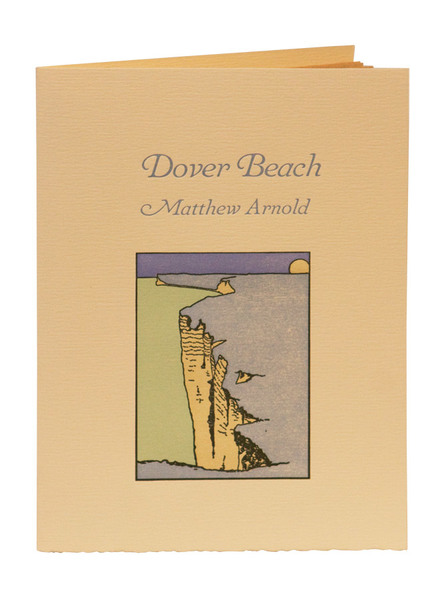
Dover Beach
"Dover Beach" is a lyric poem by the English poet Matthew Arnold. It was first published in 1867 in the collection New Poems, but surviving notes indicate its composition may have begun as early as 1849. The most likely date is 1851.
The title, locale and subject of the poem's descriptive opening lines is the shore of the English ferry port of Dover, Kent, facing Calais, France, at the Strait of Dover, the narrowest part (21 miles) of the English Channel, where Arnold honeymooned in 1851.
The sea is calm tonight.
The tide is full, the moon lies fair
Upon the straits; on the French coast the light
Gleams and is gone; the cliffs of England stand,
Glimmering and vast, out in the tranquil bay.
Come to the window, sweet is the night-air!
Only, from the long line of spray
Where the sea meets the moon-blanched land,
Listen! you hear the grating roar
Of pebbles which the waves draw back, and fling,
At their return, up the high strand,
Begin, and cease, and then again begin,
With tremulous cadence slow, and bring
The eternal note of sadness in.
Sophocles long ago
Heard it on the Ægean, and it brought
Into his mind the turbid ebb and flow
Of human misery; we
Find also in the sound a thought,
Hearing it by this distant northern sea.
The Sea of Faith
Was once, too, at the full, and round earth’s shore
Lay like the folds of a bright girdle furled.
But now I only hear
Its melancholy, long, withdrawing roar,
Retreating, to the breath
Of the night-wind, down the vast edges drear
And naked shingles of the world.
Ah, love, let us be true
To one another! for the world, which seems
To lie before us like a land of dreams,
So various, so beautiful, so new,
Hath really neither joy, nor love, nor light,
Nor certitude, nor peace, nor help for pain;
And we are here as on a darkling plain
Swept with confused alarms of struggle and flight,
Where ignorant armies clash by night.
Summary
"Dover Beach" opens with a quiet scene. A couple looks out on the moonlit water of the English Channel, and listens to the sound of the waves. Then, all of a sudden it zooms out. And we mean way out.
See, the sound of the waves makes the speaker think first of ancient Greece. Yep, Greece. Then he turns the sound of the surf into a metaphor for human history, and the gradual, steady loss of faith that his culture has experienced. The poem ends on a gorgeous, heartbreaking note, with the couple clinging to their love in a world of violence and fear and pain.
Analysis
Arguably Matthew Arnold's most famous poem, "Dover Beach" manages to comment on his most recurring themes despite its relatively short length. Its message - like that of many of his other poems - is that the world's mystery has declined in the face of modernity. However, that decline is here painted as particularly uncertain, dark, and volatile.
What also makes the poem particularly powerful is that his romantic streak has almost no tinge of the religious. Instead, he speaks of the "Sea of Faith" without linking it to any deity or heaven. This "faith" has a definite humanist tinge - it seems to have once guided decisions and smoothed over the world's problems, tying everyone together in a meaningful way. It is no accident that the sight inspiring such reflection is that of untouched nature, almost entirely absent from any human involvement. In fact, the speaker's true reflection begins once the only sign of life - the light over in France - extinguishes. What Arnold is expressing is an innate quality, a natural drive towards beauty.
He explores this contradiction through what is possibly the poem's most famous stanza, that which compares his experience to that of Sophocles. The comparison could be trite, if the point were merely that someone long before had appreciated the same type of beauty that he does. However, it is poignant because it reveals a darker potential in the beautiful. What natural beauty reminds us of is human misery. Because we can recognize the beauty in nature, but can never quite transcend our limited natures to reach it, we might be drawn to lament as well as celebrate it. The two responses are not mutually exclusive. This contradictory feeling is explored in many of Arnold's poems - "The Scholar-Gipsy" and "A Dream" are two examples - and he shows in other poems an instinct towards the tragic, the human inability to transcend our weakness (an example would be "Consolation," which presents time as a tragic force). Thus, the allusion to Socrates, a Greek playwright celebrated for his tragedies, is particularly apt.
Such a dual experience - between celebration of and lament for humanity - is particularly possible for Arnold, since mankind has traded faith for science following the publication of On the Origin of Species and the rise of Darwinism. Ironically, the tumult of nature - out on the ocean - is nothing compared to the tumult of this new way of life. It is this latter tumult that frightens the speaker, that has him beg his lover to stay true to him. He worries that the chaos of the modern world will be too great, and that she will be shocked to discover that even in the presence of great beauty like that outside their window, mankind is gearing up for destruction. Behind even the appearance of faith is the new order, and he hopes that they might use this moment to keep them together despite such uncertainty.
The poem epitomizes a certain type of poetic experience, in which the poet focuses on a single moment in order to discover profound depths. Here, the moment is the visceral serenity the speaker feels in studying the landscape, and the contradictory fear that that serenity then leads him to feel. To accomplish that end, the poem uses a lot of imagery and sensory information. It begins with mostly visual depictions, describing the calm sea, the fair moon, and the lights in France across the Channel. "The cliffs of England stand/Glimmering and vast" not only describes the scene, but establishes how small the two humans detailed in the poem are in the face of nature.
Perhaps most interestingly, the first stanza switches from visual to auditory descriptions, including "the grating roar" and "tremulous cadence slow." The evocation of several senses fills out the experience more, and creates the sense of an overwhelming and all-encompassing moment.
The poem also employs a lot of enjambment (the poetic technique of leaving a sentence unfinished on one line, to continue and finish it on the next). The effect is to give the poem a faster pace: the information hits us in rapid succession, forming a clear picture in our minds little by little. It also suggests that Arnold does not wish to create a pretty picture meant for reflection. Instead, the beautiful sight is significant because of the fear and anxiety it inspires in the speaker. Because the poem so wonderfully straddles the line between poetic reflection and desperate uncertainty, it has remained a well-loved piece throughout the centuries.
限會員,要發表迴響,請先登入


