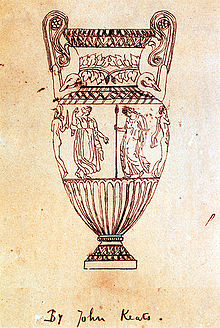
Ode on a Grecian Urn
"Ode on a Grecian Urn" is a poem written by the English Romantic poet John Keats in May 1819 and published anonymously in the January 1820, Number 15, issue of the magazine Annals of the Fine Arts (see 1820 in poetry).
The poem is one of several "Great Odes of 1819", which includes "Ode on Indolence", "Ode on Melancholy", "Ode to a Nightingale", and "Ode to Psyche". Keats found earlier forms of poetry unsatisfactory for his purpose, and the collection represented a new development of the ode form. He was inspired to write the poem after reading two articles by English artist and writer Benjamin Haydon. Keats was aware of other works on classical Greek art, and had first-hand exposure to the Elgin Marbles, all of which reinforced his belief that classical Greek art was idealistic and captured Greek virtues, which forms the basis of the poem.
Divided into five stanzas of ten lines each, the ode contains a narrator's discourse on a series of designs on a Grecian urn. The poem focuses on two scenes: one in which a lover eternally pursues a beloved without fulfilment, and another of villagers about to perform a sacrifice. The final lines of the poem declare that "'beauty is truth, truth beauty,' – that is all / Ye know on earth, and all ye need to know", and literary critics have debated whether they increase or diminish the overall beauty of the poem. Critics have focused on other aspects of the poem, including the role of the narrator, the inspirational qualities of real-world objects, and the paradoxical relationship between the poem's world and reality.
"Ode on a Grecian Urn" was not well received by contemporary critics. It was only by the mid-19th century that it began to be praised, although it is now considered to be one of the greatest odes in the English language. A long debate over the poem's final statement divided 20th-century critics, but most agreed on the beauty of the work, despite various perceived inadequacies.
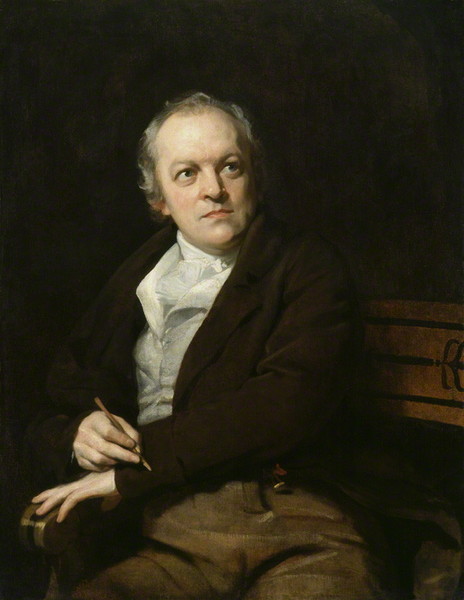
William Blake
William Blake (28 November 1757 – 12 August 1827) was an English poet, painter, and printmaker. Largely unrecognised during his lifetime, Blake is now considered a seminal figure in the history of the poetry and visual arts of the Romantic Age. His so-called prophetic works were said by 20th century critic Northrop Frye to form "what is in proportion to its merits the least read body of poetry in the English language". His visual artistry led 21st-century critic Jonathan Jones to proclaim him "far and away the greatest artist Britain has ever produced". In 2002, Blake was placed at number 38 in the BBC's poll of the 100 Greatest Britons. Although he lived in London his entire life (except for three years spent in Felpham), he produced a diverse and symbolically rich œuvre, which embraced the imagination as "the body of God" or "human existence itself".
Although Blake was considered mad by contemporaries for his idiosyncratic views, he is held in high regard by later critics for his expressiveness and creativity, and for the philosophical and mystical undercurrents within his work. His paintings and poetry have been characterised as part of the Romantic movement and as "Pre-Romantic". Reverent of the Bible but hostile to the Church of England (indeed, to almost all forms of organised religion), Blake was influenced by the ideals and ambitions of the French and American Revolutions. Though later he rejected many of these political beliefs, he maintained an amiable relationship with the political activist Thomas Paine; he was also influenced by thinkers such as Emanuel Swedenborg. Despite these known influences, the singularity of Blake's work makes him difficult to classify. The 19th-century scholar William Rossetti characterised him as a "glorious luminary", and "a man not forestalled by predecessors, nor to be classed with contemporaries, nor to be replaced by known or readily surmisable successors".
The Lamb
BY WILLIAM BLAKE
Little Lamb who made thee
Dost thou know who made thee
Gave thee life & bid thee feed.
By the stream & o'er the mead;
Gave thee clothing of delight,
Softest clothing wooly bright;
Gave thee such a tender voice,
Making all the vales rejoice!
Little Lamb who made thee
Dost thou know who made thee
Little Lamb I'll tell thee,
Little Lamb I'll tell thee!
He is called by thy name,
For he calls himself a Lamb:
He is meek & he is mild,
He became a little child:
I a child & thou a lamb,
We are called by his name.
Little Lamb God bless thee.
Little Lamb God bless thee.
Summary
The poem begins with the question, “Little Lamb, who made thee?” The speaker, a child, asks the lamb about its origins: how it came into being, how it acquired its particular manner of feeding, its “clothing” of wool, its “tender voice.” In the next stanza, the speaker attempts a riddling answer to his own question: the lamb was made by one who “calls himself a Lamb,” one who resembles in his gentleness both the child and the lamb. The poem ends with the child bestowing a blessing on the lamb.
Commentary
The poem is a child’s song, in the form of a question and answer. The first stanza is rural and descriptive, while the second focuses on abstract spiritual matters and contains explanation and analogy. The child’s question is both naive and profound. The question (“who made thee?”) is a simple one, and yet the child is also tapping into the deep and timeless questions that all human beings have, about their own origins and the nature of creation. The poem’s apostrophic form contributes to the effect of naiveté, since the situation of a child talking to an animal is a believable one, and not simply a literary contrivance. Yet by answering his own question, the child converts it into a rhetorical one, thus counteracting the initial spontaneous sense of the poem. The answer is presented as a puzzle or riddle, and even though it is an easy one—child’s play—this also contributes to an underlying sense of ironic knowingness or artifice in the poem. The child’s answer, however, reveals his confidence in his simple Christian faith and his innocent acceptance of its teachings.
The lamb of course symbolizes Jesus. The traditional image of Jesus as a lamb underscores the Christian values of gentleness, meekness, and peace. The image of the child is also associated with Jesus: in the Gospel, Jesus displays a special solicitude for children, and the Bible’s depiction of Jesus in his childhood shows him as guileless and vulnerable. These are also the characteristics from which the child-speaker approaches the ideas of nature and of God. This poem, like many of the Songs of Innocence, accepts what Blake saw as the more positive aspects of conventional Christian belief. But it does not provide a completely adequate doctrine, because it fails to account for the presence of suffering and evil in the world. The pendant (or companion) poem to this one, found in the Songs of Experience, is “The Tyger”; taken together, the two poems give a perspective on religion that includes the good and clear as well as the terrible and inscrutable. These poems complement each other to produce a fuller account than either offers independently. They offer a good instance of how Blake himself stands somewhere outside the perspectives of innocence and experience he projects.
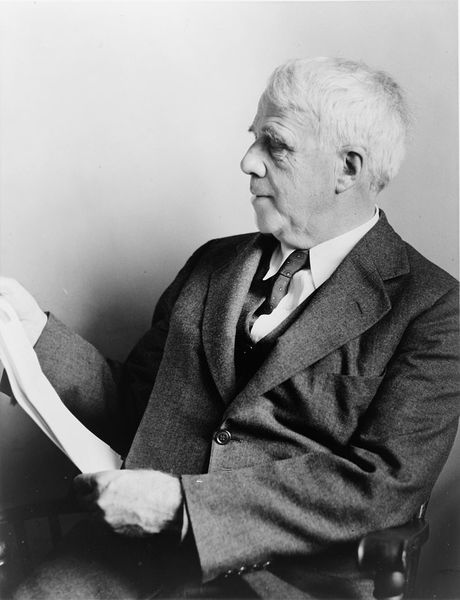
Robert Frost
Robert Lee Frost (March 26, 1874 – January 29, 1963) was an American poet. His work was initially published in England before it was published in America. He is highly regarded for his realistic depictions of rural life and his command of American colloquial speech. His work frequently employed settings from rural life in New England in the early twentieth century, using them to examine complex social and philosophical themes. One of the most popular and critically respected American poets of the twentieth century, Frost was honored frequently during his lifetime, receiving four Pulitzer Prizes for Poetry. He became one of America's rare "public literary figures, almost an artistic institution." He was awarded the Congressional Gold Medal in 1960 for his poetic works. On July 22, 1961, Frost was named poet laureate of Vermont.
The Road Not Taken
BY ROBERT FROST
Two roads diverged in a yellow wood,
And sorry I could not travel both
And be one traveler, long I stood
And looked down one as far as I could
To where it bent in the undergrowth;
Then took the other, as just as fair,
And having perhaps the better claim,
Because it was grassy and wanted wear;
Though as for that the passing there
Had worn them really about the same,
And both that morning equally lay
In leaves no step had trodden black.
Oh, I kept the first for another day!
Yet knowing how way leads on to way,
I doubted if I should ever come back.
I shall be telling this with a sigh
Somewhere ages and ages hence:
Two roads diverged in a wood, and I—
I took the one less traveled by,
And that has made all the difference.
John Donne
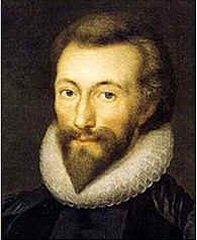
John Donne was an English poet and cleric in the Church of England.
He is considered the pre-eminent representative of the metaphysical poets. His works are noted for their strong, sensual style and include sonnets, love poems, religious poems, Latin translations, epigrams, elegies, songs, satires and sermons. His poetry is noted for its vibrancy of language and inventiveness of metaphor, especially compared to that of his contemporaries. Donne's style is characterised by abrupt openings and various paradoxes, ironies and dislocations. These features, along with his frequent dramatic or everyday speech rhythms, his tense syntax and his tough eloquence, were both a reaction against the smoothness of conventional Elizabethan poetry and an adaptation into English of European baroque and mannerist techniques. His early career was marked by poetry that bore immense knowledge of English society and he met that knowledge with sharp criticism. Another important theme in Donne's poetry is the idea of true religion, something that he spent much time considering and about which he often theorized. He wrote secular poems as well as erotic and love poems. He is particularly famous for his mastery of metaphysical conceits.
Despite his great education and poetic talents, Donne lived in poverty for several years, relying heavily on wealthy friends. He spent much of the money he inherited during and after his education on womanising, literature, pastimes, and travel. In 1601, Donne secretly married Anne More, with whom he had twelve children. In 1615, he became an Anglican priest, although he did not want to take Anglican orders. He did so because King James I persistently ordered it. In 1621, he was appointed the Dean of St Paul's Cathedral in London. He also served as a member of Parliament in 1601 and in 1614.
No Man is an Island
BY JOHN DONNE
No man is an island entire of itself; every man
is a piece of the continent, a part of the main;
if a clod be washed away by the sea, Europe
is the less, as well as if a promontory were, as
well as any manner of thy friends or of thine
own were; any man's death diminishes me,
because I am involved in mankind.
And therefore never send to know for whom
the bell tolls; it tolls for thee.
Metaphysics
Metaphysics is a branch of philosophy exploring the fundamental nature of reality.
While various views and methods have been called 'metaphysics' across history, this article approaches metaphysics first from the perspective of contemporary analytical philosophy, and then explores metaphysics in other traditions. In this vein, metaphysics seeks to answer two basic questions:
1.Ultimately, what is there?
2.What is it like?
Topics of metaphysical investigation include existence, objects and their properties, space and time, cause and effect, and possibility. A central branch of metaphysics is ontology, the investigation into the basic categories of being and how they relate to one another. Another branch is metaphysical cosmology: which seeks to understand the origin and meaning of the universe by thought alone.
There are two broad conceptions about what "world" is studied by metaphysics. The strong, classical view assumes that the objects studied by metaphysics exist independently of any observer, so that the subject is the most fundamental of all sciences. The weaker, more modern view assumes that the objects studied by metaphysics exist inside the mind of an observer, so the subject becomes a form of introspection and conceptual analysis. Some philosophers, notably Kant, discuss both of these "worlds" and what can be inferred about each one.
Some philosophers and scientists, such as the logical positivists, reject the entire subject of metaphysics as meaningless, while others disagree and think that it is legitimate.
Perseus
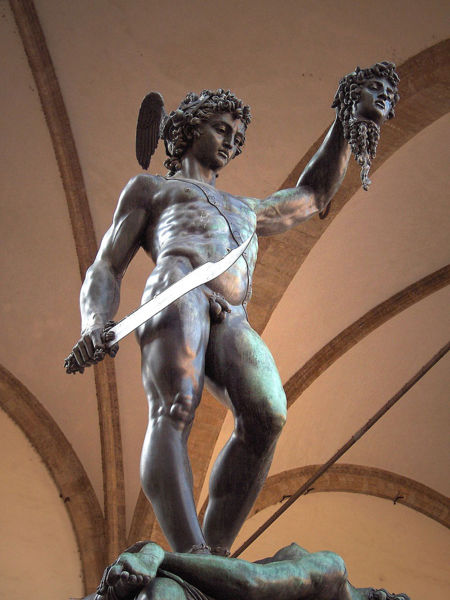
In Greek mythology, Perseus (/ˈpɜːrsiəs, -sjuːs/; Greek: Περσεύς), the legendary founder of Mycenae and of the Perseid dynasty of Danaans, was, alongside Cadmus and Bellerophon, the greatest Greek hero and slayer of monsters before the days of Heracles. Perseus beheaded the Gorgon Medusa and saved Andromeda from the sea monster Cetus. Perseus was the son of the mortal Danaë and the god Zeus. He was also the half-brother and great grandfather of Heracles.
限會員,要發表迴響,請先登入


