William Faulkner
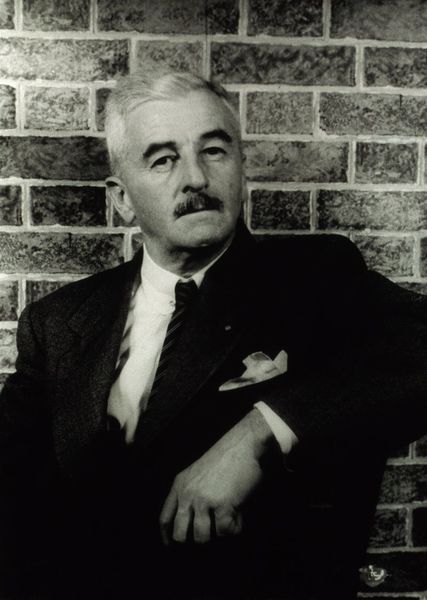
William Cuthbert Faulkner ( September 25, 1897 – July 6, 1962) was an American writer and Nobel Prize laureate from Oxford, Mississippi. Faulkner wrote novels, short stories, a play, poetry, essays, and screenplays. He is primarily known for his novels and short stories set in the fictional Yoknapatawpha County, based on Lafayette County, Mississippi, where he spent most of his life.
Faulkner is one of the most celebrated writers in American literature generally and Southern literature specifically. Though his work was published as early as 1919, and largely during the 1920s and 1930s, Faulkner was relatively unknown until receiving the 1949 Nobel Prize in Literature, for which he became the only Mississippi-born Nobel winner. Two of his works, A Fable (1954) and his last novel The Reivers (1962), won the Pulitzer Prize for Fiction. In 1998, the Modern Library ranked his 1929 novel The Sound and the Fury sixth on its list of the 100 best English-language novels of the 20th century; also on the list were As I Lay Dying (1930) and Light in August (1932). Absalom, Absalom! (1936) is often included on similar lists.
The Sound and the Fury
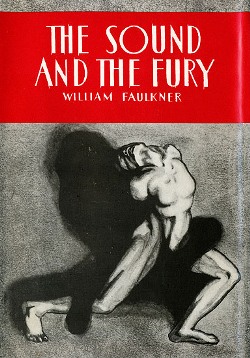
The Sound and the Fury is a novel written by the American author William Faulkner. It employs a number of narrative styles, including stream of consciousness. Published in 1929, The Sound and the Fury was Faulkner's fourth novel, and was not immediately successful. In 1931, however, when Faulkner's sixth novel, Sanctuary, was published—a sensationalist story, which Faulkner later claimed was written only for money—The Sound and the Fury also became commercially successful, and Faulkner began to receive critical attention.
In 1998, the Modern Library ranked The Sound and the Fury sixth on its list of the 100 best English-language novels of the 20th century.
Stream of consciousness
In literary criticism, stream of consciousness is a narrative mode or method that attempts to depicts the multitudinous thoughts and feelings which pass through the mind. The term was coined by William James in 1890 in his The Principles of Psychology, and in 1918 the novelist May Sinclair (1863–1946) first applied the term stream of consciousness, in a literary context, when discussing Dorothy Richardson's (1873–1957) novels. Pointed Roofs (1915), the first work in Richardson's series of 13 semi-autobiographical novels titled Pilgrimage, is the first complete stream of consciousness novel published in English. However, in 1934, Richardson comments that "Proust, James Joyce, Virginia Woolf & D.R. ... were all using 'the new method', though very differently, simultaneously".
Macbeth
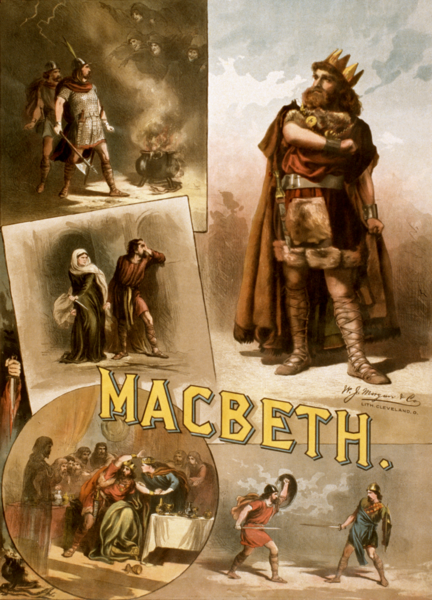
Macbeth (full title The Tragedy of Macbeth) is a tragedy by William Shakespeare; it is thought to have been first performed in 1606. It dramatises the damaging physical and psychological effects of political ambition on those who seek power for its own sake. Of all the plays that Shakespeare wrote during the reign of James I, who was patron of Shakespeare's acting company, Macbeth most clearly reflects the playwright's relationship with his sovereign. It was first published in the Folio of 1623, possibly from a prompt book, and is Shakespeare's shortest tragedy.
Sothern Gothic
Southern Gothic is a subgenre of Gothic fiction in American literature that takes place in the American South.
Common themes in Southern Gothic literature include deeply flawed, disturbing or eccentric characters who may or may not dabble in hoodoo, ambivalent gender roles, decayed or derelict settings, grotesque situations, and other sinister events relating to or stemming from poverty, alienation, crime, or violence.
限會員,要發表迴響,請先登入


