Anecdote of the Jar
"Anecdote of the Jar" is a poem from Wallace Stevens's first book of poetry, Harmonium. First published in 1919, it is in the public domain.
I placed a jar in Tennessee,
And round it was, upon a hill.
It made the slovenly wilderness
Surround that hill.
The wilderness rose up to it,
And sprawled around, no longer wild.
The jar was round upon the ground
And tall and of a port in air.
It took dominion everywhere.
The jar was gray and bare.
It did not give of bird or bush,
Like nothing else in Tennessee.
This famous, much-anthologized poem succinctly accommodates a remarkable number of different and plausible interpretations, as Jacqueline Brogan observes in a discussion of how she teaches it to her students. It can be approached from a New Critical perspective as a poem about writing poetry and making art generally. From a poststructuralist perspective the poem is concerned with temporal and linguistic disjunction, especially in the convoluted syntax of the last two lines. A feminist perspective reveals a poem concerned with male dominance over a traditionally feminized landscape. A cultural critic might find a sense of industrial imperialism. Brogan concludes: "When the debate gets particularly intense, I introduce Roy Harvey Pearce's discovery of the Dominion canning jars (a picture of which is then passed around)."
Buttel suggests that the speaker would arrange the wild landscape into the order of a still life, and though his success is qualified, art and imagination do at least impose an idea of order on the sprawling reality.
Helen Vendler, in a reading that contradicts Brogan's and Buttel's, asserts that the poem is incomprehensible except as understood as a commentary on Keats's "Ode on a Grecian Urn." The poem alludes to Keats, she argues, as a way of discussing the predicament of the American artist "who cannot feel confidently the possessor, as Keats felt, of the Western cultural tradition." Shall he use language imported from Europe ("of a port in air", to "give of"), or "plain American that cats and dogs can read" (as Marianne Moore put it), like "The jar was round upon the ground"? The poem is a palinode, retracting the Keatsian conceits of "Sunday Morning" and vowing "to stop imitating Keats and seek a native American language that will not take the wild out of the wilderness."
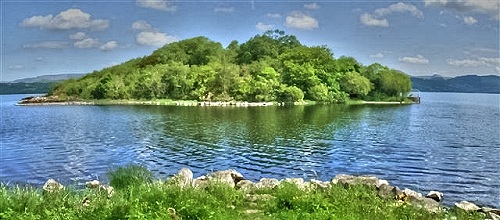
The Lale Isle of Innisfree
BY WILLIAM BUTLER YEATS
I will arise and go now, and go to Innisfree,
And a small cabin build there, of clay and wattles made;
Nine bean-rows will I have there, a hive for the honey-bee,
And live alone in the bee-loud glade.
And I shall have some peace there, for peace comes dropping slow,
Dropping from the veils of the morning to where the cricket sings;
There midnight’s all a glimmer, and noon a purple glow,
And evening full of the linnet’s wings.
I will arise and go now, for always night and day
I hear lake water lapping with low sounds by the shore;
While I stand on the roadway, or on the pavements grey,
I hear it in the deep heart’s core.
Summary>
The speaker says he's going to go to Innisfree to build a small, simple cabin. He'll have a little bean garden and a honeybee hive. He wants to live alone in peace with nature and the slow pace of country living. Sounds like a plan, buddy.
In the last stanza, the speaker restates that he's leaving and explains it's because every night he hears the water lapping against the shore (of Innisfree). Even though he lives in a more urban place with paved roads, deep down inside he's drawn to the rural sounds of Innisfree. It's all about rustling trees, not bustling buses for this speaker.
Commentary>
“The Lake Isle of Innisfree,” published in Yeats’s second book of poems, 1893’s The Rose, is one of his first great poems, and one of his most enduring. The tranquil, hypnotic hexameters recreate the rhythmic pulse of the tide. The simple imagery of the quiet life the speaker longs to lead, as he enumerates each of its qualities, lulls the reader into his idyllic fantasy, until the penultimate line jolts the speaker—and the reader—back into the reality of his drab urban existence: “While I stand on the roadway, or on the pavements grey.” The final line—“I hear it in the deep heart’s core”—is a crucial statement for Yeats, not only in this poem but also in his career as a whole. The implication that the truths of the “deep heart’s core” are essential to life is one that would preoccupy Yeats for the rest of his career as a poet; the struggle to remain true to the deep heart’s core may be thought of as Yeats’s primary undertaking as a poet.
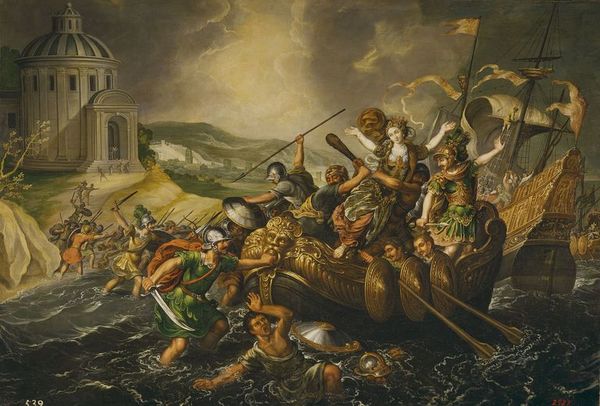
The Face That Launched a thousand ships
"The face that launched a thousand ships" is a well-known figure of speech and a snippet of 17th-century poetry that refers to Helen of Troy.
The poetry of Shakespeare's contemporary English playwright Christopher Marlowe is responsible for what is among the most lovely and famous lines in English literature.
‧Was this the face that launched a thousand ships
‧And burnt the topless towers of Illium?
‧Sweet Helen, make me immortal with a kiss...
The line comes from Marlowe's play The Tragical History of Dr. Faustus, published in 1604. In the play, Faustus is an ambitious man, who has decided that necromancy--speaking to the dead--is the only path to the power he seeks. The risk of communing with dead spirits, however, is that raising them can make you their master, or their slave. Faustus, conjuring on his own, makes a deal with the demon Mephistopheles, and one of the spirits Faustus raises is Helen of Troy. Because he cannot resist her, he makes her his paramour and is damned forever.
HELEN IN THE ILIAD
According to Homer's The Iliad, Helen was the wife of the king of Sparta, Menelaus. She was so beautiful that Greek men went to Troy and fought the Trojan War to win her back from her lover Paris. The "thousand ships" in Marlowe's play refer to the Greek army who set sail from Aulis to war with the Trojans and burn down Troy (Greek name=Illium).
But the immortality requested results in the curse of Mephistopheles and the damnation of Faustus.
Helen had been abducted before she married Menelaus, so Menelaus knew it could happen again. Before Helen of Sparta married Menelaus, all the Greek suitors, and she had had quite a few, swore an oath to aid Menelaus should he ever need their help retrieving his wife.
Those suitors or their sons brought their own troops and ships to Troy.
The Trojan War may have actually happened. The stories about it, best known from the author known as Homer, say it lasted 10 years. At the end of the Trojan War, the belly of the Trojan Horse (from which we get the expression "beware of Greeks bearing gifts") sneakily transported Greeks into Troy where they set fire to the city, killed the Trojan men, and took many of the Trojan women as concubines. Helen of Troy returned to her original husband, Menelaus.
Helen as an Icon; Marlowe's Play on Words
Marlowe's phrase is not to be taken literally, of course, it's an example of what English scholars call metalepsis, a stylistic flourish that skips from X to Z, bypassing Y: of course, Helen's face didn't launch any ships, Marlowe is saying she caused the Trojan War. Today the phrase is most commonly used as a metaphor for beauty and its seductive and destructive force. There have been several books exploring the feminist considerations of Helen and her treacherous beauty, including the well-received one from historian Bettany Hughes (Helen of Troy: The Story Behind the Most Beautiful Woman in the World, 2009, Knopf Doubleday).
The phrase has also been used to describe women from the first lady of the Phillippines Imelda Marcos ("the face that launched a thousand votes") to consumer spokesperson Betty Furness ("the face that launched a thousand refrigerators"). You're starting to think Marlowe's quote is not entirely friendly, aren't you? And you'd be right.
12 Labours of Hercules
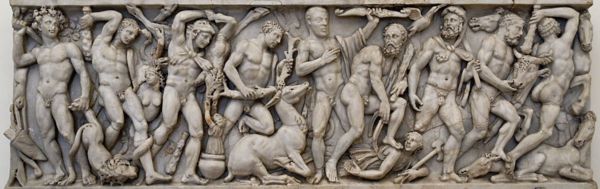
The twelve labours of Heracles or Hercules (Greek: οἱ Ἡρακλέους ἆθλοι, hoi Hērakleous athloi) are a series of episodes concerning a penance carried out by Heracles, the greatest of the Greek heroes, whose name was later Romanised as Hercules. They were accomplished over 12 years at the service of King Eurystheus. The episodes were later connected by a continuous narrative. The establishment of a fixed cycle of twelve labours was attributed by the Greeks to an epic poem, now lost, written by Peisander, dated about 600 BC. After Hercules killed his wife and children, he went to the oracle at Delphi. He prayed to the god Apollo for guidance. Hercules was told to serve the king of Mycenae, Eurystheus, for 12 years. During these 12 years, Hercules is sent to perform twelve difficult feats, called labours.
Christopher Marlowe
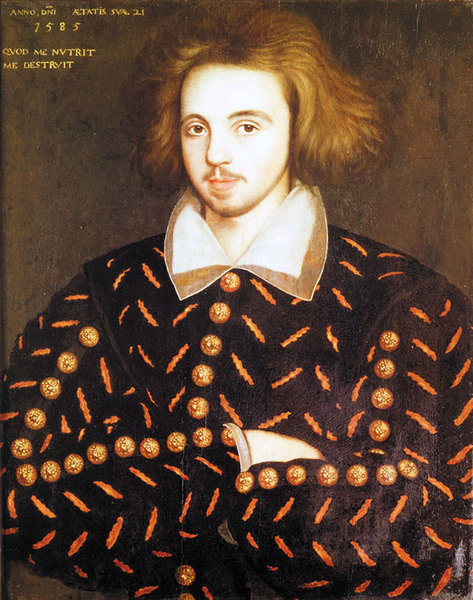
Christopher Marlowe, also known as Kit Marlowe (baptised 26 February 1564 – 30 May 1593), was an English playwright, poet and translator of the Elizabethan era. Marlowe was the foremost Elizabethan tragedian of his day. He greatly influenced William Shakespeare, who was born in the same year as Marlowe and who rose to become the pre-eminent Elizabethan playwright after Marlowe's mysterious early death. Marlowe's plays are known for the use of blank verse and their overreaching protagonists.
A warrant was issued for Marlowe's arrest on 18 May 1593. No reason was given for it, though it was thought to be connected to allegations of blasphemy—a manuscript believed to have been written by Marlowe was said to contain "vile heretical conceipts". On 20 May, he was brought to the court to attend upon the Privy Council for questioning. There is no record of their having met that day, however, and he was commanded to attend upon them each day thereafter until "licensed to the contrary". Ten days later, he was stabbed to death by Ingram Frizer. Whether the stabbing was connected to his arrest has never been resolved.
Book of Revelation
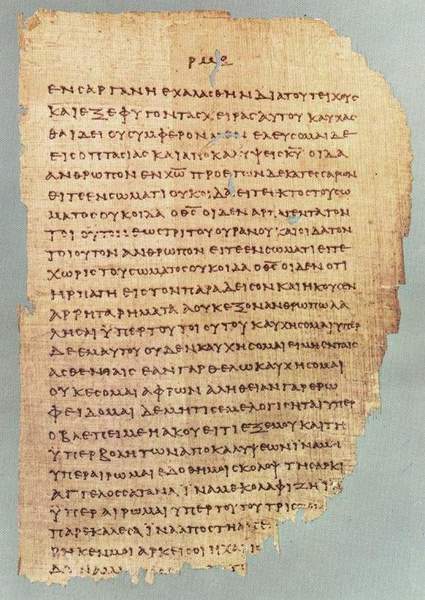
The Book of Revelation, often called the Revelation to John, the Apocalypse of John, The Revelation, or simply Revelation or Apocalypse, is a book of the New Testament that occupies a central place in Christian eschatology. Its title is derived from the first word of the text, written in Koine Greek: apokalypsis, meaning "unveiling" or "revelation" (before title pages, books were commonly known by their first words, as is also the case of the Hebrew Five Books of Moses (Torah)). The Book of Revelation is the only apocalyptic document in the New Testament canon (although there are short apocalyptic passages in various places in the Gospels and the Epistles).
The author names himself in the text as "John", but his precise identity remains a point of academic debate. Second century Christian writers such as Justin Martyr, Irenaeus, Melito the bishop of Sardis, and Clement of Alexandria and the author of the Muratorian fragment identify John the Apostle as the "John" of Revelation. Modern scholarship generally takes a different view, and many consider that nothing can be known about the author except that he was a Christian prophet. Some modern scholars characterise Revelation's author as a putative figure whom they call "John of Patmos". The bulk of traditional sources date the book to the reign of the emperor Domitian (AD 81–96), and the evidence tends to confirm this.
The book spans three literary genres: the epistolary, the apocalyptic, and the prophetic. It begins with John, on the island of Patmos in the Aegean, addressing a letter to the "Seven Churches of Asia". He then describes a series of prophetic visions, including figures such as the Whore of Babylon and the Beast, culminating in the Second Coming of Jesus.
The obscure and extravagant imagery has led to a wide variety of Christian interpretations: historicist interpretations see in Revelation a broad view of history; preterist interpretations treat Revelation as mostly referring to the events of the apostolic era (1st century), or, at the latest, the fall of the Roman Empire; futurists believe that Revelation describes future events; and idealist or symbolic interpretations consider that Revelation does not refer to actual people or events, but is an allegory of the spiritual path and the ongoing struggle between good and evil.
Ode to a Nightgale
BY JOHN KEATS
My heart aches, and a drowsy numbness pains
My sense, as though of hemlock I had drunk,
Or emptied some dull opiate to the drains
One minute past, and Lethe-wards had sunk:
'Tis not through envy of thy happy lot,
But being too happy in thine happiness,—
That thou, light-winged Dryad of the trees
In some melodious plot
Of beechen green, and shadows numberless,
Singest of summer in full-throated ease.
O, for a draught of vintage! that hath been
Cool'd a long age in the deep-delved earth,
Tasting of Flora and the country green,
Dance, and Provençal song, and sunburnt mirth!
O for a beaker full of the warm South,
Full of the true, the blushful Hippocrene,
With beaded bubbles winking at the brim,
And purple-stained mouth;
That I might drink, and leave the world unseen,
And with thee fade away into the forest dim:
Fade far away, dissolve, and quite forget
What thou among the leaves hast never known,
The weariness, the fever, and the fret
Here, where men sit and hear each other groan;
Where palsy shakes a few, sad, last gray hairs,
Where youth grows pale, and spectre-thin, and dies;
Where but to think is to be full of sorrow
And leaden-eyed despairs,
Where Beauty cannot keep her lustrous eyes,
Or new Love pine at them beyond to-morrow.
Away! away! for I will fly to thee,
Not charioted by Bacchus and his pards,
But on the viewless wings of Poesy,
Though the dull brain perplexes and retards:
Already with thee! tender is the night,
And haply the Queen-Moon is on her throne,
Cluster'd around by all her starry Fays;
But here there is no light,
Save what from heaven is with the breezes blown
Through verdurous glooms and winding mossy ways.
I cannot see what flowers are at my feet,
Nor what soft incense hangs upon the boughs,
But, in embalmed darkness, guess each sweet
Wherewith the seasonable month endows
The grass, the thicket, and the fruit-tree wild;
White hawthorn, and the pastoral eglantine;
Fast fading violets cover'd up in leaves;
And mid-May's eldest child,
Summary
The poem begins as the speaker starts to feel disoriented from listening to the song of the nightingale, as if he had just drunken something really, really strong. He feels bittersweet happiness at the thought of the nightingale's carefree life.
The speaker wishes he had a special wine distilled directly from the earth. He wants to drink such a wine and fade into the forest with the nightingale. He wants to escape the worries and concerns of life, age, and time.
He uses poetry to join the nightingale's nighttime world, deep in the dark forest where hardly any moonlight can reach. He can't see any of the flowers or plants around him, but he can smell them. He thinks it wouldn't be so bad to die at night in the forest, with no one around except the nightingale singing.
But the nightingale can't die. The nightingale must be immortal, because so many different kinds of generations of people have heard its song throughout history, everyone from clowns and emperors to Biblical characters to people in fantasy stories.
The speaker's vision is interrupted when the nightingale flies away and leaves him alone. He feels abandoned and disappointed that his imagination is not strong enough to create its own reality. He is left confused and bewildered, not knowing the difference between reality and dreams.
限會員,要發表迴響,請先登入


