orientation:
Genre:
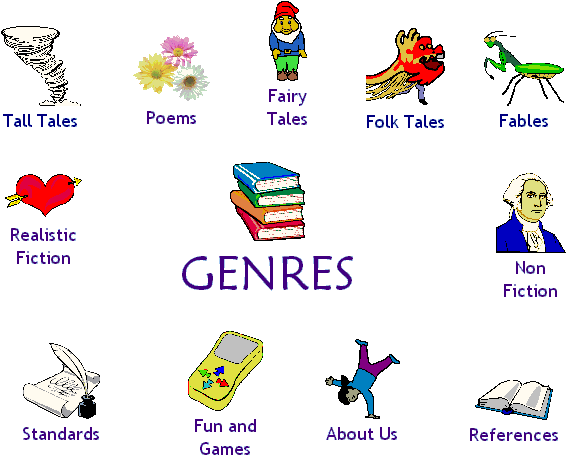
A genre is any form or type of communication in any mode (written, spoken, digital, artistic, etc.) with socially-agreed upon conventions developed over time. Genre is most popularly known as a category of literature, music, or other forms of art or entertainment, whether written or spoken, audio or visual, based on some set of stylistic criteria, yet genres can be aesthetic, rhetorical, communicative, or functional. Genres form by conventions that change over time as new genres are invented and the use of old ones is discontinued. Often, works fit into multiple genres by way of borrowing and recombining these conventions. Stand alone texts, works, or pieces of communication may have individual styles, but genres are amalgams of these texts based on agreed upon or socially inferred conventions. Some genres may be rigid with strictly adhered to guidelines while others may be very flexible.
Genre began as an absolute classification system for ancient Greek literature. Poetry, prose, and performance each had a specific and calculated style that related to the theme of the story. Speech patterns for comedy would not be appropriate for tragedy, and even actors were restricted to their genre under the assumption that a type of person could tell one type of story best. In later periods genres proliferated and developed in response to changes in audiences and creators. Genre became a dynamic tool to help the public make sense out of unpredictable art. Because art is often a response to a social state, in that people write/paint/sing/dance about what they know about, the use of genre as a tool must be able to adapt to changing meanings.
Plot(narrative)
Plot refers to the sequence of events inside a story which affect other events through the principle of cause and effect. The causal events of a plot can be thought of as a series of sentences linked by "and so". Plots can vary from simple structures such as in a traditional ballad to complex interwoven structures sometimes referred to as an imbroglio. The term plot can serve as a verb and refer to a character planning future actions in the story.
Exposition
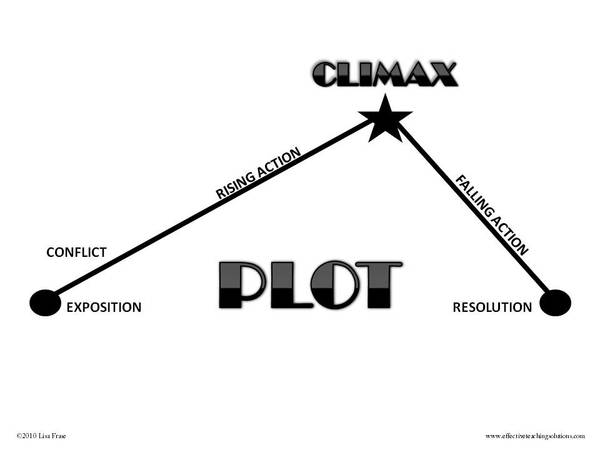
The first phase in Freytag's pyramid is the exposition, which introduces the characters, especially the main character, also known as the protagonist. It shows how the characters relate to one another, their goals and motivations, as well as their moral character. During the exposition, the protagonist learns their main goal and what is at stake.
Conflict
Freytag's definition of conflict refers to the second act in a five-act play, a point of time in which all of the major characters have been introduced, their motives and allegiances have been made clear, and they have begun to struggle against one another.
Rising action
Rising action is the second phase in Freytag's five-phase structure. It starts with a conflict, for example, the death of a character. The inciting incident is the point of the plot that begins the conflict. It is the event that catalyzes the protagonist to go into motion and to take action. Rising action involves the buildup of events until the climax.
In this phase, the protagonist understands his or her goal and begins to work toward it. Smaller problems thwart their initial success and their progress is directed primarily against these secondary obstacles. This phase demonstrates how the protagonist overcomes these obstacles.
Climax
The climax is the turning point or highest point of the story. The protagonist makes the single big decision that defines not only the outcome of the story, but also who they are as a person. Freytag defines the climax as the third of the five dramatic phases which occupies the middle of the story.
At the beginning of this phase, the protagonist finally clears away the preliminary barriers and engages with the adversary. Usually, both the protagonist and the antagonist have a plan to win against the other as they enter this phase. For the first time, the audience sees the pair going against one another in direct or nearly direct conflict.
This struggle usually results in neither character completely winning or losing. In most cases, each character's plan is both partially successful and partially foiled by their adversary. The central struggle between the two characters is unique in that the protagonist makes a decision which shows their moral quality, and ultimately decides their fate. In a tragedy, the protagonist here makes a poor decision or a miscalculation that demonstrates their tragic flaw.
Falling action
According to Freytag, the falling action phase consists of events that lead to the ending. Character's actions resolve the problem. In the beginning of this phase, the antagonist often has the upper hand. The protagonist has never been further from accomplishing their goal. The outcome depends on which side the protagonist has put themselves on.
Resolution
In this phase the protagonist and antagonist have solved their problems and either the protagonist or antagonist wins the conflict. The conflict officially ends. Some stories show what happens to the characters after the conflict ends and/or they show what happens to the characters in the future.
限會員,要發表迴響,請先登入


