Viola tricolor
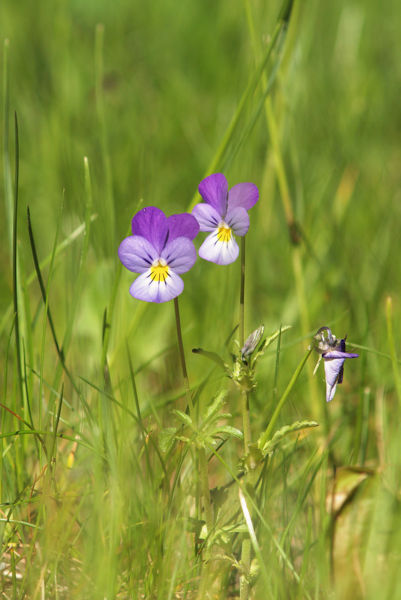
Viola tricolor, Also known as Johnny Jump up (though this name is also applied to similar species such as the yellow pansy), heartsease, heart's ease, heart's delight, tickle-my-fancy, Jack-jump-up-and-kiss-me, come-and-cuddle-me, three faces in a hood, or love-in-idleness, is a common European wild flower, growing as an annual or short-lived perennial. It has been introduced into North America, where it has spread. It is the progenitor of the cultivated pansy, and is therefore sometimes called wild pansy; before the cultivated pansies were developed, "pansy" was an alternative name for the wild form.
V. tricolor is a small plant of creeping and ramping habit, reaching at most 15 cm in height, with flowers about 1.5 cm in diameter. It grows in short grassland on farms and wasteland, chiefly on acid or neutral soils. It is usually found in partial shade. It flowers from April to September (in the northern hemisphere). The flowers can be purple, blue, yellow or white. They are hermaphrodite and self-fertile, pollinated by bees.
As its name implies,[citation needed] heartsease has a long history of use in herbalism. It has been recommended, among other uses, for epilepsy, asthma, skin diseases and eczema. V. tricolor has a history in folk medicine of helping respiratory problems such as bronchitis, asthma, and cold symptoms. It has expectorant properties, and so has been used in the treatment of chest complaints such as bronchitis and whooping cough.[medical citation needed] It is also a diuretic, leading to its use in treating rheumatism and cystitis.[citation needed]
The flowers have also been used to make yellow, green and blue-green dyes, while the leaves can be used to make a chemical indicator.[citation needed]
Long before cultivated pansies were released into the trade in 1839, V. tricolor was associated with thought in the "language of flowers", often by its alternative name of pansy (from the French "pensée" - thought):[citation needed] hence Ophelia's often quoted line in Shakespeare's Hamlet, "There's pansies, that's for thoughts". What Shakespeare had in mind was V. tricolor, not a modern garden pansy.
Shakespeare makes a more direct reference, probably to V. tricolor in A Midsummer Night's Dream. Oberon sends Puck to gather "a little western flower" that maidens call "love-in-idleness". Oberon's account is that he diverted an arrow from Cupid's bow aimed at "a fair vestal, throned by the west" (supposedly Queen Elizabeth I) to fall upon the plant "before milk-white, now purple with love's wound". The "imperial vot'ress" passes on "fancy-free", destined never to fall in love. The juice of the heartsease now, claims Oberon, "on sleeping eyelids laid, Will make or man or woman madly dote Upon the next live creature that it sees." Equipped with such powers, Oberon and Puck control the fates of various characters in the play to provide Shakespeare's essential dramatic and comic structure for the play.
Closet drama
A closet drama is a play that is not intended to be performed onstage, but read by a solitary reader or, sometimes, out loud in a small group. The dichotomy between private 'closet' drama (designed for reading) and public 'stage' drama (designed for performance in a commercial theater setting) dates from the late eighteenth century. The practice of circulating plays in written form (printed or handwritten) for literary audiences predates this period, however.
Thirteenth Amendment to the United States Constitution
The Thirteenth Amendment (Amendment XIII) to the United States Constitution abolished slavery and involuntary servitude, except as punishment for a crime. In Congress, it was passed by the Senate on April 8, 1864, and by the House on January 31, 1865. The amendment was ratified by the required number of states on December 6, 1865. On December 18, 1865, Secretary of State William H. Seward proclaimed its adoption. It was the first of the three Reconstruction Amendments adopted following the American Civil War.
Since the American Revolution, states had divided into states that allowed and states that prohibited slavery. Slavery had been tacitly enshrined in the original Constitution through provisions such as Article I, Section 2, Clause 3, commonly known as the Three-Fifths Compromise, which detailed how each slave state's enslaved population would be factored into its total population count for the purposes of apportioning seats in the United States House of Representatives and direct taxes among the states. Though many slaves had been declared free by President Abraham Lincoln's 1863 Emancipation Proclamation, their post-war status was uncertain. On April 8, 1864, the Senate passed an amendment to abolish slavery. After one unsuccessful vote and extensive legislative maneuvering by the Lincoln administration, the House followed suit on January 31, 1865. The measure was swiftly ratified by nearly all Northern states, along with a sufficient number of border and "reconstructed" Southern states, to cause it to be adopted before the end of the year.
Though the amendment formally abolished slavery throughout the United States, factors such as Black Codes, white supremacist violence, and selective enforcement of statutes continued to subject some black Americans to involuntary labor,
限會員,要發表迴響,請先登入


