Catharsis
Catharsis (from Greek κάθαρσις katharsis meaning "purification" or "cleansing") is the purification and purgation of emotions—especially pity and fear—through art or any extreme change in emotion that results in renewal and restoration. It is a metaphor originally used by Aristotle in the Poetics, comparing the effects of tragedy on the mind of a spectator to the effect of a cathartic on the body.
Catharsis is a term in dramatic art that describes the effect of tragedy (or comedy and quite possibly other artistic forms) principally on the audience (although some have speculated on characters in the drama as well). Nowhere does Aristotle explain the meaning of "catharsis" as he is using that term in the definition of tragedy in the Poetics (1449b21-28). G. F. Else argues that traditional, widely held interpretations of catharsis as "purification" or "purgation" have no basis in the text of the Poetics, but are derived from the use of catharsis in other Aristotelian and non-Aristotelian contexts. For this reason, a number of diverse interpretations of the meaning of this term have arisen. The term is often discussed along with Aristotle's concept of anagnorisis.
Classical unities
The classical unities, Aristotelian unities, or three unities are rules for drama derived from a passage in Aristotle's Poetics. In their neoclassical form they are as follows:
1.unity of action: a play should have one action that it follows, with minimal subplots.
2.unity of time: the a.ction in a play should occur over a period of no more than 24 hours.
3.unity of place: a play should exist in a single physical space and should not attempt to compress geography, nor should the stage represent more than one place.
Phallus
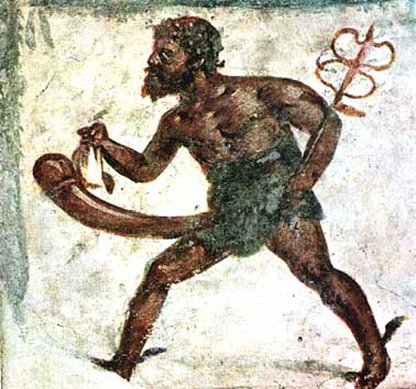
A phallus is a penis, especially when erect, an object that resembles a penis, or a mimetic image of an erect penis.
Any object that symbolically—or, more precisely, iconically—resembles a penis may also be referred to as a phallus; however, such objects are more often referred to as being phallic (as in "phallic symbol"). Such symbols often represent fertility and cultural implications that are associated with the male sexual organ, as well as the male orgasm.
Rapunzel
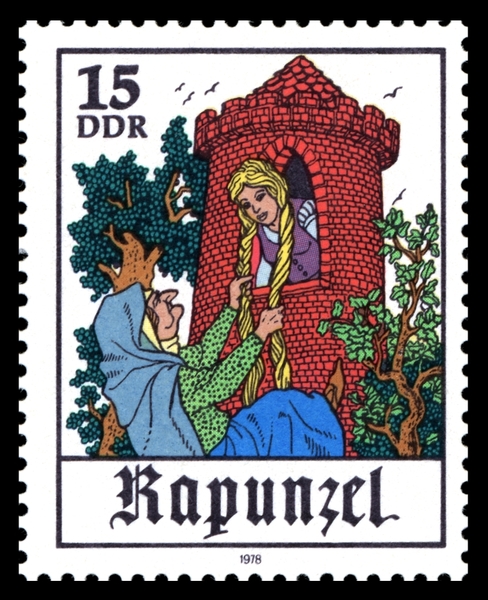
"Rapunzel" (/rəˈpʌnzəl/; German pronunciation: [ʁaˈpʊnt͡səl]) is a German fairy tale in the collection assembled by the Brothers Grimm, and first published in 1812 as part of Children's and Household Tales. The Grimm Brothers' story is an adaptation of the fairy tale Rapunzel by Friedrich Schulz published in 1790. The Schulz version is based on Persinette by Charlotte-Rose de Caumont de La Force originally published in 1698 which in turn was influenced by an even earlier tale, Petrosinella by Giambattista Basile, published in 1634. Its plot has been used and parodied in various media and its best known line ("Rapunzel, Rapunzel, let down your hair") is an idiom of popular culture. In volume I of the 1812 annotations (Anhang), it is listed as coming from Friedrich Schulz Kleine Romane, Book 5, pp. 269–288, published in Leipzig 1790.
In the Aarne–Thompson classification system for folktales it is type 310, "The Maiden in The Tower".
Andrew Lang included it in The Red Fairy Book. Other versions of the tale also appear in A Book of Witches by Ruth Manning-Sanders and in Paul O. Zelinsky's 1997 Caldecott Medal-winning picture book, Rapunzel and the Disney movieTangled.
In Just
BY E. E. CUNNINGS
in Just-
spring when the world is mud-
luscious the little
lame balloonman
whistles far and wee
and eddieandbill come
running from marbles and
piracies and it's
spring
when the world is puddle-wonderful
the queer
old balloonman whistles
far and wee
and bettyandisbel come dancing
from hop-scotch and jump-rope and
it's
spring
and
the
goat-footed
balloonMan whistles
far
and
wee
Summary
It’s that day in May when the sun starts shining for the first time in weeks and everybody you know heads out to the park. The story’s pretty simple: spring has sprung. Everything’s growing and all-around delightful. The kids, in fact, jump for joy when the man selling balloons starts to whistle. Clowns (and other balloon-selling folk) have gotten a bad rap for being scary and creepy, but this guy seems to be all right. At the very least, he gets the kiddies to come running to him.
That, folks, is the poem. See? We told you it wasn’t so bad.
Why the big fuss about the first day of spring? Well, that’s where the magic of this poem takes over. See, E.E. Cummings creates a poem that’s half painting and half sound-scape (that’s the aural version of a landscape). We know, we know: we told you it was a poem. But it’s also an image. We won’t get deep into the technical reasons for why this works so well here; check out "Symbols, Imagery, Wordplay" for some closer looks at all the good stuff that’s going on. For now, though, we’ll just tell you to read the poem aloud. You’ll see what we mean. Chock-full of words like "mud-luscious" and "puddle-wonderful," the poem seems to be bursting with descriptions of the way that a spring day in the park looks and feels and sounds and smells. And because the poem repeats itself several times (in fancy technical terms, we’d call that a "refrain,") it emphasizes the way that all the tiny details of the poem actually contribute to one overarching image: the park in spring.
Analysis
In only twenty-four lines, E. E. Cummings captures both the feeling and the meaning of spring. Only in spring, or “just” in spring, is the world a kind of wonderful mud bath for children. Spring rains make puddles in which children love to play. Spring is a carnival season—a time to celebrate nature—which accounts for the appearance of the “balloonman,” who adds a festive air to the season.
The first stanza and the next line also suggest that adults spring to life “in just,” or precisely in, spring. The balloonman may be little and lame, but he is whistling and apparently happy to be out and about. Cummings suggests the enthusiasm of children and the childlike enthusiasms of adults in his first use of the word “wee” in line 5. The word “wide” is expected after “far and,” but Cummings changes this clichéd expression to convey the “wee” of the fun that spring represents.
In the second stanza, the childlike speaker of the poem revels in playmates and their games. Playing marbles and pretending to be pirates are examples of the energy and imagination that spring stimulates. The poem itself is a manifestation of vigor; it is at once a description, celebration, and evocation of what spring feels like.
somewhere i have never travelled,gladly beyond
E. E. Cummings, 1894 - 1962
somewhere i have never travelled,gladly beyond
any experience,your eyes have their silence:
in your most frail gesture are things which enclose me,
or which i cannot touch because they are too near
your slightest look easily will unclose me
though i have closed myself as fingers,
you open always petal by petal myself as Spring opens
(touching skilfully,mysteriously)her first rose
or if your wish be to close me,i and
my life will shut very beautifully,suddenly,
as when the heart of this flower imagines
the snow carefully everywhere descending;
nothing which we are to perceive in this world equals
the power of your intense fragility:whose texture
compels me with the colour of its countries,
rendering death and forever with each breathing
(i do not know what it is about you that closes
and opens;only something in me understands
the voice of your eyes is deeper than all roses)
nobody,not even the rain,has such small hands
Summary
We could summarize this poem really quickly by saying it's about a guy who's in love, like really in love. Of course, if you described it that way, you wouldn't really get the gist of just how bad the speaker has it for his lover. It's bad, y'all—real bad.
He starts off by telling us that he's off on some fabulous journey deep into his lover's mysterious eyes. We hear all about how she has amazing powers over him. This lady can open and close him emotionally with the flick of her hand or the smallest of glances. The thing is he seems to be just as happy being shut down as being opened up. Whatever she does is amazing to him.
The speaker takes it even farther when he compares himself to a rose being opened and closed by the seasons. He even goes so far as to say that his lover can open him wide to the infinite: the universe, death, and whatever comes after. In the end, he admits that he has no idea what gives her so much power over him. But whatever it is, he's more than okay with it. He's obsessed.
Themes and meanings
The narrator of this love poem tries to express the inexpressible, to describe the intensity of his emotions. He finds himself unable to meet the challenge except in paradoxical words that simultaneously express his surprise and wonder at the mystery of love.
The narrator describes the love as similar to a foreign territory, an area never before explored; the effect of the journey is stunning, evoking a disorientation which causes the senses to overlap. Yet at the same time he finds himself unable to delineate the specific elements which attract him; instead, he explores the inexpressible by saying that the sense of touch fails when objects are too near. Love can also bring about a beautiful and sudden seclusion, with the individual shutting out other demands in favor of love; the speaker depicts such a closing by using the image of a flower as it begins to close when it senses falling snow.
Cummings’s descriptions of his beloved as having texture and color indicate her depth of character, but they also, when combined with the word “countries” at the end of line 15, suggest mapmaking and tie in with the poem’s initial image of traveling. Just as explorers of new lands are awed by their initial discoveries, so the narrator reacts with surprise at the variety he finds in his lover, a woman who with her very breathing destroys or breaks down the fear of death and eternity.
The narrator reiterates his inability to understand exactly what it is about the beloved that possesses the power to open and close him. The image of the garden is repeated, as the flower (rose) symbolizes both the narrator and his beloved, and the powerful final line states the incomparable quality of love. No body and no thing (lines 13 and 20) can truly attain the level of the narrator and his beloved. The rain, nurturer of the symbolic garden, though it is important, pales in importance to the small hands of the beloved, whose touch has moved the narrator to ecstasy, to a height of emotion never before experienced.
The five senses, emphasized and raised by the association with love, are combined with the traditional and archetypal symbols of a garden and flowers to serve as symbols for wordlessness, for the inexpressible expressed and given life by the poet’s effort.
Walt Whitman
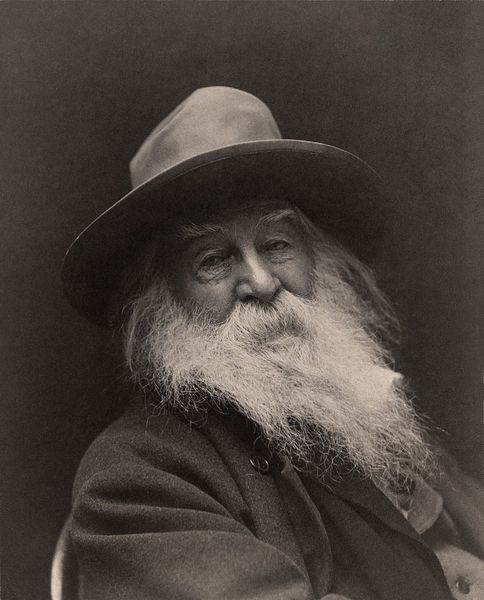
Walter "Walt" Whitman (/ˈhwɪtmən/; May 31, 1819 – March 26, 1892) was an American poet, essayist, and journalist. A humanist, he was a part of the transition between transcendentalism and realism, incorporating both views in his works. Whitman is among the most influential poets in the American canon, often called the father of free verse. His work was very controversial in its time, particularly his poetry collection Leaves of Grass, which was described as obscene for its overt sexuality.
Born in Huntington on Long Island, Whitman worked as a journalist, a teacher, a government clerk, and—in addition to publishing his poetry—was a volunteer nurse during the American Civil War. Early in his career, he also produced a temperance novel, Franklin Evans (1842). Whitman's major work, Leaves of Grass, was first published in 1855 with his own money. The work was an attempt at reaching out to the common person with an American epic. He continued expanding and revising it until his death in 1892. After a stroke towards the end of his life, he moved to Camden, New Jersey, where his health further declined. When he died at age 72, his funeral became a public spectacle.
限會員,要發表迴響,請先登入


