Augustine of Hippo
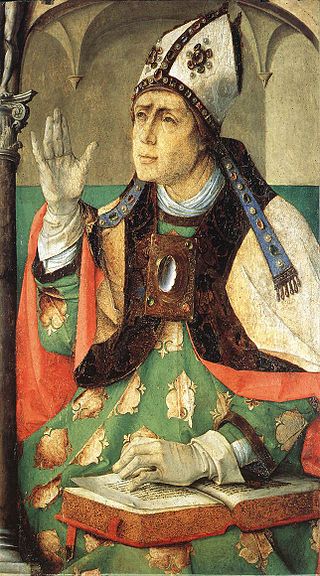
Augustine of Hippo, also known as Saint Augustine, Saint Austin, Blessed Augustine, and the Doctor of Grace (Latin: Doctor gratiae), was an early Christian theologian and philosopher whose writings influenced the development of Western Christianity and Western philosophy. He was the bishop of Hippo Regius (modern-day Annaba, Algeria), located in Numidia (Roman province of Africa). He is viewed as one of the most important Church Fathers in Western Christianity for his writings in the Patristic Era. Among his most important works are The City of God and Confessions.
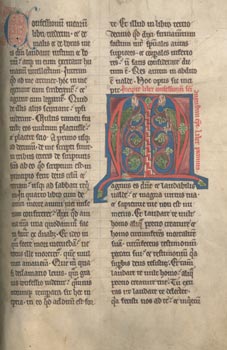
Confessions (Augustine)
Confessions (Latin: Confessiones) is the name of an autobiographical work, consisting of 13 books, by St. Augustine of Hippo, written in Latin between AD 397 and 400. The work outlines St. Augustine's sinful youth and his conversion to Christianity. Modern English translations of it are sometimes published under the title The Confessions of St. Augustine in order to distinguish the book from other books with similar titles. Its original title was Confessions in Thirteen Books, and it was composed to be read out loud with each book being a complete unit.
Confessions is generally considered one of Augustine's most important texts.It is widely seen as the first Western autobiography ever written, and was an influential model for Christian writers throughout the Middle Ages.
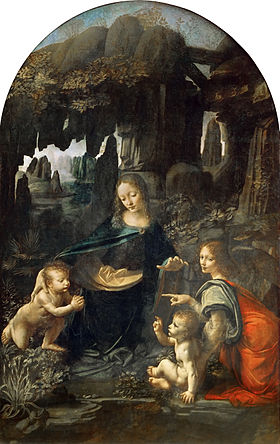
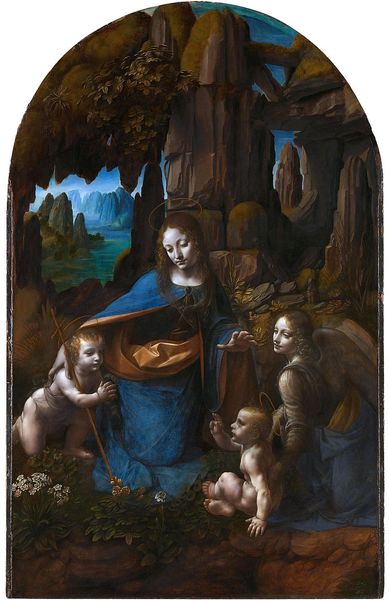
Virgin of the Rocks
The Virgin of the Rocks (sometimes the Madonna of the Rocks) is the name used for two paintings by Leonardo da Vinci, of the same subject, and of a composition which is identical except for several significant details. The version generally considered the prime version, that is the earlier of the two, hangs in The Louvre in Paris and the other in the National Gallery, London. The paintings are both nearly 2 metres (over 6 feet) high and are painted in oils. Both were painted on wooden panel; that in the Louvre has been transferred to canvas.
Both paintings show the Madonna and Child Jesus with the infant John the Baptist and an angel, in a rocky setting which gives the paintings their usual name. The significant compositional differences are in the gaze and right hand of the angel.There are many minor ways in which the works differ, including the colours, the lighting, the flora, and the way in which sfumato has been used. Although the date of an associated commission is documented, the complete histories of the two paintings are unknown, and lead to speculation about which of the two is earlier.
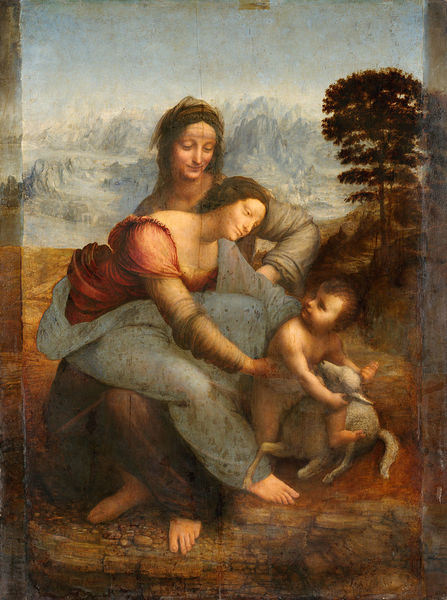
The Virgin and Child with St. Anne (Leonardo)
The Virgin and Child with Saint Anne is an oil painting by Leonardo da Vinci depicting St Anne, her daughter the Virgin Mary and the infant Jesus.Christ is shown grappling with a sacrificial lamb symbolizing his Passion as the Virgin tries to restrain him. The painting was commissioned as the high altarpiece for the Church of Santissima Annunziata in Florence and its theme had long preoccupied Leonardo.
限會員,要發表迴響,請先登入


